Objects with a Story
«Items with a History»—a Russian-language media outlet focused on vintage clothing, secondhand stores, and individual style. The project showcases how to find unique pieces, understand their origins and quality, and integrate them into a modern wardrobe.
The main object of study is not a trend or a brand, but the item itself: its history, provenance, character, and potential for new interpretation.
In a single feature, a user can see a specific garment, learn when and why it appeared, why it looks the way it does, where it can be found, and how to use it today.
Goal: To create an accessible media platform that transforms clothing sourcing into an exploration, a game, and a method for cultivating one’s own style.
The Challenge and Value of Media
Explore the history and origins of clothing;
Showcase interesting vintage finds;
Explain how to distinguish quality pieces;
Assist in finding vintage and secondhand items;
Demonstrate contemporary styling techniques;
Cultivate a community of individuals who seek out pieces with character.
User Value: You don’t have to gather information about an item from various sources yourself.
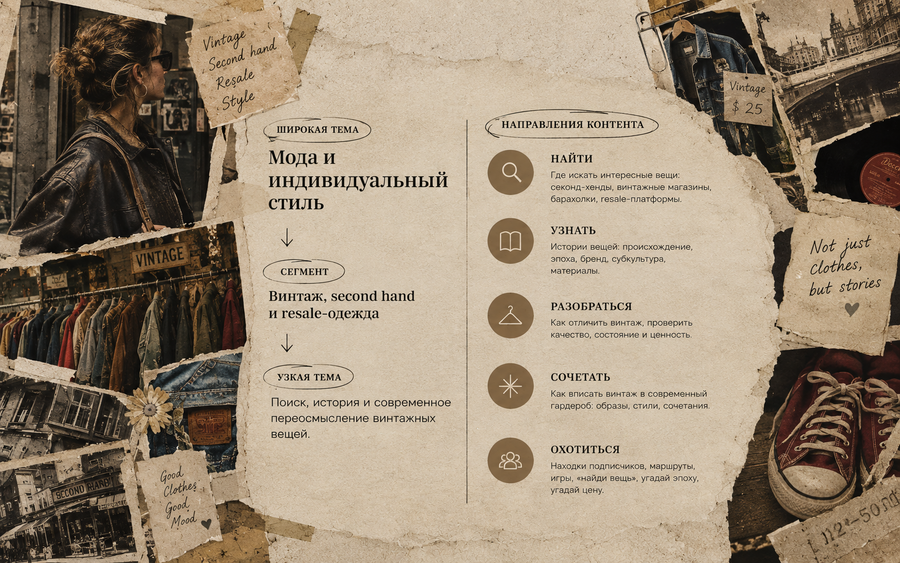
Media Topics and Five Editorial Directions
Competitive Analysis Method
Objective: to understand which projects are already attracting an audience interested in: fashion; vintage; secondhand; individual style; and the history of clothing. And to determine what additional value «Items with a Story» can offer.Search Method: thematic searching using queries such as: vintage clothing; secondhand; vintage stores; fashion history; vintage fashion media; secondhand fashion; resale fashion; fashion history.Additional Research Included: websites; Telegram; VK; YouTube; short-form video; fashion media; resale platforms
Competitor Comparison Criteria
- Platforms
Where content is published.2. Content
What topics and formats are used.3. Visuals
Photos, videos, collages, motion graphics, typography.4. Tone of voice
How they speak to the audience.5. Engagement
Comments, reactions, saves, shares, interactivity.6. Value
What the user gains after viewing the material.
Direct Competitors
SVALKA
Thrift store + items with a story + ecological approachOSKELLY (O! Trends)
Resale + fashion content + communitySecond Friend Store
Resale + curated selections + fashion contentSVALKA builds communication around items from different eras and their reuse; OSKELLY merges resale with editorial and social content. Second Friend Store can serve as an important case study for the resale market, even though the project announced its closure after 15 years in operation.
Indirect Competitors
THE BLUEPRINT
Fashion + Culture + LifestyleRBC LIFE
Fashion + Shopping + LifestyleT—ZH
Practical content on shopping, clothing, and resaleWhy are they competitors?
They don’t necessarily offer the purchase of vintage items, but they compete for the same audience time and attention—the audience interested in fashion and style. The Blueprint positions itself as a publication covering fashion, culture, beauty, career, and lifestyle; RBC Life regularly features topics related to vintage and its integration into the modern wardrobe.
Potential competitors
- Vintage Telegram Channels
Already have an audience actively seeking items2. Resale Platforms
Can amplify their own editorial media3. Fashion Bloggers and Stylists
Can independently create content about vintage and thrift finds
Competitor Comparison
Insights and Solutions
Insight 1
Narrow Specialization Works
Strong projects don’t try to cover everything.
SVALKA focuses on things and their second lives.
Resale platforms focus on buying and selling.
Fashion media focuses on style and culture.The «Items with a Story» Approach
Focusing on the item as the starting point for research. Not «fashion in general, ” but the history of a specific object and its new life.
Insight 2
Turning Searching into a Game
Instead of passive consumption: «Here is an article about vintage.»
We create: «Can you find this item?»The Solution
The audience suggests:
items; stores; finds; stories; topics for future contentIn this way, the user becomes part of the editorial team, not just a reader.
Distribution Channels
Target Audience
Relationship Type: B2C
The subscriber is not necessarily paying for the media.Value is built around: knowledge; inspiration;
discovery; practical information; community.4 Segments:
1—Discovery Hunters
2—Style Seekers
3—Budget Fashionistas
4—History and Culture Lovers
Personas