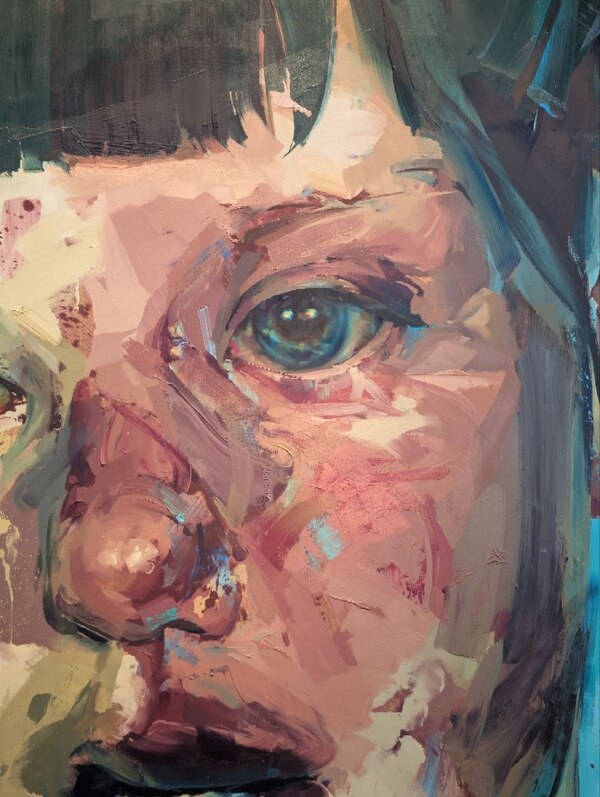
* Marina Abramović, «Rhythm 0.» 1974.
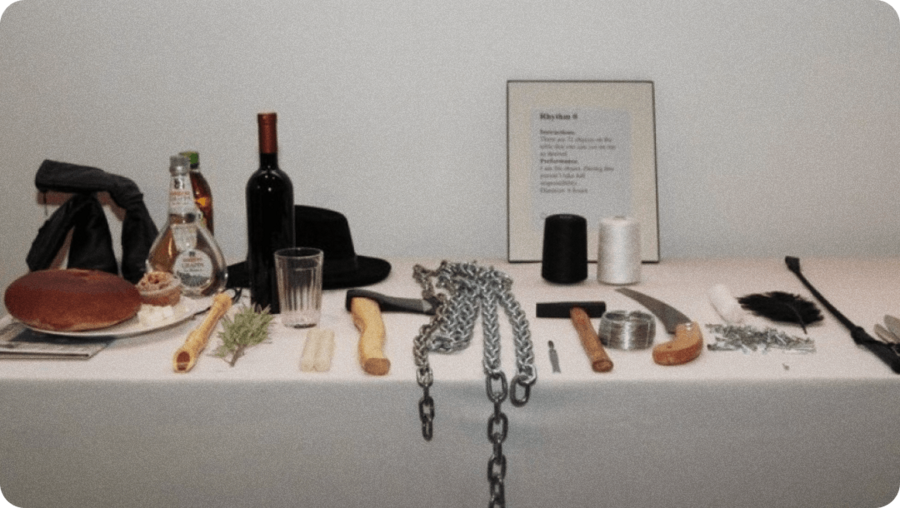
The experiment was founded on the idea of exploring the limits and capabilities of the human body, as well as the role of the viewer in the creation of art. The central concept of this work was that the artist completely relinquishes control over their body, entrusting that authority to the audience, allowing them to use it as they see fit. This prompts questions about the boundaries of individuality, free will, and moral constraints.
The performance took place in the Studio Morra gallery in Naples, Italy. The space was decorated minimally, housing 72 objects within it. Rose, feather, wine, knife, pistol, and bullet—these could bring either benefit or harm to a person.
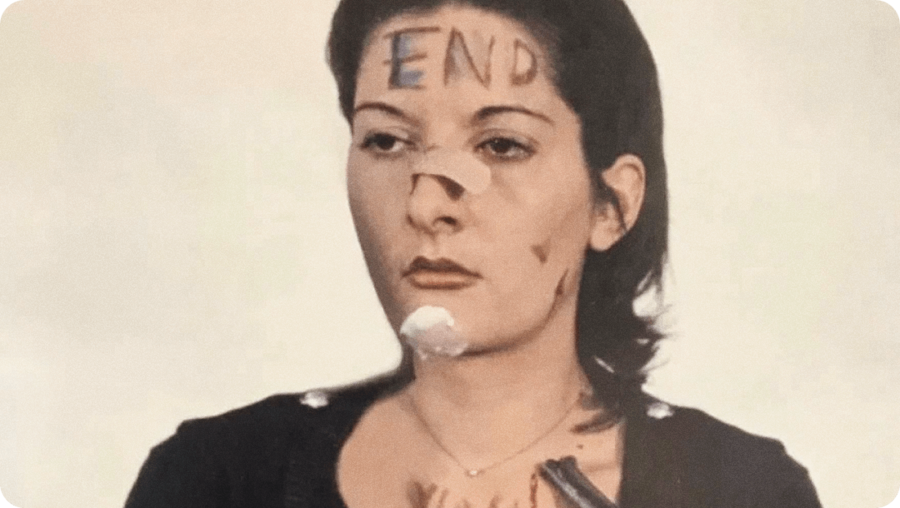
She recalled: «I felt real violence: they slashed my clothes, stuck rose thorns in my stomach, one took a gun and aimed it at my head, but the other took the weapon away. An atmosphere of aggression settled in.»
* Jenny Saville Exhibition in Ca' Pesaro
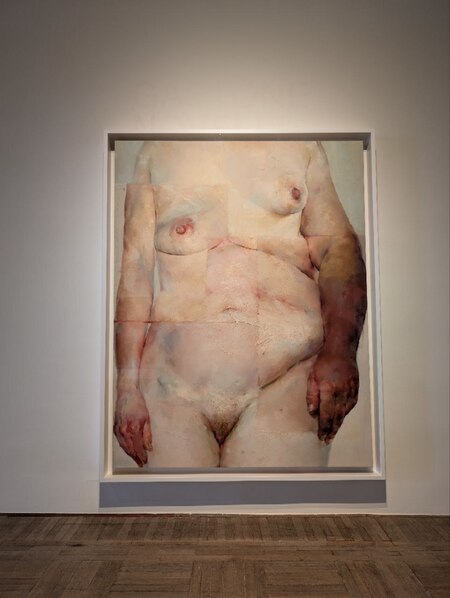
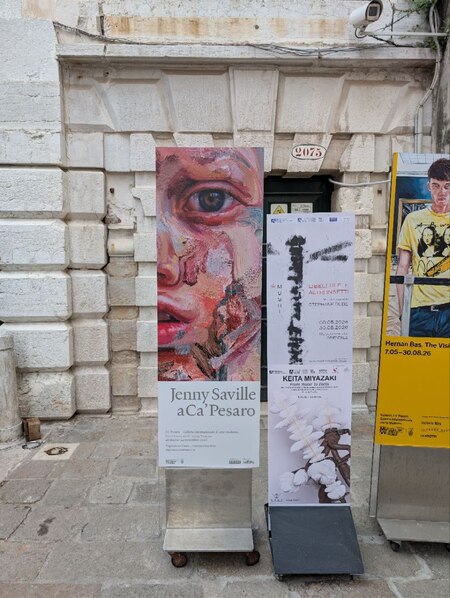
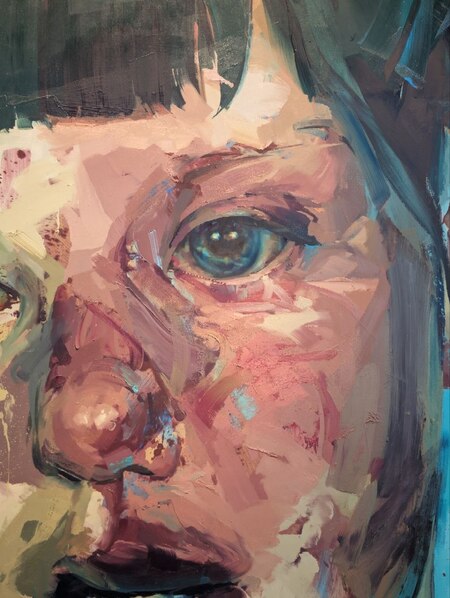
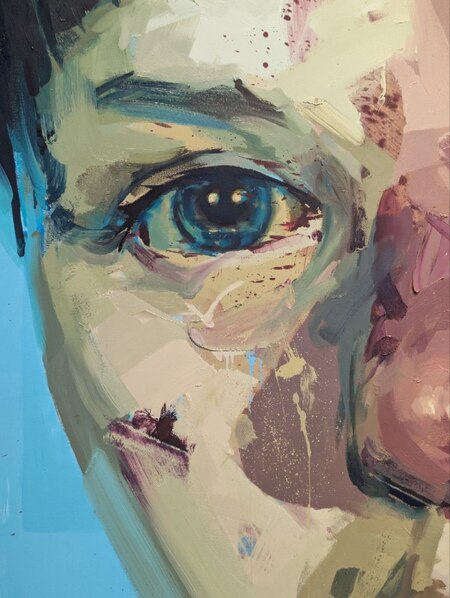
in Venice—an exhibition of the British artist Jenny Saville’s work as part of the Biennale’s parallel program. Saville is one of the key figures in contemporary figurative painting. Her exhibition is held at Ca' Pesaro (Ca' Pesaro, Galleria Internazionale d’Arte Moderna)—a Baroque palazzo on the Grand Canal. The exhibition features about thirty monumental canvases painted by the artist since the 1990s, in addition to a new series of works created specifically for Venice.
Saville works with themes of vulnerability, growing up, plastic surgery, and the instability of self-image. Her paintings are massive in scale, but it’s not just the size that impresses and sends shivers down your spine.
«In her paintings, you see the faces of young girls with wide-open eyes—and you realize: she is about to cry. She doesn’t know what is happening to her body. Saville knows how to raise these issues so powerfully that you feel it physically»
* «Balkan Baroque.» Marina Abramović. 1997. Venice Biennale
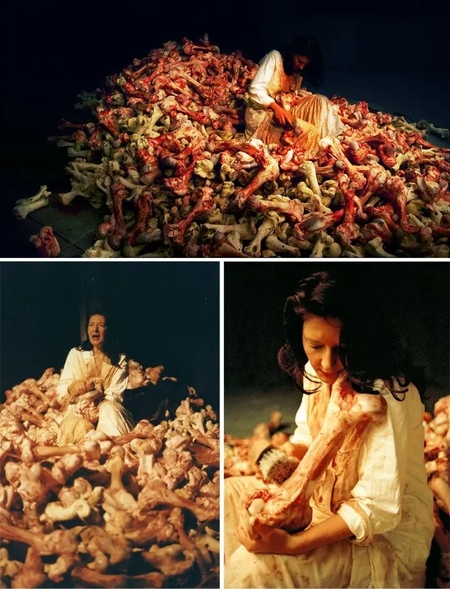
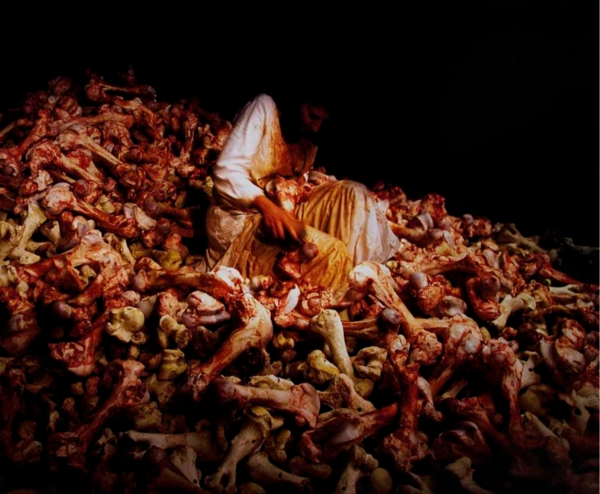
In 1997, at the 47th Venice Biennale, Marina Abramović performed one of her stunning pieces, «Balkan Baroque, ” under the direction of Germano Celant. The performance was dedicated to the war that led to the dissolution of her native country, Yugoslavia. This multi-hour act earned the artist the „Golden Lion.“Sitting in a white shirt atop a pile of 1,500 massive bovine bones, she acted like a Baroque saint, attempting to wash the bones clean of blood while singing folk songs and speaking about her hometown of Belgrade. Attendees could also experience the unbearable stench of the bones.
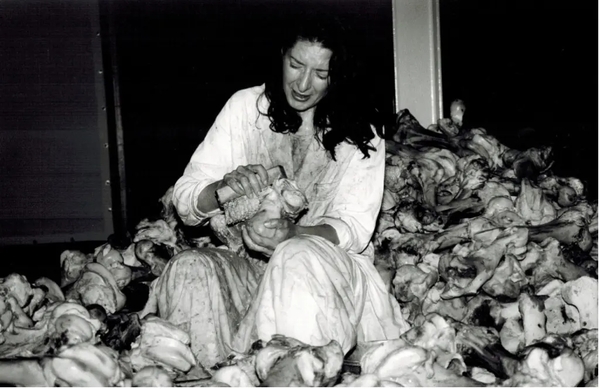
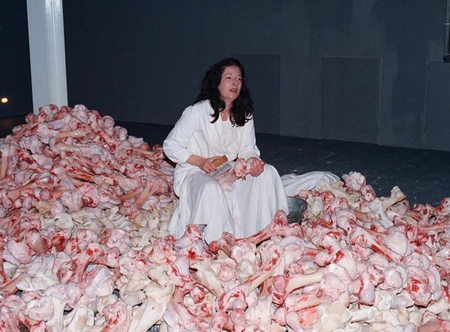
The artist seemed to have been assigned the most unsuitable space—a damp, dark cellar—but it was precisely that which helped create the desired atmosphere. Over six days in that raw basement, Abramovich washed real cow bones with blood and sinew, cried, washed them again, and cried again.
* Chris Burden — «Shoot» (1971)
Ironically, one of the hallmarks of endurance art—Kris Burden’s performance piece «Shooting”—lasted only a few seconds. On November 9, 1971, in a California gallery, Burden shot himself with a shotgun from a distance of about 4.5 meters.
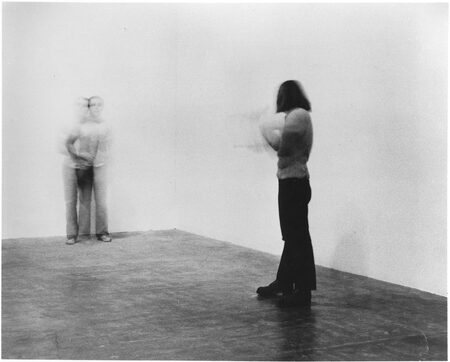
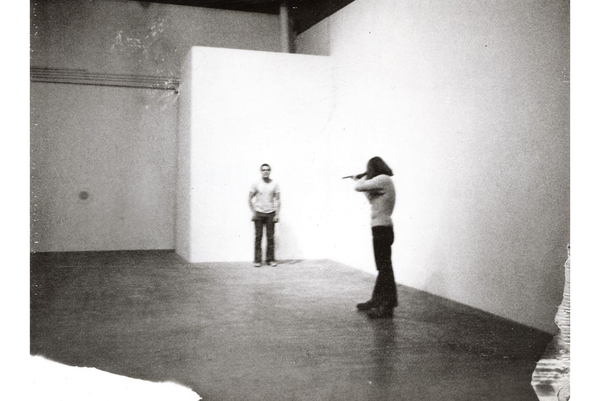
Berden had expected the bullet to merely graze him, leaving only a scratch on his skin. However, the performance went awry, and the artist was shot in the arm. For Berden, this «error» did not matter much. «What matters is the idea itself—that you can be shot to hit the target, ” he would say two years later.
«Shoot» was Bernd’s reaction to the level of brutality transmitted through the media during the Vietnam War. «It’s as American as apple pie, ” Bernd explained, „either you get shot, or you shoot people.“
* Alfredo Jaar. The End of the World. 2023–2024.
The installation occupies a long space, entirely saturated with red light. At the far end of the room, there is a small glass display case housing a tiny metallic cube composed of layers of rare-earth minerals—materials essential for producing microchips, batteries, and modern technology.The artist transforms the invisible resources of the global economy into something approaching a religious artifact. Through this minimalist space and charged atmosphere, the work explores themes of resource extraction, global politics, and the hidden violence underpinning technological progress. The small object becomes a symbol of the immense influence that inconspicuous elements wield over the contemporary world.
* Maria Magdalena Campos-Jones Installation: Anatomy of the Magnolia Tree for Koyo Kouoh. 2026.
Maria Magdalene Campos-Pons' work, «Anatomy of a Magnolia Tree: For Koiyo Kuo and Toni Morrison» (2026), is a monument embodied in floral imagery. Portraits of Morrison—the first Black woman to receive the Nobel Prize in Literature—and Kuo, the first African woman to serve as a curator for the Venice Biennale of Arts, are displayed on eight towering panels. Simultaneously, seven sculptures crafted from resin and glass replicate the form of the magnolia—a signature flower of the American South. Grounded in the ideals of Black female solidarity, this piece unites its subjects, transcending boundaries of discipline, generation, and geography.