Metenkov House
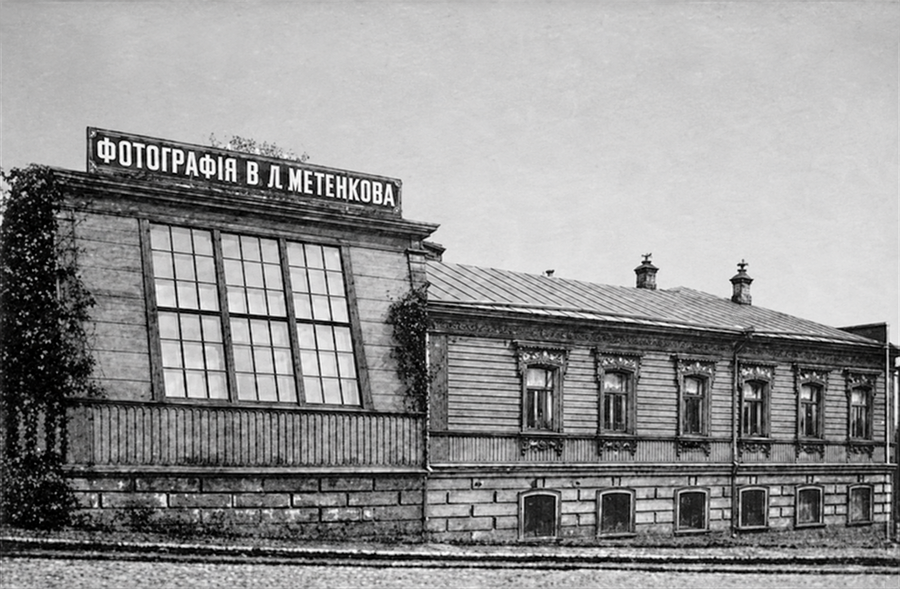
The house on Voznesensky Prospekt (now Karl Liebknecht Street, 36) was purchased in 1895 by Evdokia Metenkova, the wife of photographer Veniamin Metenkov. It housed a photo shop and a pavilion with a glass wall. In 1920, the house was confiscated, and for almost 60 years, it operated as a tub dispensary, before becoming a photography museum in 1998. As of 2024, the museum is undergoing renovation and is temporarily operating at Turgenev Street, 15.
Essay
In the late 1920s, a treasure was discovered in the attic of a house in Sverdlovsk: two silver spoons and old camera equipment. The treasure, to be honest, was unremarkable, but the person who owned it was arrested for concealing valuables. The strangest part of this story is that the attic was in his own house, though he no longer owned the house by that time.
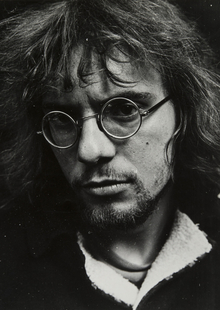
This man was called Veniamin Metenkov, and about thirty years before his arrest, he was the most renowned photographer in the Urals. The son of a leatherworker from Miass, he learned to shoot on a gold-plated bellows camera, moved to Yekaterinburg, and became the first in the region to create portraits using artificial light—his postcards of the Urals landscapes are still considered canonical. In 1895, his wife, Evdokia Vasilievna, purchased the house on Voznesensky Prospekt, and interestingly, the photo supply store on the ground floor initially operated under her name as well. A pavilion with a sloped glass wall was added to the house to ensure ample light for photography; on the upper floor, four daughters and a son lived, and in the yard resided dogs, cats, and, as the museum notes, «even a tamed mouse.»
Then came 1919. The family moved to Tomsk, their home was confiscated, and when he returned, Metenkov lived at a different address. The man who had captured all of the Urals worked as a laboratory assistant, then managed a store, and then came the spoons. In 1931, he was arrested for the second time and was kept on bread and water for three weeks, eventually dying in March 1933. Tuberculosis had been treated in his home for almost sixty years.
I used to be a photographer and attended exhibitions in this building many times because photography made a comeback there in the nineties. The building was slated for demolition to make way for a parking lot, but it was successfully declared a monument, and a museum opened there in 1998. I knew nothing about the spoons back then. I certainly never imagined that history could repeat itself, but in January 2024, the museum closed for renovations, promising to reopen in a year, yet it is still living in a temporary space at the Makletsky House at Turgenev 15. The house on Karl Libknecht Street is once again without a photographer.
So, if you’re in Yekaterinburg, do this. Go to Karl Libknechta, 36, stand across from the balcony, and film the house—but only once, like it’s a single glass plate where there was no second attempt. Then take that shot to the Turgenev Museum for the «Venya Alive?» exhibition. I think the house needs to know it’s still being watched.
Legend
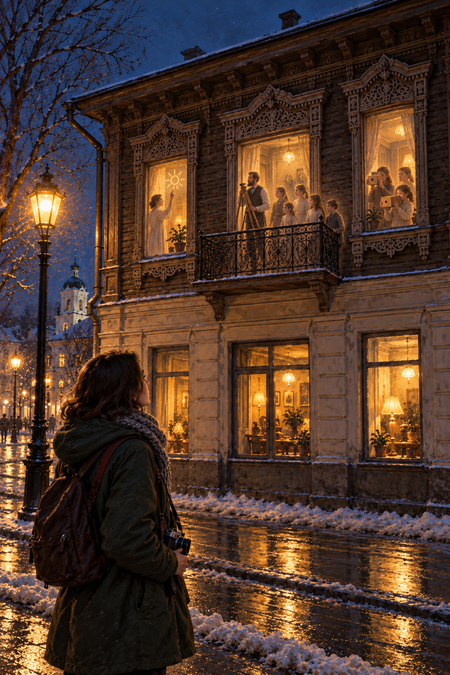
On Karl Libknecht Street, right in the heart of Yekaterinburg, stands building number thirty-six—a building one cannot pass by without slowing down, even though almost everyone does. It is a two-story structure: the lower level is stone, light-colored, with tall windows from the former shop, while the upper level is dark wood, featuring carved trim where, if you look closely, leaves and stems intertwine. Centered above the entrance is a balcony with an intricate lattice, so small that only two people could barely fit on it. Over a hundred years ago, photographer Veniamin Metenkov lived in this building; later, it housed a photography museum. Currently, the windows are dark, and a notice bearing the new address is taped to the door because the museum has moved «temporarily for renovation.»
Nika walked past this house every morning on her way to work and never once read the note. She was usually glued to her phone. At one point, she used to attend every single exhibition because she was a photographer herself, but she hadn’t shot in two years. She never made any vows—she simply put her camera in the closet with the lens facing the wall after her fourteenth wedding anniversary and never took it out again. To be honest, I understand her: that’s how it is when your eyes tire before your hands, and you look at the city, but all you can picture in your head is, «well, home, well, trees.» Then, in November, in the thickest slush, before the snow had fallen but was just smeared across the sidewalk as gray mush, and the streetlights had already turned on at five o’clock, the house took a picture.
A sudden white flash erupted in the window above the balcony—brief and silent, much like magnesium ignited in an old film shoot—and Nika dropped her glove in surprise. The light in the house, where rumors suggested even the heating was off, was odd, and for the first time in a long while, she raised her eyes. On the glass, from the inside, a picture slowly began to materialize, like an image developing on paper: a street, a lamppost, and a hunched-over girl in a hood, her chin tucked into a scarf, her face blue from the screen. The portrait was strikingly accurate, and that was what angered Nika.
The next day, she came to the house dressed formally—no hood, straight back, and even wearing lipstick. She stood beneath the lamppost, as if it were a softbox, and turned toward the window with the working side facing it, because frankly, she knew how to teach others how to pose. The house was silent. She smiled, and the house fell silent again. She stood there for about ten minutes, smiling at the empty window, until the janitor asked if she was alright. Yesterday’s hunched-over girl still appeared on the glass, and it seemed she was visible from the bus stop. «Well, sure, ” Nika said, raising her phone toward the window.
Instead of a window on the screen, there was a black hole—neat and rectangular, as if the house refused to be framed. Then she finally read the note on the door: «We’ve moved: Turgenev St., 15. Wednesday–Sunday.» It happened to be Sunday. The museum was now a guest in a borrowed mansion, on the first floor, and it smelled of old parquet and a faint hint of chemicals, like any developing lab. The caretaker, wrapped in a gray shawl, listened to her about the flash, showed no surprise, and only asked:
— Were you standing or walking? — I was walking. — I see. Well, he doesn’t like it when you’re on the move. She led Nika up to a display case where a glass plate lay under glass—a negative: a bearded man in a vest, straight as a tripod.
— Veniamin Leontievich was the first in the Urals to shoot with artificial light. He had a pavilion on the roof—a wall entirely made of glass so there would be enough sunlight. There’s one plate for each person; they shouldn’t have brought a second one. You sit there, you freeze, and he counts the exposure time out loud, up to eight. If you blink, it’s your own fault—you’ll remain like that. — She adjusted her shawl and spoke more softly, the way one talks about a relative. — In nineteen— he left, they took his house, and it seems he never understood that the filming was over. For sixty years, there was a tuberculosis dispensary there, then we came, and he felt better. And now, for the third year, there’s no one—no one to work with. So, he catches passersby, as best as he can.