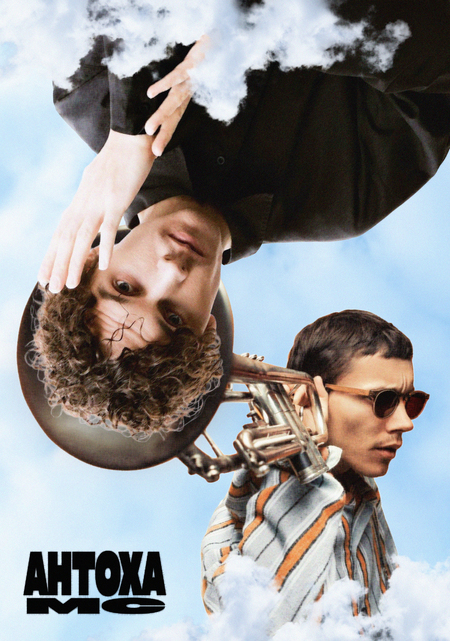

Is it possible to create something new in musical culture when musicians constantly reference existing genres and techniques? I believe so: novelty can emerge through reinterpreting the familiar. In class, we discussed acceleration and the move toward an «inhuman» sound. I am interested in exploring a different path—namely, creating my own musical language and developing it through live performance. Using Antokhi MS as an example, I will demonstrate how the interplay between electronic rhythm, voice, and live instrumentation allows familiar forms to be updated, and explore where a recognizable style ends and something new begins.
In «Vremya, ” from the album „Rodnya, ” the lyrics themselves immediately draw attention: their intonation and rhythm become part of the music. I believe this is a starting point for discussing the new—an individual musical language can be formed from already familiar elements.
The musicians' task is to borrow existing themes and translate them into contemporary contexts.

In «Heartbeat, ” Antokha’s signature style merges with the dance rhythm. The electronic beat does not impede the voice from maintaining a conversational character. This raises a question: can a particular way of using familiar musical elements constitute a form of novelty?
This question is especially vividly illustrated by Antonha’s engagement with Alexander Vertinsky’s work. The familiar text appears in a different musical and performance context. What is new here is the interpretation: a past piece is being voiced by a contemporary artist.
What do these examples demonstrate?
Neither dance electronic music nor the reworking of old songs is innovation in itself. These examples allow us to speak of renewal within a tradition. In my view, musical culture develops partly through such changes: familiar tools take on a different expression and meaning.
Another way to refresh a song is through live performance. The acoustic version recording features guitar, bass, keys, drums, saxophone, and trumpet. Thus, «ZHARA» receives a separate live band version that can be compared to the studio recording.
It seems the work on the song continues even after its release. I’ve been to several of Antokha’s concerts, and sometimes he starts playing the trumpet spontaneously, or a choir joins him. Those moments change the mood of familiar songs, and it’s interesting every time to hear how they sound today!
Of course, having living tools in itself doesn’t signify innovation—similar reinterpretations have existed for a long time. But here, the potential for something new emerges at the level of a specific work. Musical culture renews itself partly through such changes, even when they don’t lead to the creation of a distinct genre.
Genre blending, covers, and improvisation existed long before Antokha MS. His work does not prove that an entirely new musical genre emerged. However, I believe that novelty in musical culture is possible even without such a breakthrough. It arises when familiar techniques coalesce into a distinct statement, and when past works are given a new sound and meaning.For me, Antokha exemplifies precisely this path. His music retains a connection to tradition while leaving room for evolution—in arrangement, delivery, and live performance. Therefore, my answer to the question of possibility is yes. Yet, not every difference constitutes a discovery. What matters is that it adds to the music and to our experience of perceiving it.
Author — Lev Zaychenko