Introduction This research focuses on a narrow subject of Etruscan funerary art: paired depictions of a man and a woman united in banquet scenes. The chronological scope is the 6th–4th centuries BCE; geographically, the material is concentrated in Southern Etruria—the necropoleis of Cerveteri (Banditaccia), Tarquinia (Monterozzi), and Volchi; individual works from these centers are held in museums in Rome, Paris, and Boston. The relevance of the topic stems from the fact that the «paired banquet» is one of the most recognizable motifs of Etruscan culture, and a stable tradition of interpretations has formed around it: ranging from the romantic «cult of spousal love» to directly opposing claims regarding matriarchy and the «equality of Etruscan women.» The object of the study is the paired male and female figures in Etruscan funerary art from the 6th–4th centuries BCE. The subject is how the monuments construct the image of the couple as a whole using visual means (pose, gesture, mutual placement, scale, attributes). The research question is: by what compositional means—pose, gesture, and figure placement—do the monuments create the visual unity of the couple, and do these means change over time or from one medium to another (monumental painting, terracotta, stone relief)? The hypothesis is formulated as follows: the paired images are primarily elite funerary self-representation—a way to present the status, wealth, and familial continuity of the deceased—rather than documentary evidence of the real rights, equality, or «happiness» of the depicted individuals.
The unity of the pair is established through a consistent set of compositional techniques (shared bier, contact, offering gesture); however, the specific techniques vary by time and material. Therefore, one late sarcophagus (for example, the Shchitov sarcophagus) cannot serve as proof of a general evolution or «decline» in the woman’s status. Method: comparative visual description and formal analysis of the composition, cross-referenced with museum and catalog descriptions. Observable facts and interpretations are deliberately separated and labeled. All research claims are based on sources that were read (museum catalogs and artifact reference descriptions); bibliographic references whose full text was not read are included in a separate section, «Further Reading.» Work structure: Introduction; Chapter 1 — Chronology and Geography; Chapter 2 — Monuments and Literature; Chapter 3 — Analysis of Paired Figures; Conclusion.
Chapter 1. Chronology and Geography
The period from the 6th to the 4th centuries BCE covers the Late Archaic and Classical eras of Etruscan history. During this time, major urban centers in Southern Etruria developed, and rich necropolises with painted chamber tombs formed. The lower boundary (6th century BCE) coincides with the flourishing of Tarquinian monumental painting and the emergence of the famous terracotta sarcophagi of Cerveteri; the upper boundary (4th century BCE) is marked by a gradual shift in funerary rites and increased Roman influence.
Research Geography — Southern Etruria. Three key centers provide the primary material. Cerveteri (ancient Cerea) — the Banditaccio necropolis, from which the terracotta sarcophagi of a couple originated. Tarquinia — the Monterozzi necropolis with painted tombs (Hunts and Fishing, Leopards, Triclinia, Shields). Vulci — a center associated with the stone sarcophagus of a couple, which is currently housed in Boston. These monuments allow for a comparison of the same theme (a couple at a banquet) across different materials and different time periods.
Observed Fact: all the listed artifacts originate from funerary contexts and are associated with elite burials. This is not a random selection of «pretty pictures, ” but a corpus united by a singular function—the accompaniment of the deceased.
Chapter 2. Monuments and Literature 2.1. Monumental Painting of Tarquinia. The Tomb of the Hunt and Fishing dates, according to the official website of the Necropolises of Tarquinia and Cerveteri, to around 530 BCE and was opened in 1873. The tympanum of the burial chamber features a banquet scene: a man lies on a cushion, and a woman, wearing a tutuolus, touches his shoulder, her hand resting on his chest as she offers a wreath. Below this are scenes depicting a boat, dolphins, birds, a hunter with a sling, and a diver. (Note: The Commons category cites 525–500 BCE, while the photographer Sailko’s file dates it 520–510 BCE; these dating discrepancies are not artificially resolved here but are presented as source variations.) The Tomb of the Leopards dates, according to the Tarquinia tourism portal, to 480–479 BCE. Three friezes depict three couples, accompanied by cupbearers, as well as a scene featuring a lyre, a flute, and dancers. The Tomb of the Triclinium is dated to 470–440 BCE, according to the same source, and was opened in 1830 in the area of Callavario; the frescoes were removed from the walls in 1949. The friezes depict three couples, an outdoor banquet, and, below the tables, a cat, a rooster, and a partridge; separately, there are dancers (a man and a woman). The Tomb of the Shields dates, according to the same portal, to the third quarter of the 4th century BCE and was opened in 1870 (Primi Archi). This tomb features the Velcha family: Lart Velcha lies down while Velia Seititi sits at his feet; the parents, Veltur Velcha and Ravntu Arptnai, are mentioned, along with a procession of lictors, a frieze of shields, and a layout reminiscent of a house. The tomb is closed to the public.
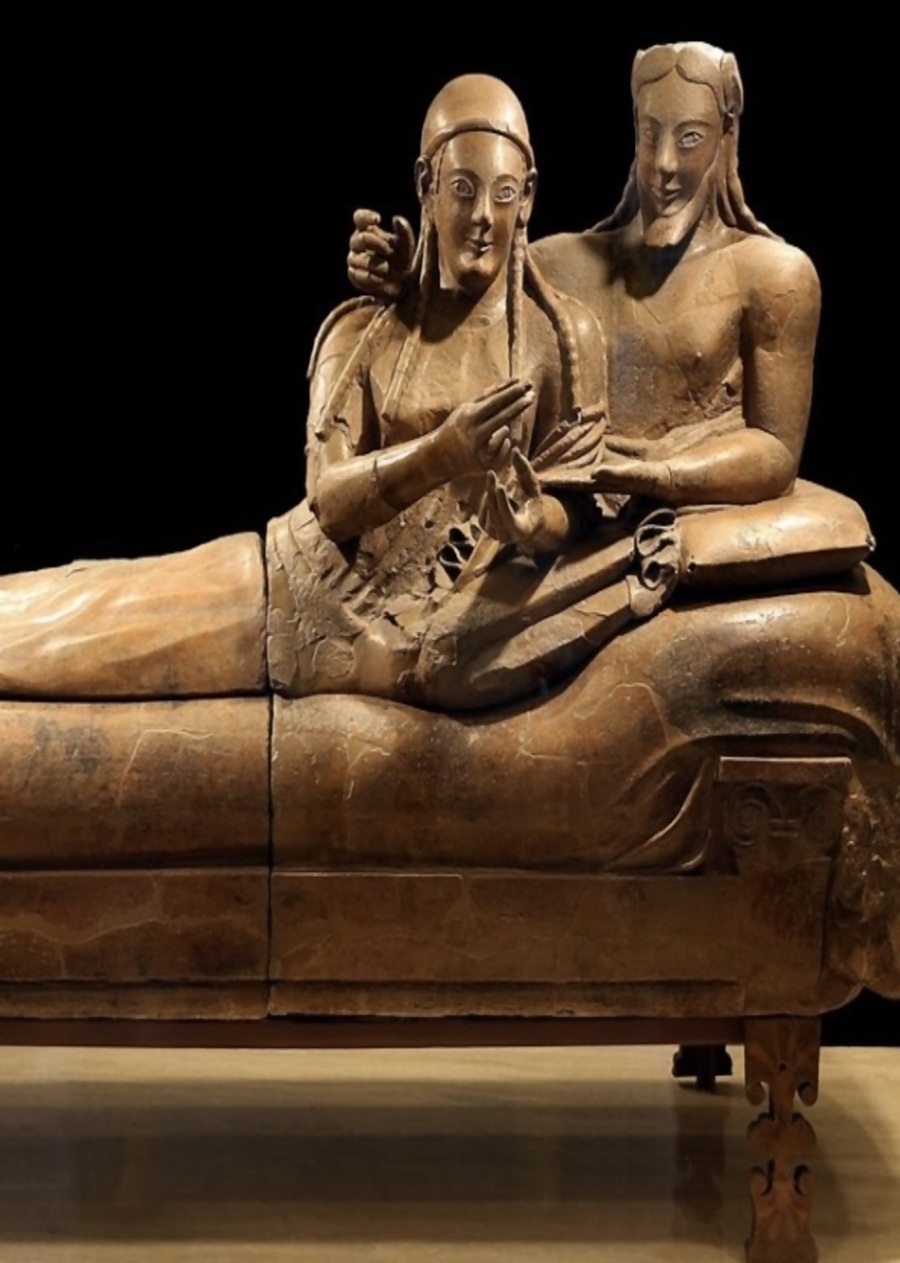
For this current draft, there is no licensed photograph, so it is described only in text—this is a deliberate limitation of the evidence base. I emphasize separately: the Scuti Tomb (Tomba degli Scudi) in Tarquinia cannot be confused with the Scuti and Sedia Tomb (Tomba degli Scudi e delle Sedie) in Cerveteri—they are different monuments. 2.2. Sculpture and Sarcophagi: Cerveteri and Vulci. The sarcophagus of the couple from Villa Giulia (Rome): according to data from the official website of the Villa Giulia Museum, circa 530–520 BCE, terracotta, it originates from Cerveteri (Banditaccia). There is a nuance here: the function of this piece is discussed in the literature (funerary urn or sarcophagus), and this question is not considered definitively resolved.
The second sarcophagus of the couple is held in the Louvre (inventory number Cp 5194.1). According to the Louvre’s collection page: dating 520–510 BCE, red clay, molded and shaped with inscriptions; dimensions—height 114 cm, width 194 cm, depth 74 cm; originates from Cerveteri (Banditaccia), discovered in 1845–46 (Campana collection), and acquired by the museum in 1861. Important note: the museum’s attribution of function is cautious—"sarcophagus (?)»; «urn (?)»; meaning the function remains undetermined, and the draft does not declare this object an absolute urn containing the ashes of both spouses.
The sarcophagus from Vulci (Boston): according to the Wikimedia Commons page, the object is titled «Sarcophagus and lid with husband and wife,» dated 350–300 BCE, executed in travertine, measuring 93,3 × 213.8 cm; originates from the Tetni cave tomb, Ponte Rotto necropolis, Vulci. The lid depicts the couple shrouded in a cloak; the long side of the chest features the battle between the Greeks and the Amazons. The identification of the object in the Museum of Fine Arts, Boston (MFA 151377, inv. 86.145a-b) is cited on the Commons page as a reference and is considered here as a tentative lead requiring confirmation via the museum database, rather than an established fact.
I also note: the image does not provide grounds to interpret this couple as «man on sarcophagus—woman in urn» or as a «seated wife»; it is specifically a couple reclining together.
2.3. Literature. Metadata confirmed for: Steingräber, Stephan. Abundance of Life: Etruscan Wall Painting. Los Angeles: J. Paul Getty Museum, 2006. ISBN 9780892368655. Louvre Bibliography confirms the following entries: Briguet, 1989 (Olschki), «The Sarcophagus of the Spouses of Cerveteri» from the Musée du Louvre; Scheffer, 2007, «Women in Etruscan Tomb-Painting, ” in Public Roles and Personal Status; Nadalini, 2016, Anabases 24, pp. 15–26, doi 10.4000/anabases.5817; Rizzo, 2021, Bollettino d’arte 47–48, pp. 3–37.
Chapter 3. Analysis: How Pose, Gesture, and Placement Create Paired Unity 3.1. Observed Facts (Description without Interpretation). On the sarcophagi of couples (Villa Giulia, Louvre), two figures recline together on a wedge-bed: the man is behind, the woman is in front, both are supported by pillows; arms are extended, fingers gesture, and there is physical contact between the figures. On the Villa Giulia sarcophagus, the man embraces the woman. On the Louvre sarcophagus, the woman holds a small object in her palm (perhaps an incense burner). These are observable compositional elements. In the Tarquinian frescoes, the observed elements are as follows: in the Tomb of the Hunt and Fish the man and woman form a unified group, where the man’s gesture (touching the shoulder of the pater) and the woman’s gesture (touching the chest, presenting a wreath) connect the figures. In the Tomb of the Leopards and in the Triclinium Tomb, the pairs are placed on wedges, with winemakers and musicians/dancers present nearby. In the Shield Tomb, the reclining man and the woman seated at his feet form a different type of group (reclining + seated), surrounded by a procession.
3.2. Interpretations (marked as interpretations). Interpretation: The recurring motif of «shared bed + physical contact + offering gesture» creates a visual formula of couple unity. This formula is stable and recognizable, but its specific content changes: in the terracotta of the 6th century BCE, the emphasis is on physical closeness and embrace; in the painting of the 5th century BCE—on the banquet setting and gestures; in the stone relief of the 4th century BCE—on the heraldic, «dynastic» presentation of the family. This is an interpretation, not a fact.
Interpretation: the paired figures serve as an elite form of self-representation—they symbolize the status, wealth, and lineage of the deceased family. This interpretation aligns with the evidence that all monuments originate from wealthy burials; however, we do not have direct textual confirmation of the patrons’ «intentions.» What the draft does NOT assert is that the depicted couples prove matriarchy or gender equality among Etruscan women; that they reflect the actual rights, happiness, or legal marriage of specific individuals; that these are portraits; or that every pair necessarily consists of heterosexual, legally married spouses. Such claims exceed the scope of what the sources allow.
Interpretation (with a caveat): the seated female figure in the Shchitov tomb (4th century BCE) may reflect a different compositional role than the reclining couples in earlier monuments. However, a single late tomb cannot serve as proof of a general evolution or «decline» in the status of women; such a conclusion requires a series of comparable monuments. 3.3. Limitations of the Evidence Base. First, some dates in popular and tourist descriptions are approximate and should not be treated as precise. Second, the Shchitov tomb is presented here only as text (no licensed photograph is available), which limits visual analysis. Third, attributing individual images (for example, the frescoes in the Triklinia tomb from a photograph) requires verification against museum and catalog data, not against the file name or the uploader’s signature.
3.4. Comparison across media: terracotta, painting, and stone. Juxtaposing these three media reveals that unity is constructed using different means. In 6th century BCE terracotta (Villa Julia, Louvre), the primary carrier of unity is physical closeness: the two figures share a bed, their bodies form a single silhouette, the man embraces the woman, and their hands touch. Here, sculptural mass is at work: the pair is perceived as a unified volume rather than as two separate figures. In monumental painting from the 5th century BCE (Leopards, Triclinium), unity is built differently—through the feasting setting and gestures: the reclining figures are integrated into a scene with servers, musicians, and dancers, and the connection between the man and the woman is emphasized by the direction of their gaze and gestures (raising a wreath, holding up a cup). Finally, in the 4th century BCE stone relief (Sarcophagus of Vulchi), the emphasis shifts toward a heraldic, «dynastic» presentation: the pair is covered by a shared cloak, and a mythological scene (the battle of the Greeks with Amazons) is placed on the chest, referencing the valor and nobility of the lineage. All these observations describe the composition; they do not prove how contemporaries perceived these images.
It is important to note that the change in practices does not create a simple linear «evolution» from greater equality to less. Terracotta and painting are different types of artifacts created in different centers and for different funerary contexts; comparing them as stages of a single process would be a stretch. A more cautious conclusion is that the set of compositional elements varies by environment and by time, rather than developing along a unified scale.
3.5. What would be needed for stronger conclusions. To test the hypothesis of elite self-representation, the following is required: (1) verifying all dating information against academic catalogs rather than tourist descriptions; (2) expanding the corpus to include a series of comparable monuments of the same type and environment so that individual examples are not mistaken for a general trend; (3) accounting for the burial context (specifically who was buried and what objects accompanied the interment); (4) distinguishing the representation from actual social practices.
Conclusion Paired male-female figures in Etruscan funerary art, 6th–4th centuries BCE, are unified by a stable compositional core—a shared bier, physical contact, and the gesture of offering—yet specific techniques evolve with time and material. The most cautious and provable interpretation is that these figures represent elite funerary self-representation rather than documentary evidence of the depicted individuals' rights or equality.
BCE, opened in 1873. • Tarquinia, Tomb of the Leopards: https://tarquiniaturismo.com/tomb-of-the-leopards/?lang=en — 480–479 BCE. • Tarquinia, Tomb of the Triclinium: https://tarquiniaturismo.com/tomb-of-the-triclinium/?lang=en — 470–440 BCE, opened in 1830 (Calvario), paintings removed in 1949. • Tarquinia, Tomb of the Shields: https://tarquiniaturismo.com/tomb-of-the-shields/?lang=en — 3rd quarter of the 4th century BCE, opened in 1870 (Primi Archi), Velcha family; closed to the public. • Steingräber, Stephan. Abundance of Life: Etruscan Wall Painting. Los Angeles: J. Paul Getty Museum, 2006. ISBN 9780892368655 — metadata: https://books.google.com/books/about/ Abundance_of_Life.html? id=DzCzvnn3KSYC; Getty: https://www.getty.edu/research/collections/ component/10V1MC (full text not read). • Wikimedia Commons, File: Boston sarcophagus from Vulci.jpg: https://commons.wikimedia.org/ wiki/File: Boston_sarcophagus_from_Vulci.jpg — «Sarcophagus and lid with husband and wife», 350–300 BCE, travertine, 93,3 × 213.8 cm, Vulci (Tettine Tomb, Ponte Rotto). B. Further Reading (metadata; full text not read) • Briguet, M.-F. Le Sarcophage des époux de Cerveteri du Musée du Louvre. Firenze: Olschki, 1989 (metadata from the Louvre bibliography; full text not read). • Scheffer, C. «Women in Etruscan tomb-painting» // Public Roles and Personal Status, 2007 (metadata from the Louvre bibliography; full text not read). • Nadalini, G. // Anabases, 24 (2016), pp. 15–26, doi: 10.4000/anabases.5817 (metadata; full text not read).
Illustrations:
Fig. 1. Sarcophagus of a Couple from Cerveteri. The author of the ancient work is unknown. Terracotta, circa 530–520 BCE. National Etruscan Museum, Villa Giulia, Rome. Photo: Sailko, Wikimedia Commons, CC BY-SA 4.0. Analysis: Two figures lie together on a kline, the man embracing the woman from behind; the physical contact and shared body contour create the image of a single whole.
Fig. 2. Sarcophagus of a Couple (Inv. Cp 5194.1). The author of this ancient work is unknown. Red clay, molding, and slip-trailing with painted decoration, 520–510 BCE. Louvre Museum, Paris. Photo: Shonagon, Wikimedia Commons, CC0. Analysis: The woman in the front holds a small object in her palm (possibly an incense burner); this gesture connects her figure with the figure of the man behind her.
Fig. 3. Sarcophagus of a couple, detail of the faces. The author of the ancient work is unknown. Red clay with painting, 520–510 BCE. Louvre Museum, Paris. Photo: Kikuyu3, Wikimedia Commons, CC BY-SA 4.0. Analysis: the closeness of the heads and the overall tilt enhance the impression of a pair; this is a formal compositional device, not a portrait characteristic of specific individuals.
Fig. 4. Banquet Scene, Leopard Tomb. The author of the ancient work is unknown. Mural painting, c. 480–479 BCE. Monterozzi Necropolis, Tarquinia. Photo: Wikimedia Commons, public domain. Analysis: The reclining figures and standing cupbearers form a banquet group; the gesture of the raised cup is incorporated into the dining scene.
Fig. 5. Dancers and musicians from the Leopard Tomb. The author of the ancient work is unknown. Wall painting, c. 480–479 BCE. Monterozzi Necropolis, Tarquinia. Photo: Wikimedia Commons, public domain. Analysis: The figures of the flutist and dancers suggest that the feast included musical accompaniment—an element of ambiance, not proof of family status.