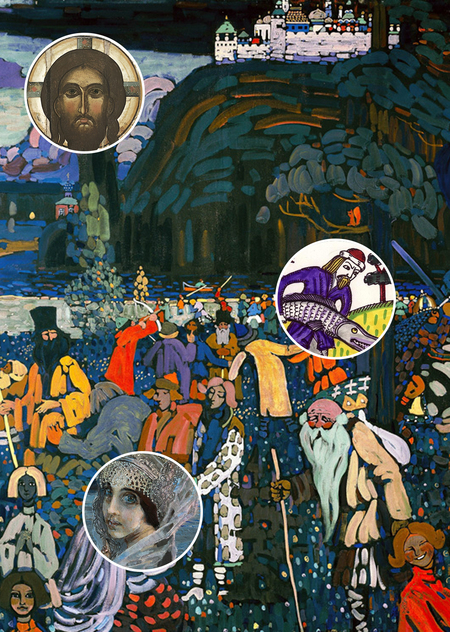
Concept
Wassily Kandinsky entered art history as an abstract artist. His journey toward expressionism—a movement that asserted the priority of subjective emotional experience over external reality—was unique in that the artist drew heavily upon a rich tradition of folk art. Vasily Kandinsky’s creative path is often viewed through the lens of a radical break from figuration and a transition to abstraction. The foundation of his visual language was laid during an ethnographic expedition to the Vologda Governorate in 1889. It was there, encountering the vibrant painting of peasant cottages, woodcarving, and the vividness of folk costumes, that the future artist experienced what he termed a «turning point in the painting» [3].
Folk art and icon painting became not only sources of inspiration for Kandinsky but also the key to understanding the magical and spiritual potential of color. In this visual study, I examined how motifs from popular prints, icon painting, and Slavic folklore acted as a catalyst for the formation of the artist’s expressionist method. I selected these three areas because they represent the «genetic code» of Kandinsky’s creativity. Folklore provided the artist with emotion and scale; icon painting offered spiritual verticality; and the popular print provided the courage of simplification [4]. Without this influence, his transition to pure abstraction would not have been possible.
«My inclination toward the ‘hidden’ and the ‘concealed’ helped me move away from the detrimental aspects of folk art, which I first encountered in its natural environment and on its own soil during my trip to Vologda Governorate» [5]
The research topic involves identifying the traits of lubok, Slavic folklore, and icon painting within the paintings of Wassily Kandinsky—examining the shared ideological concepts related to the incorporation of native motifs. The artist’s work was analyzed through the lenses of symbolism, biographical and historical context, and the transformation of ancient Russian art.
Today, studying Kandinsky’s folkloric origins is relevant for understanding how global ideas emerge from local traditions. In the age of digitalization, interest in the authentic, mythical, and subconscious—which folklore, lubok, and icon painting embodied for Kandinsky—is becoming a means of preserving the human element in art. By studying the meaning that past artists instilled in their work, we can learn to comprehend contemporary art and imbue our own creations with profound meaning.
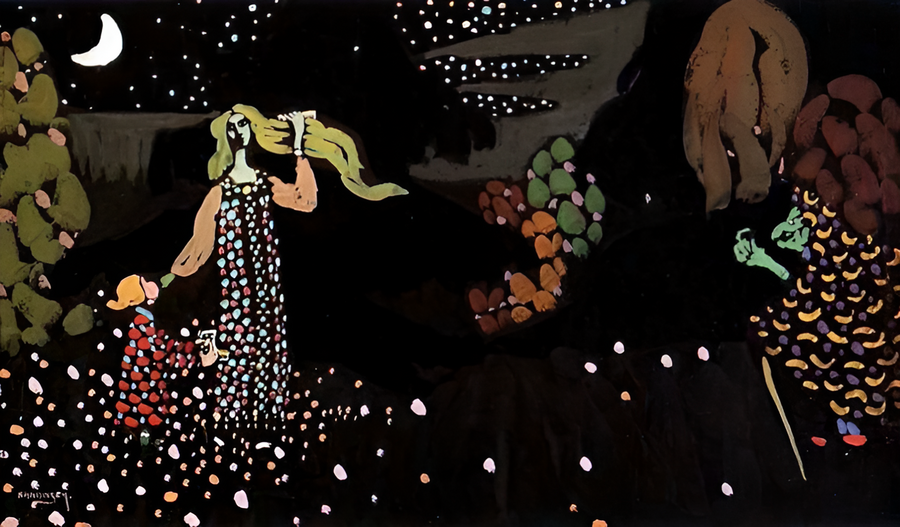
V. Kandinsky. Night. 1907.
The goal of this study is to compare works of art—including pieces by Kandinsky, popular prints, icons, and folkloric motifs that the artist adapted and incorporated into their creative work—that span several centuries, and to define the relationships and similarities between them.
It was important to present the visual material in a way that clearly demonstrated the connection and lineage among the chosen works of art. To achieve this, I used animations at a pace that was easy for the viewer to analyze, adding circular vector elements to illustrate especially significant parallels within the selected works without distorting their appearance.
The study incorporated the most recognizable and traditional paintings, most of which date from Kandinsky’s early creative period. During the research, I consulted fundamental textual sources not only regarding the chosen artist’s work but also concerning Slavic folklore, icon painting, and popular prints, as well as art history in general, in order to better understand the artistic allusions of that era.
We can surmise that Kandinsky intentionally utilized diverse techniques—referencing Slavic imagery and symbols, imitating decorative arts techniques, employing a distinct color palette, and compositional elements—from ancient Russian art to realize the concept of the synthesis of the arts, continuity, and a «primal sincerity» [5].
For the visual basis of my research, I selected Kandinsky’s paintings that most vividly express Slavic folkloric elements. To draw parallels, I utilized works by other artists traditionally associated with specific folk artifacts. I analyzed the connection between the art underpinning these works and the unique characteristics of the historical and cultural context in which the artist created.
V. Kandinsky. Akhtyrka Estate. 1916.
Such images—the foundation of the visual research is a structured analysis of Kandinsky’s paintings (it is organized by chapters, each describing a separate sphere borrowed from Slavic folklore, popular prints, and icon painting)—and the visual reflection of the information found.
Chapter 1. Imagery from Slavic Mythology and Folklore
«Other art, capable of further development, also has roots in its spiritual era, but it is not merely an echo or a mirror of the last—it possesses an awakening, prophetic power…» [3]
Studying Kandinsky’s paintings reveals his reinterpretation of folk themes. The works evoke fairy-tale canvases and popular illustrations. Special attention is paid to the deconstruction of the image: specific symbols—riders, boats, church domes—gradually lose their contours, transforming into lines and fields of color [7].
V. Kandinsky. A Colorful Life. Fragment. 1907.
For details: V. Vasnetsov. Bogatyrs. Fragment. 1876–1898.
In the painting «Colorful Life» (1907), Wassily Kandinsky employs folk imagery as a means of creating a new artistic language. This work is the culmination of his early «folkloric» period, where he reinterprets Russian traditions through the prism of symbolism and expressionism.
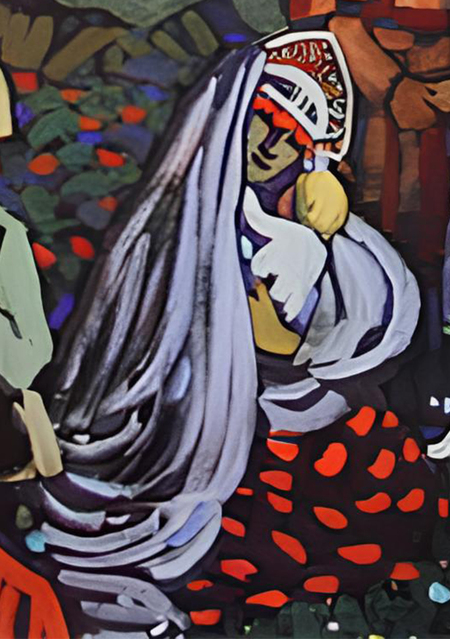
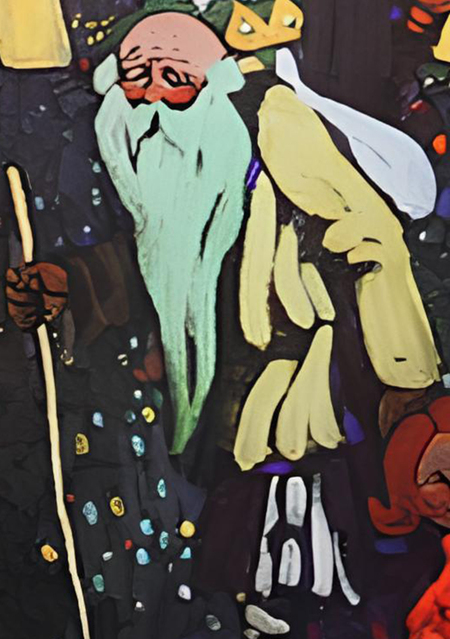
Wassily Kandinsky. Colorful Life. Fragment. 1907.
We observe how the artist constructs a panorama of human life, where the fantastical intertwines with the mundane: in this richly composed painting, one can discern heroes from Slavic fairy tales and epics, as well as symbols of life and death from Ancient Rus'. These include the bogatyrs (the painting «Bogatyrs» by V. Васнецов was chosen as visual accompaniment, as it is inextricably linked to the modern viewer’s perception of these epics), wanderers, and a reinterpreted image of the Swan Princess. On the mountain peak across the river rises a radiant city with golden domes. This is the central spiritual beacon that Kandinsky deliberately introduced—a symbol of the ideal future toward which both the characters and the viewer aspire. The river serves as a barrier between the earthly and the sacred realms (a common theme in the artist’s later work).
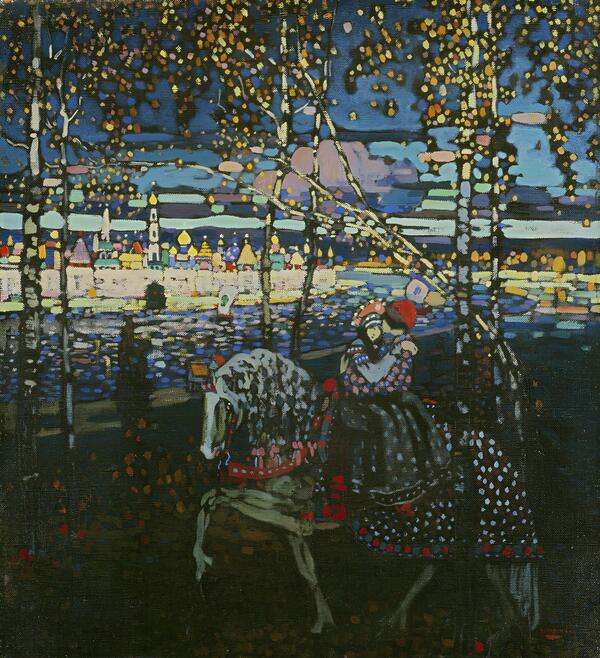
Left: Wassily Kandinsky. Two Riders on a Horse. 1906–1907.
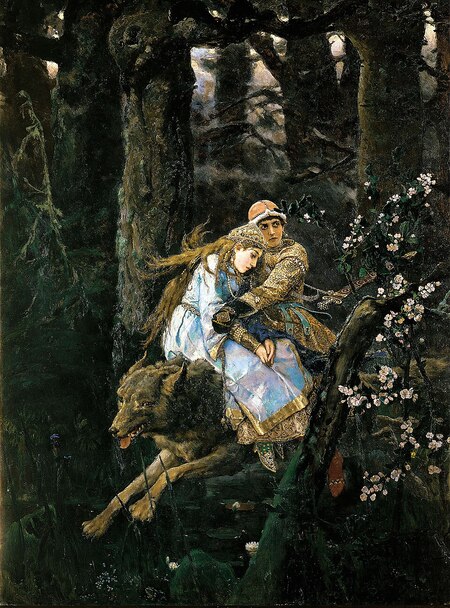
Right: Vasily Vasnetsov. Tsarevich Ivan on a Grey Wolf. 1889.
V. Kandinsky. Two on a Horse. Fragment. 1906–1907.
For detail: V. Васнецов. Ivan Tsarevich on the Grey Wolf. Fragment. 1889.
Similar motifs are also noticeable in the painting «Two on a Horse» (1906). Here, folkloric themes become a reflection of the author’s inner experiences—a metaphor for the shared journey of the artist and his beloved, the search for a «promised land» [3].
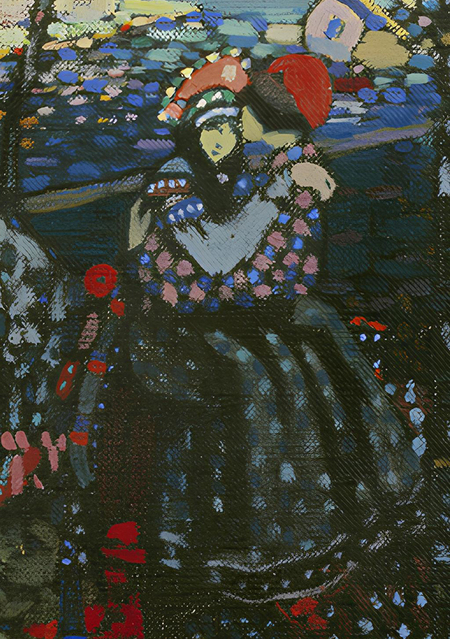
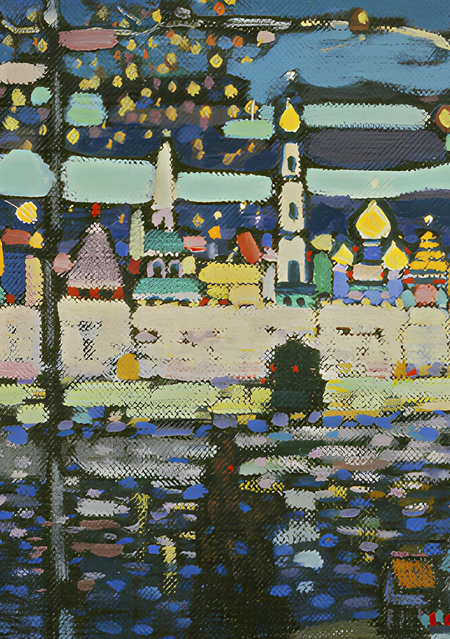
V. Kandinsky. Two on Horseback. Fragment. 1906–1907.
When viewing the painting, everyone unconsciously finds an allusion to the magical Russian folk tale of the East Slavs, «Ivan Tsarevich and the Gray Wolf, ” expressed in the two riders. Kandinsky links one of the images in his painting to the famous work of Viktor Mikhailovich Vasnetsov, „Ivan Tsarevich on the Gray Wolf, ” which is traditionally associated with this fairy tale [6]. The connection to the historical context of the past and the parallel to the white-stone Moscow and the Ivan the Great Bell, visible on the opposite bank of the painting—are traditional symbols of Orthodox Russia.
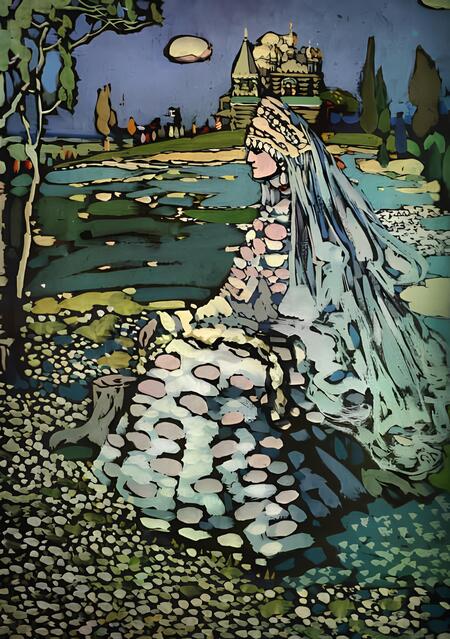
Left: V. Kandinsky. Russian Beauty in Landscape. 1904.
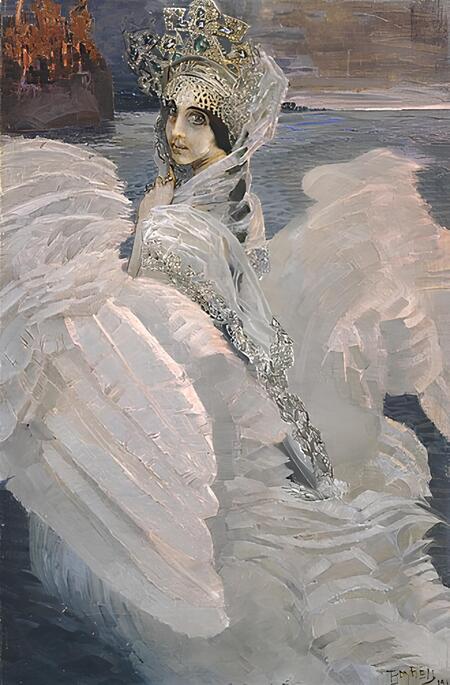
Right: M. Vrubel. Tsarevna-Lebed. 1900.
The closeness to Russian folklore is also evident in another painting from this period of Kandinsky’s work. The artist, who had not yet moved into pure abstraction, sought inspiration in national roots and ethnography.
Many researchers of Kandinsky’s work are convinced that the prototype for the «Russian beauty» was Tsarevna-lebed (Swan Princess) by M. Vrubel (note the color palette of the painting—it is not characteristic of the artist—and the details of the heroine’s clothing) [7]. However, a connection to the painting provided for comparison is traceable at the level of symbolism and compositional mood: both artists embody the ideal of foreign, melancholic beauty. The heroine’s clothing is a vibrant pattern. The artist perceived «invisible music» in folk ornaments, which later led him to his theory regarding the connection between color and sound (lyrical geometricism and synesthesia) [3].
V. Kandinsky. Volga Song. Fragment. 1906.
For details: Palekh. Sadko. Fragment. c. 1990.
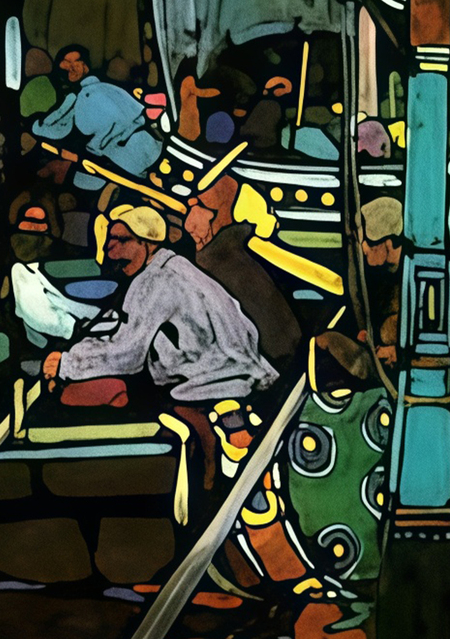
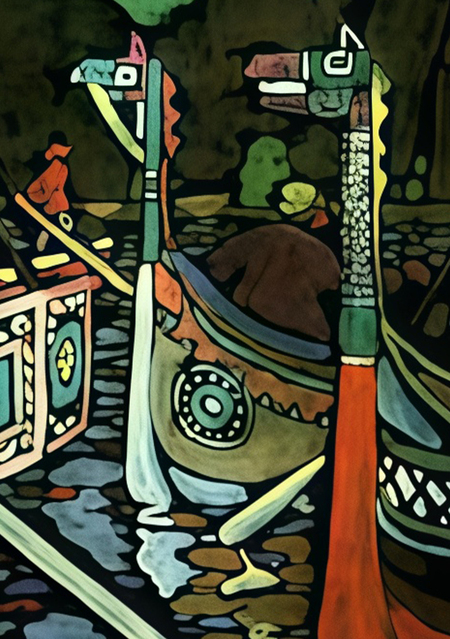
V. Kandinsky. Song of the Volga. Fragment. 1906.
In the painting «Song of the Volga, ” Kandinsky does not paint a specific portrait of a bilyna hero, as the masters of Paleh do: instead, he creates a symbolic image where Sadko is the spirit of wandering and poetry. Instead of a finely detailed face, we see only the hero’s silhouette. For Kandinsky, what matters is not how Sadko looks, but what he embodies. Recalling the artist’s works—particularly „Dot and Line on the Plane”—we understand that he searched his entire life for a connection between music and painting. The artist attempted to translate the „sound“ of the bilyna onto the canvas through patches of color [5] [7].
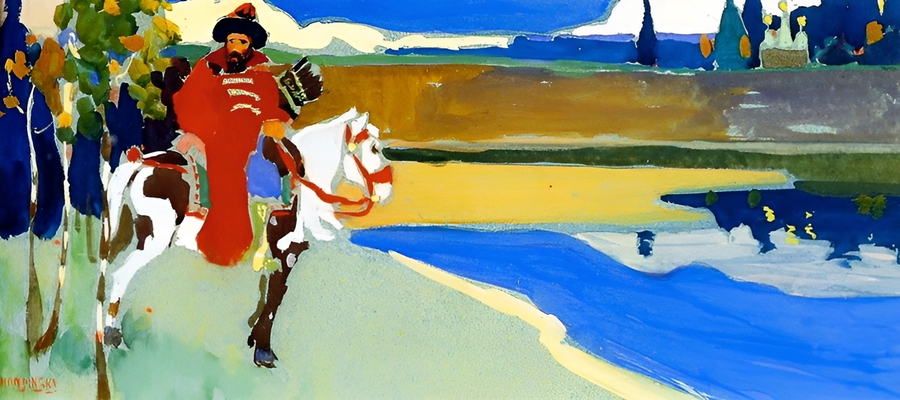
Left: V. Kandinsky. Russian Knight. 1902.
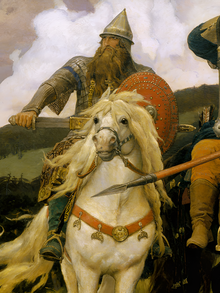
Right: V. Vasnetsov. Bogatyrs. Fragment. 1876–1898.
V. Kandinsky. Russian Knight. Fragment. 1902.
For details: V. Vasnetsov. Bogatyrs. Fragment. 1876–1898.