Concept
Jazz holds a unique place in 20th-century culture: as V.D. Konen stated, «if the 20th century entered history as the century of electricity» or «the century of atomic energy, ” it can just as readily be characterized as the „century of jazz.“ Jazz opened up a special sphere of expression in music that was foreign to centuries of European experience.»
Among the numerous directions spawned by this art form, 1960s modal jazz represents an exceptional case: the shift in harmonic paradigms was so radical that its structural consequences are observable in genres that continue to emerge decades later. The connection between jazz and modern R&B is widely acknowledged in critical discourse; however, the specific mechanism of this succession remains poorly studied in Russian musicological literature. This study fills that gap by tracing the structural line from 1960s modal jazz to 1990–2020s neo-soul.
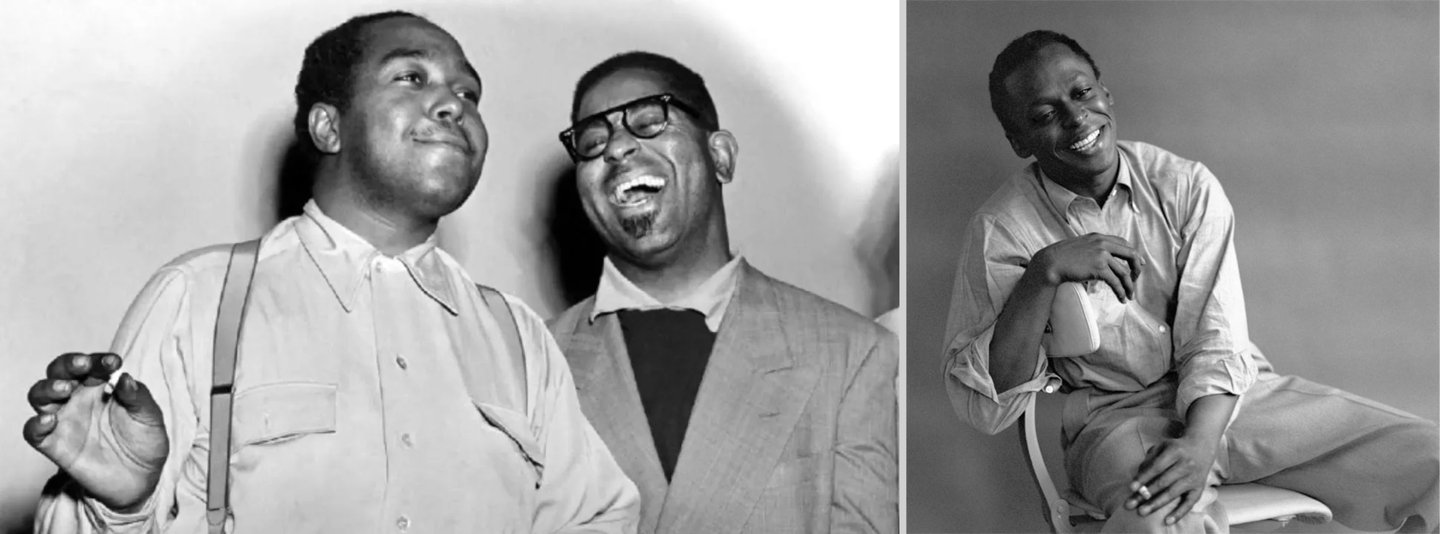
[01] Charlie Parker, Dizzy Gillespie, 1952 [02] Miles Davis, 1952
As one delves into musicological material, the question arises: is the modal harmonic paradigm of the 1960s the structural foundation of neo-soul, or is it merely a surface-level stylistic resemblance? The research hypothesis posits that 1960s modal jazz gifted the neo-soul genre a fundamental sonic principle—a way of organizing harmony where the music remains within a single mode rather than progressing through functional chords. This principle has solidified within neo-soul as the genre’s structural core: the listener recognizes the characteristic sense of space and stasis inherent in jazz aesthetics, yet the source of this feeling remains elusive. Neo-soul is a descendant of modal jazz at the level of deep sonic logic. This is precisely why the connection between the two genres eludes us during casual listening but becomes apparent through harmonic analysis.
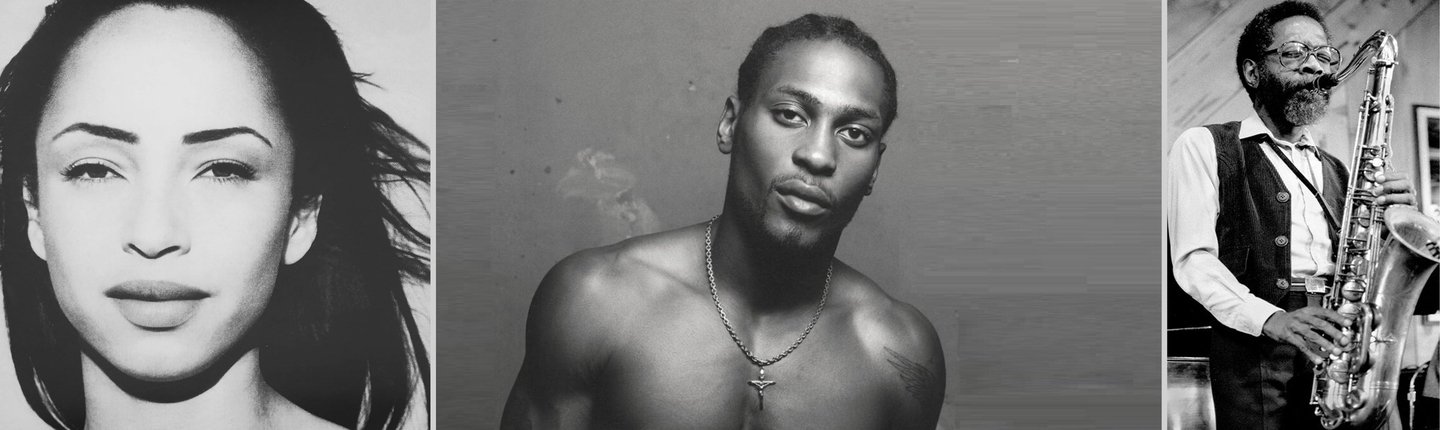
[03] Sade [04] D’Angelo [05] Joe Henderson
The research material consists of specific musical texts forming a verifiable chronological chain: «So What» by Miles Davis (1959) and «A Love Supreme» by Coltrane (1964) serve as the initial modal samples; «Smooth Operator» by Sade (1984) functions as a transitional link between the jazz and pop audiences; «Bag Lady» by Erykah Badu (2000) and «Voodoo» by D’Angelo (2000) are the central neo-soul texts; «Afro Blue» by Robert Glasper (2012) is an example of explicit lineage; and the works of Jordan Rakei and Anderson .Paak represent the contemporary phase. The selection of tracks is based on two criteria: the existence of verifiable harmonic analysis in authoritative sources and the musicians' own documented connection to the jazz tradition.
The work is structured chronologically: each section examines a specific period and particular tracks, illustrating how the sonic principles of modal jazz transitioned from one genre to the next. The source material comprises three types of resources: academic musicological studies, original writings by the musicians themselves, and Russian-language research on jazz history.
Modal Jazz
The concept of «modal jazz» describes an improvisation technique where each section of the form corresponds to a specific mode (Dorian, Mixolydian, Phrygian, etc.), rather than a sequence of functional chords. Fundamentally, the Dorian mode—the most sought-after in modal jazz—differs from natural minor by its raised sixth degree, which eliminates its «tonic» in the context of classical harmony. Whereas melody in traditional tonal music always strives toward a conclusive, stable chord, the situation here is different: the movement toward a final point is replaced by dwelling within a single modal space.
The modal approach became one of the key impulses driving the change in jazz language during the 1960s. V.N. Syrov, analyzing the evolution of jazz styles, situates the modal layer within the broader direction of fusion, describing it as one of the relevant «stylistic paths» on the map of modern jazz. Of particular note is the role of Miles Davis: he was the one who introduced modal scales into improvisation as early as the 1960s, aiming to move beyond the well-trodden routes of traditional bebop, where, according to V.N. Syrov, «classic models demanded substantial reform.»
Kind of Blue and the New Era of Jazz
[06] Album cover for Kind Of Blue, Miles Davis, 1959. [07] Miles Davis, early 1980s.
Miles Davis’s album Kind of Blue (1959) became the starting point for the development of modal jazz. To grasp the scope of this turning point, context is vital: in the 1940s and 50s, jazz was built upon rapid, dense chord progressions. The standard was a 32-bar form, with harmonies changing every two beats. It is from this model that Davis consciously started to deviate—exploring the evolution of Davis’s work, Sia Yu and Shack discovered that he «moved away from the 32-bar AABA form, striving to find less predictable and exquisitely constructed progressions.»
This revolution happened specifically with Kind of Blue. The central composition from the album So What is built upon a minimal harmonic palette: all the music exists within two modes, between which there is only one change throughout the entire duration. The harmony changes rarely—one chord is held for 8 to 16 measures consecutively. Bill Evans plays these chords using a unique technique where the sounds coalesce into open, unresolved chords. The introductory section of So What—featuring Paul Chambers’ bass and the brass instruments—establishes the mode in the first measures, the mode within which the entire composition will exist, without suggesting any further harmonic movement. This approach fundamentally differs from the logic of bebop, where the introduction typically set the direction of the chordal progression. Here, the introduction, conversely, delineates the sonic space from which the music does not exit throughout the entire section.
[08] Paul Chambers, early 1950s.
Steven Thomas Erlewine, in his review on AllMusic, characterizes Kind of Blue as an album that transcends its contemporaries and is universally recognized as a benchmark of jazz art. The critic particularly emphasizes the modal nature of the recording: the melodies and solos are built from chords rather than a single overarching key, which lends the music a quality of subtle shifting. Equally noteworthy is «Flamenco Sketches”—the album’s final track, where each soloist chooses the moment to shift modes, moving through five modes without a fixed number of measures. It is also telling that, according to Bill Evans in the original liner notes for the album, none of the pieces were rehearsed—Davis outlined the themes and chords before recording, after which the ensemble improvised.
«A Love Supreme»: The Spiritual Jazz of John Coltrane
John Coltrane’s «A Love Supreme, ” recorded in December 1964, holds a singular place in jazz history: the album is regarded as the culmination of the musician’s spiritual quest and simultaneously as one of the genre’s most significant recordings. Miles Davis lends modal technique a quality of intellectual restraint, whereas John Coltrane emphasizes intensity and spirituality. „A Love Supreme“ synthesizes modal stasis and religious catharsis.
[09] John Coltrane, early 1960s. [10] Album cover for A Love Supreme, John Coltrane, 1965.
«A Love Supreme» (1964) is not merely a jazz album; it is a musical declaration of religious significance: the four movements of the cycle are structured as an act of thanksgiving (Coltrane himself wrote about this in the album’s liner notes). The first movement, «Acknowledgement, ” is built upon a repeating bass motif and sustains a single sonic state throughout the entire section—the same principle of modal stasis translated into a meditative context. The music here reflects an internal state rather than simply telling a story. This philosophy later became one of the key codes of neo-soul. Erykah Badu and Maxwell, for instance, have repeatedly cited Coltrane as a primary source of inspiration.
[11] Cover of the album Mode For Joe, Joe Henderson, 1966. [12] Joe Henderson, early 1970s.
A similar principle is developed by Joe Henderson’s «Mode for Joe» (1966): the expanded instrumentation, featuring trombone and vibraphone, combines modal stasis with a denser rhythmic texture. This brass ensemble within the jazz collective anticipates the aesthetic of 1990s neo-soul groups, which consistently featured trumpeters and trombonists alongside keyboardists—such as Roy Hargrove with D’Angelo and Don Byron with Maxwell.
Sade and the new sound of soul
[13] Performance by Sade [14] Album cover for Diamond Life, Sade, 1984
The band Sade was among the first to apply this concept of modal thinking to pop music, creating a crucial link between 1960s jazz and 1990s neo-soul. Sade Adu and her band, emerging in the early 1980s, immediately cultivated a sound that resisted traditional genre classification—it was simultaneously jazzy and soulful, gentle yet assured. Their debut album, Diamond Life (1984), instantly made Sade synonymous with the «quiet storm» format—a smooth blend of R&B, jazz, and soul. This term, originating from Smokey Robinson’s album of the same name and flourishing as a radio format on WHUR 96.3 FM in Washington, perfectly described the atmosphere Sade perfected: music that didn’t demand attention; it invited the listener into its world.
[15] Sade, 1988 [16] Sade, 1988