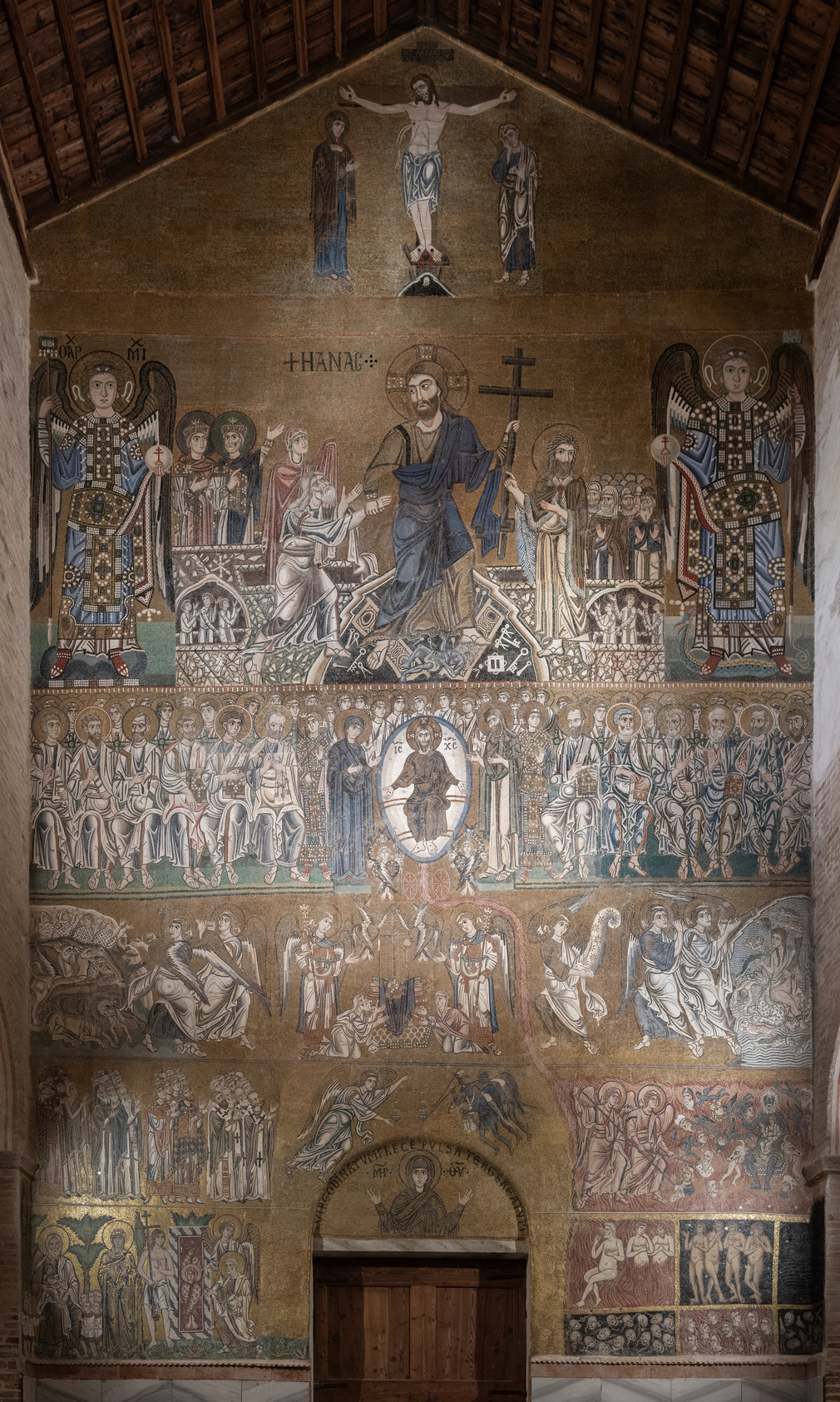
Concept
Perceptions of death and the afterlife held a vital place in the religious and cultural life of medieval society. In the Christian tradition, death was not viewed merely as the end of earthly life, but as a transition to eternity, linked to concepts of the resurrection of the soul, hell, heaven, and the Last Judgment. The impossibility of exploring the afterlife contributed to the creation of its visual representation, which was embodied in art—in paintings, mosaics, sculptures, and illuminated manuscripts.
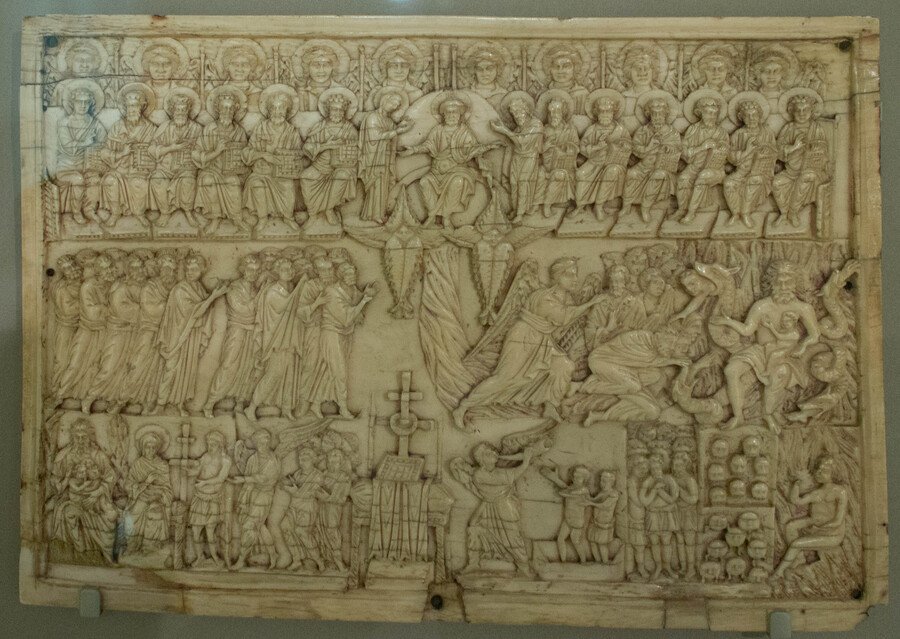
«The Last Judgment.» Byzantine ivory relief. 12th century.
Interest in this topic stems from the opportunity to trace how conceptions of life after death became part of artistic culture and acquired visual forms. Of particular significance is the comparison between Byzantine and Western European artistic traditions, which, despite sharing a common foundation, developed under different historical and cultural conditions. All of this allows us to examine not only the themes common to Christian art but also the particularities of their interpretation across different regions.
Main research question: How were and how did visual representations of the afterlife form and differ in Western European and Byzantine art from the 4th to the 12th centuries?
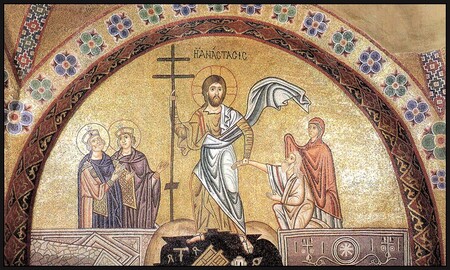
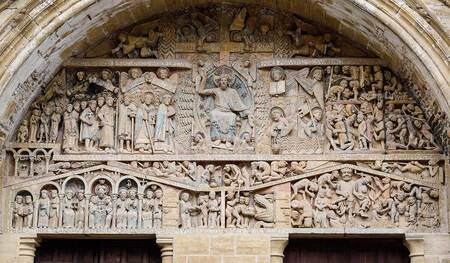
1. Anastasis. Mosaic of the narthex and iconostasis of the Osios-Lukas Monastery, Greece. 11th century. 2. Last Judgment. Tympanum of St. Foy Abbey, Conques, France. Early 12th century.
The objective of this study is to trace the evolution and identify the characteristics of artistic methods used to depict the afterlife in Christian traditions throughout the period under consideration.
To achieve this, I studied the symbolism of death and resurrection in early Christian art, examined the evolution of concepts regarding human afterlife in early medieval art, analyzed Byzantine depictions of hell and heaven, and researched the formation of iconography for the Last Judgment in Romanesque art.
It is assumed that despite the similarities in Christian concepts of the afterlife, Byzantine and Western European art developed different ways of depicting it. These differences were determined by the specific characteristics of artistic traditions, culture, and environment. A comparative analysis of the works will allow us to determine which traditions were common, which developed independently, and how the image of the afterlife changed throughout the 4th–12th centuries.
(1) The Formation of the Visual Image of the Afterlife in Early Christian Art
In early Christian art, the afterlife had not yet gained a detailed visual structure. Concepts of the world after death in the 4th–5th centuries were primarily expressed through biblical scenes of salvation, divine patronage, and symbols of resurrection.It is important to trace how these images articulated attitudes toward death and formed the visual iconography that allowed for the representation of the unseen afterlife.
The Resurrection of Lazarus. 4th Century. Fresco. Rome, Catacombs on Via Latina.
The fresco presents an example of early Christian iconography. Christ is depicted before an aedicular tomb; unlike most representations of this subject, the tomb remains empty. This feature allows us to trace an early stage of iconography that had not yet settled into a unified form. The compositional center is formed not by the image of the resurrected man, but by Christ’s address to the tomb.
Furthermore, the composition demonstrates the link between early Christian iconography and ancient funerary traditions. The image of the aedicule and the presence before the tomb retain a familiar artistic framework but acquire a different religious meaning.
The fresco does not depict the afterlife as a separate space; its content is tied to the transition from death to life.
For the study, the object is important as a visual reflection of the Christian idea of overcoming death. The figure of Christ, turned toward the tomb, connects the narrative to the possibility of the deceased’s resurrection. The imagery conveys the concept of divine power over death.
The image of Orpheus holds a significant place in the formation of early Christian culture. Initially, he was associated with ancient concepts of death and existence after it. According to the myth, in an attempt to bring Eurydice back, Orpheus descended into the underworld, and his music influenced the inhabitants of the dead world, thus associating his figure with the ability to bridge the boundaries between life and death. In early Christian art, this image acquires a new interpretation.
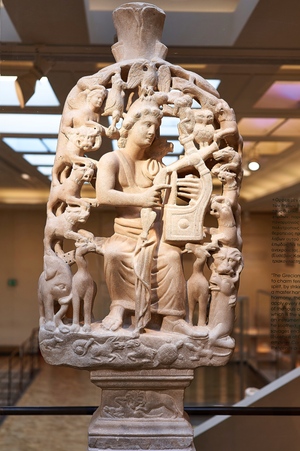
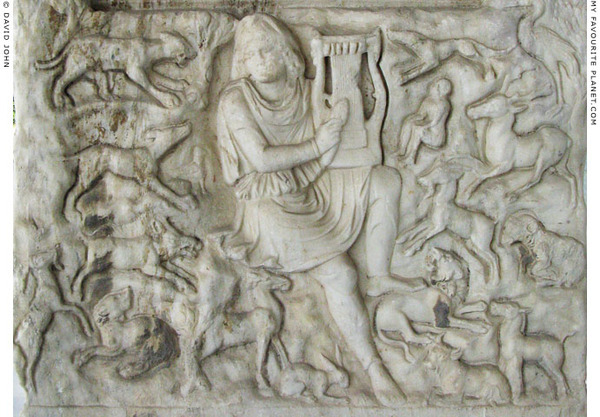
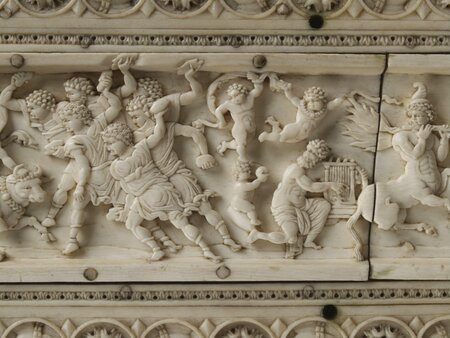
Trapezophore with Orpheus playing the lyre. 5th century. Byzantine Museum, Athens. // Orpheus playing the lyre. 230–240 AD. Sarcophagus. Archaeological Museum, Thessaloniki.
In 5th-century monuments, the image of Orpheus exists within the Byzantine artistic milieu. Its placement on a trapezophoros indicates that the motif was not confined to funerary monuments but remained relevant in a broader artistic context.On a sarcophagus from 230–240, Orpheus is depicted with a lyre, surrounded by animals. Music becomes the central element, uniting the surrounding creatures in a single space. In a funerary context, such a scene could express the hope of overcoming death and attaining peace. The ancient mythological subject does not directly depict the Christian paradise, but it conveys the image of a harmonious world that could be reinterpreted in line with new religious understandings.
It is important to note that in both pieces, the recognizable classical motif is preserved, but its meaning is no longer purely mythological. Early Christian art actively utilized ancient narratives, reinterpreting them in accordance with its worldview. Within the context of beliefs about the afterlife, the image of Orpheus allows us to trace the transition from ancient ideas about entering the realm of the dead to Christian hopes for salvation and eternal life.
Good shepherd. Series V. Mosaic. Mausoleum of Galla Placidia, Ravenna.
The image of the Good Shepherd plays a vital role in shaping the early Christian concept of paradise. In the mosaic of the Mausoleum of Gallus Placidus, Christ is depicted among the sheep against a backdrop of nature; his figure becomes the central focus toward which the animals are turned.Unlike the Resurrection of Lazarus, where the focus is on overcoming death, this image conveys a sense of a peaceful and protected world. The sheep can be interpreted as symbols of the faithful, and the shepherd acts as the archetype of the savior.
The natural environment enhances the depiction of Paradise as a space of harmony. The absence of conflict among the animals and their focus around Christ create an image of a world set against earthly suffering and death. Furthermore, the composition is not a literal depiction of the afterlife; the idea of Paradise is conveyed through the symbolism of pastoralism, tranquility, and divine presence. The image of the Good Shepherd allows one to trace the transition from the idea of overcoming death to the representation of the soul’s blissful state.
In Early Christian art of the 6th–5th centuries, the visual representation of the afterlife developed gradually and lacked a single iconographic form. Concepts of posthumous existence were conveyed through biblical narratives, symbolic imagery, and the reinterpretation of antique motifs.
A primary characteristic of early Christian art is the depiction of the afterlife not through literal imagery, but through symbols expressing hope for salvation and eternal life.
(2) The Development of the Visual Image of the Afterlife in Early Medieval Byzantine and Western European Art
During the 6th–9th centuries, conceptions of the afterlife in Christian art continued to evolve, taking on increasingly complex forms. In the early Christian period, these were conveyed primarily through individual symbols and biblical narratives; in the early Middle Ages, the depiction of the celestial realm and its inhabitants gained greater significance.
During this time, compositions developed that revealed heaven through the image of Christ, angelic forces, and symbolic representations of paradise. A more vivid understanding of hell and a person’s fate after death began to form. The narrative of Christ’s Descent into Hell became particularly important, as it allowed for the depiction not only of the realm of the dead but also of the victory over death.
Christ in the celestial sphere. Mosaic of the apse of the Basilica of San Vitale. Ravenna, 6th century.
The mosaic of the apse of the Basilica of San Vitale in Ravenna, created in the mid-sixth century, serves as a vivid example. Christ is depicted in the center, seated upon a sphere and encircled by angels. To his left is Bishop Ecclesius, presenting a model of the church, and to his right is Saint Vitalis, receiving the crown of martyrdom.
The composition is divided into two zones. Christ is placed on a celestial sphere, while the other figures stand on the surface of the paradise garden. This contrast illustrates the stratification of the heavenly hierarchy. The angels also function as intermediaries, presenting the saints to Christ.
The depiction of the natural surroundings holds significance. Four paradisiacal rivers flow from the rocky surface, and the ground is covered in flowers. These motifs allude to the biblical image of Eden and establish the concept of paradise as a space of harmony.
The paradisiacal idea is expressed not through a single scene of the saved’s dwelling, but through the union of the celestial image of Christ and the symbolic landscape.
Transfiguration. Mosaic of the apse of the Basilica di Sant’Apollinare in Classe. Ravenna, circa 549.