Concept
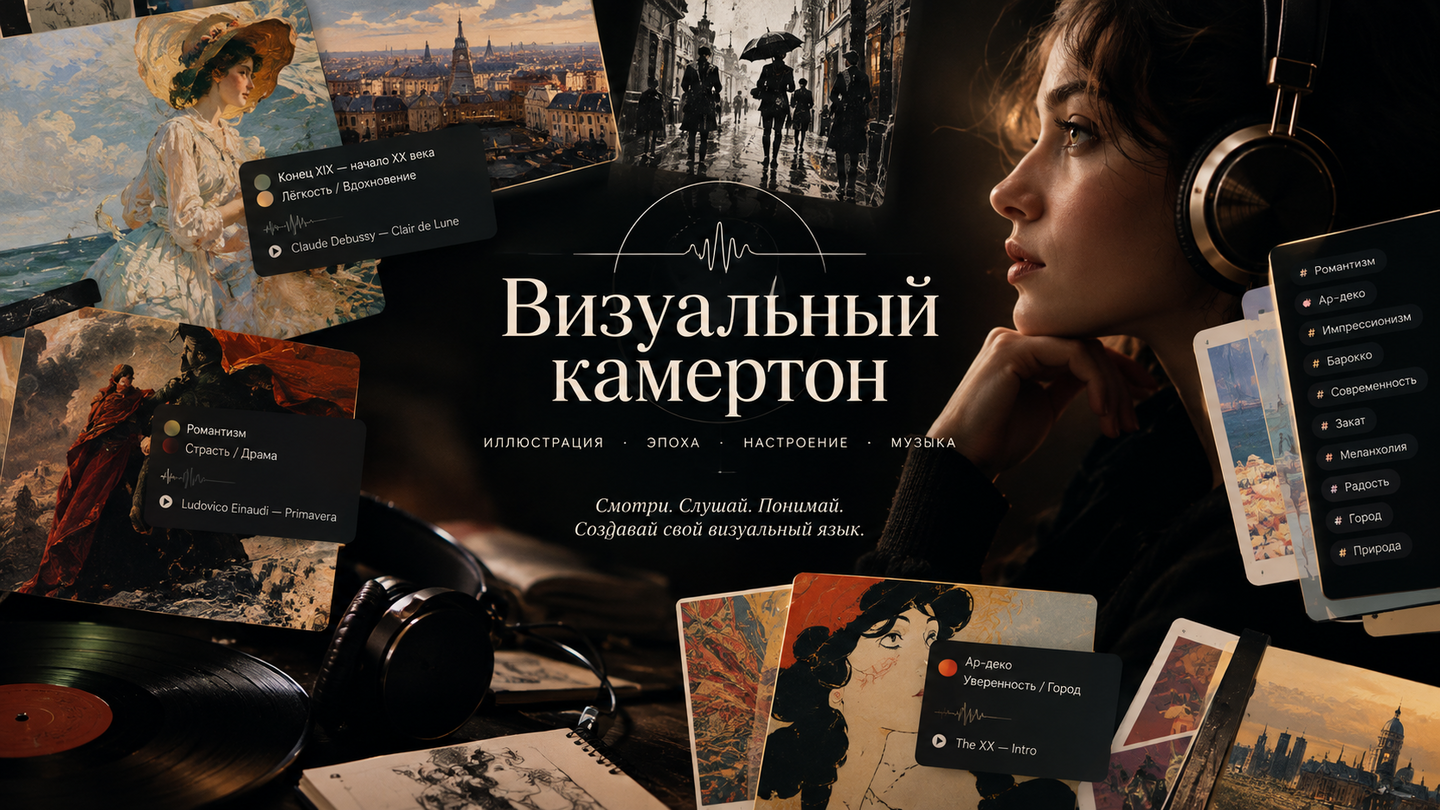
«The Visual Tuning Fork» is the only illustration archive that resonates: every piece is accompanied by a track, establishing a benchmark for understanding the era and the mood. The tuning fork sets the standard tone by which everything else is calibrated—and the media does the same for illustration: it provides a reference point from which the artist calibrates their own vision, hearing, and visual language.
The goal is to make the study of illustration conscious and emotionally engaging, so that a beginning artist can see the connections between eras and moods, understand techniques, and confidently form their own visual language.
Format: A media archive of cards featuring «illustration + curator’s analysis + track + tags, ” complete with regular themed selections and audio releases. It is neither an encyclopedia nor a social network—it is a calibrator for the eye and the ear. The media archive will feature two axes of navigation. The first is the historical period: spanning from engraving and book graphics to contemporary illustration. The second is the emotional mood: silence and contemplation, fairy tale and anxiety, energy and experimentation, hope and lightness, chaos and freedom, and reflection and identity. The intersection of these axes allows users to find works not just „by time, ” but „by state”—the way an artist genuinely seeks references.
Data sources for media
Visual Material (Illustrations)
- Open archives and museums: Wikimedia Commons, The Met Open Access, Rijksmuseum, Library of Congress, Internet Archive, Gallica (BnF), Smithsonian Open Access.2. Specialized illustration collections: The Arthur Rackham Society, Illustrated Gallery, Vintage Children’s Books, poster archives (e.g., Poster House, SSPL).3. Public domain and open-licensed publications (CC0, CC BY).
Music Material (Tracks)
- Free Music Archive, Jamendo, ccMixter — tracks with open licenses.2. Public Domain: classical and antique music recordings available in open archives (Musopen, IMSLP Audio, Internet Archive).3. Licensed libraries (with required attribution)
Contextual and Reference Materials
Museum catalogs and descriptions (metadata: author, year, medium, genre).
Art historical publications and books on the history of illustration.
Encyclopedias and reference guides (for fact-checking).
Personal curatorial notes and analyses.
Data schema separating human and machine processing
The principle of separation: the machine handles routine tasks—parsing, normalization, rough suggestions, validation. The human creates meaning—selection, analysis, and final decisions regarding era, mood, and track.
Guidelines for Automated Services
Rights and Licenses1) Automatically skip submissions that lack a confirmed open license (CC0, CC BY, public domain) or explicit permission. 2) Retain the source and license for every artwork and track; block publication if these details are missing. 3) Do not use images or music without proper attribution.Image Quality1) Minimum resolution for the thumbnail—for example, 1200 px on the longer side. 2) Check for sharpness, absence of watermarks and artifacts; discard duplicates. 3) Preserve both the original and the optimized web version.Metadata1) Autofill must only come from verified sources (museum APIs, catalogs). 2) Normalize fields: artist name, year (range if uncertain), medium, genre. 3) Flag fields that require curator review with a distinct marker.Era and Mood Tags1) Use only the internal media glossary; do not create free-form tags. 2) Machine classification provides a preliminary suggestion—the curator makes the final decision. 3) Do not assign a mood without visual evidence or supporting description.
Track Selection1) Search only in licensed libraries with open licenses. 2) Check duration (e.g., 1–5 minutes) and audio quality. 3) Use mood and era tags as a guide; final approval rests with the curator.Text Content1) Automatically generated texts (descriptions, rough analyses) are not published without human editing. 2) It is forbidden to publish generated text as a curated analysis without review.Privacy and Ethics1) Do not collect users' personal data unless necessary; anonymize metrics. 2) Do not use the works of contemporary authors without permission, even if they are publicly available. 3) Indicate which fields are filled out automatically and which are provided by the curator.Validation and Control1) Every card undergoes an automated check for required fields (artwork, rights, era, mood, track, analysis).2) Problematic cards are added to the queue for manual review.3) Maintain a log of automated actions for auditing.Updates and Maintenance1) Regularly check source and license links; broken links are queued for correction. 2) Update the glossary of moods and the reference guide of periods as media evolves. 3) Record versions of automation rules to ensure changes are transparent.