Concept
At present, the precise time when humans began painting remains undetermined. We also do not fully know their true goals and motivations. However, ancient artists left behind numerous cave paintings, including animals, most often those familiar to their environment. It can be hypothesized that painting served either as a means of entertainment, a desire to convey information to future generations, or as a tool for hunting instruction. An additional point of interest in this process is the evident impulse and desire in Paleolithic cave art to capture the surrounding reality. Artists depicted animals both standing and in the act of hunting or resting, which suggests not only a practical relationship with the world but also an awareness of its dynamism. My hypothesis is that Paleolithic artists intentionally created a sense of movement, utilizing all the tools available to them. This represents one of the first manifestations of visual thinking in the history of art, which subsequently gave rise to human creativity.
The key research question is formulated as follows: how were people with minimal drawing knowledge able to create not just static images, but also imbue them with dynamism?
My research examines some of the most significant cave paintings from famous caves in Europe and Russia, such as Lascaux, Altamira, Chauvet, Pech-Merle, and Kapova. These works are arranged chronologically and by territory to identify shared features and highlight unique distinctions. A crucial element of the study is comparing the techniques used by peoples from Europe and Russia to trace their similarities and differences.
The primary objective of this research is to analyze the artistic techniques by which Paleolithic masters created the illusion of movement in their rock art.
A secondary, yet equally significant goal is to engage the viewer with the unique phenomenon of ancient human drawings.
Through the oral survey I conducted to gather material for the visual research, I learned that only a small number of people are aware of the cultural significance of cave paintings. In my opinion, people do not fully grasp its value or fail to notice its beauty. It is important to me to convey the genius of these ancient artists because, despite the perilous environment surrounding them, they found the drive to observe the world and dedicate time to creative expression. I divided my visual research into sections based on the territorial location of the caves. You can review the sample in the categorization.
Sections
- Concept
- Rock Art of Europe: A Case Study of Chauvet, Pech Merle, Altamira, and Lascaux Caves
- Rock Art from the Kapova Cave in Russia
- Conclusion
Cave Painting of Europe
Chauvet Cave
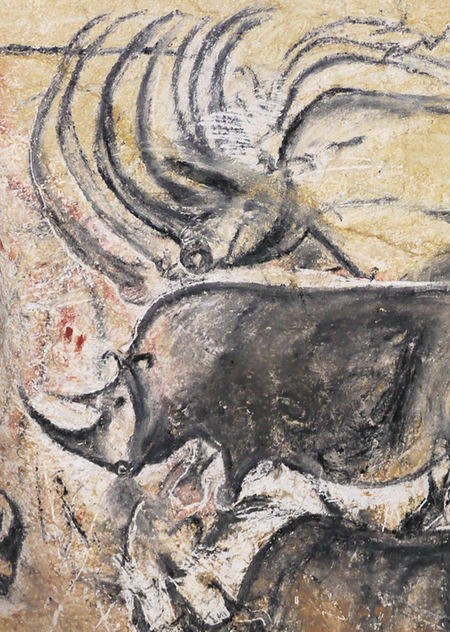
In the Chauvet Cave, the earliest depictions date back to the Aurignacian period, making them some of the oldest on the planet. A distinguishing feature of the cave is the atypical selection of animals: there are numerous drawings that feature not only the animals humans hunted (such as horses) but also creatures that potentially posed a danger to people.
«Lions Panel, ” fragment. Chauvet Cave
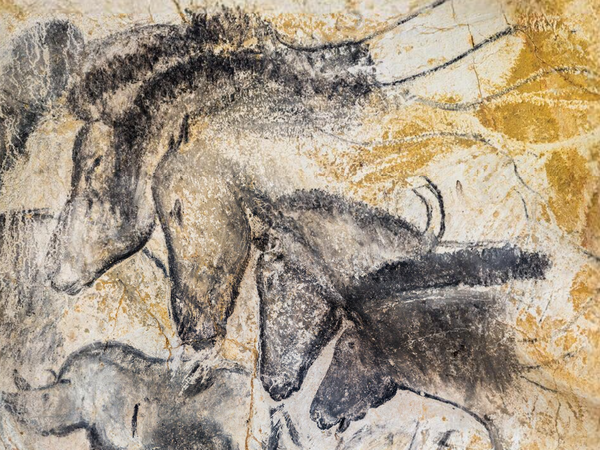
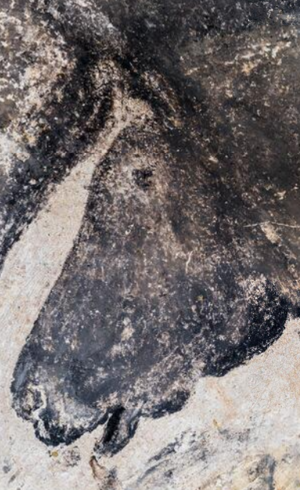
Let’s examine a fragment of the «Horse Panel, ” which depicts animals of the same name. This is one of the most recognizable images of the cave. The foundation of the dynamism here is the diagonal formed by the arrangement of the horses' heads. This diagonal line establishes a vector of movement and guides the viewer’s gaze along the panel, creating the effect of a herd moving in a single direction. The slight overlapping of the contours of the drawings adds naturalism to the movement, creating the sensation that the animals are overtaking each other. Thus, the ancient artist skillfully managed to convey the speed of the herd’s movement. It is worth noting a detail in the provided drawing—one of the horses has its mouth slightly open—which adds realism to both the image and the movement.
«Horse Panel, ” fragment. Chauvet Cave
Next, we will examine the lion panel. The animals are densely grouped, partially overlapping each other, which intensifies the sense of dynamism. The gaze of nearly every lion is focused on a single point, adding tension to the composition and creating the impression of a hunt. It is likely that the ancient person captured a moment of the animals' chase. In particular, the relief of the rock on the panel plays a significant role, adding realistic volume to the figures in the muzzles and bodies of the lions. Under torchlight, the flickering of the fire enhanced the illusion of movement in the static image.
«Panel of Lions, ” fragment. Chauvet Cave
«The Lion Panel, ” fragment. Chauvet Cave
Thus, in the examples provided, the artists used techniques such as multiple contour lines, diagonal and horizontal lines of motion, and the relief of the cave itself to convey volume when representing movement. All of this communicates a sense of swift action.
Pesh-Mardia Cave
In the Pech-Merl Cave, the depictions belong to the Gravettian period. The spotted horses are of particular interest here. The dotted motifs create a rhythm on them. The spotting can be viewed not only as an embellishment to the image but also from the perspective of wanting to enhance the shimmering effect under firelight. The image becomes almost pulsating: the spots function as elements of dynamic texture. Simultaneously, the outline of the horses accentuates volume and the direction of movement.
«Spotted Horses.» Pesh-Mersh Cave
Altamira Cave
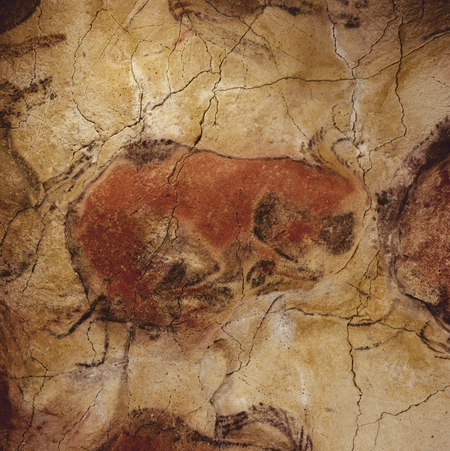
The Altamira Cave houses a vast collection of unique prehistoric murals, created approximately 14,800–13,130 years B.C. The most compelling feature of the cave is the ceiling, which has been dubbed the «Sistine Chapel of the Paleolithic.» This is a truly singular creation, notable for its unusual composition, the postures of the animals, and the color palette.
«Sistine Chapel of the Paleolithic,» fragment. Altamira Cave
The drawings are executed in red and yellow ochre and charcoal. The color is complemented by the uneven relief of the cave itself, which the artists used to give volume to the animals. Moreover, the bison are anatomically close to the real animals of that period, which speaks to how observant the people of that era were.
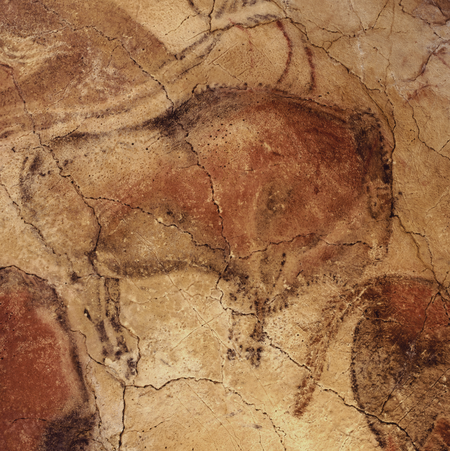
«Sistine Chapel of the Paleolithic,» fragments. Altamira Cave
But what is most noteworthy here is the composition. It is considered, not haphazard. The animals are drawn in different stages of walking, stillness, and rest. The grouping of the bison evokes the feeling of a herd. All these details lend the image dynamism and naturalism.
«Sistine Chapel of the Paleolithic,» fragment. Altamira Cave
In Altamira, there is another drawing that may be interesting for study. This image depicts a boar with several legs that vary in color saturation. Most likely, the ancient person illustrated the animal running in this manner.
Boar. Altamira Cave