Their suffering was already foreseen…
Concept
Pieter Bruegel the Elder (1525–1569) was a 16th-century Dutch painter and draftsman. He was highly sought after, collaborated with a major publishing house, earned the status of a Master of the Saint Luke’s Guild, and later worked on drawings that were subsequently reproduced in engravings by Hieronymus Cock.Art historian Jakob Wisse notes that Bruegel did not merely address traditional subjects but sought to present them in an original manner. His work contains numerous mythological and religious scenes, as well as depictions of various aspects of everyday life. The artist’s keen observation allowed him to integrate many figures and events into a cohesive whole.As one studies Bruegel’s work, a frequent theme will be the complexity and multi-figure nature of his compositions, and the interaction of multiple narrative lines. We will examine how the overall structure of a painting influences the perception of the subject matter, creating a sense of anxiety, threat, or human helplessness.
The expression of fear or the sensation of threat in painting is often conveyed not only through people’s faces, poses, and gestures but also through the image’s composition, color palette, and symbols. Artists manipulate the chaos of movement, level of detail, density or openness of space, or the scale and scope of the narrative.
This study investigates how various visual devices are employed in the paintings of Pieter Bruegel the Elder.In his works, human life is sometimes just a small part of global events, where individual figures can become lost. Despite this, each depicted character carries a personal, fraught life story.The combination of the narrative content and the overall form, details, and composition allows the observer to perceive the threat and terror embedded by the artist.
Navigation
— Concept - Fear of destruction and the supernatural - The threat of violence and death - Human helplessness - Conclusion - Bibliography
This categorization allows one not only to understand the content of specific events but also to more clearly perceive the methods of conveying certain emotions. Furthermore, comparing images within each theme helps trace shared visual techniques and note some differences.
Fear of destruction and the supernatural
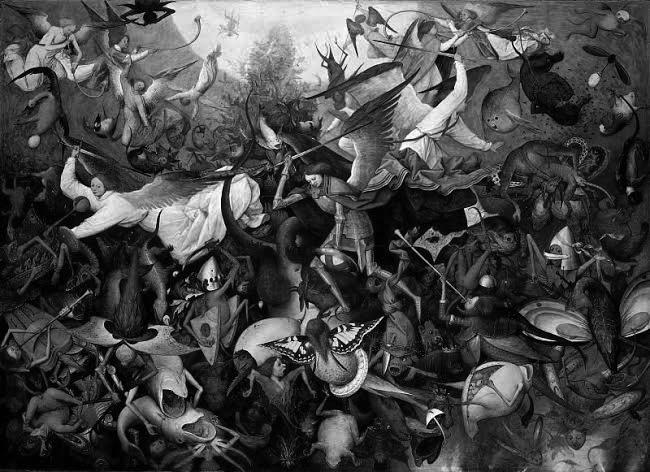
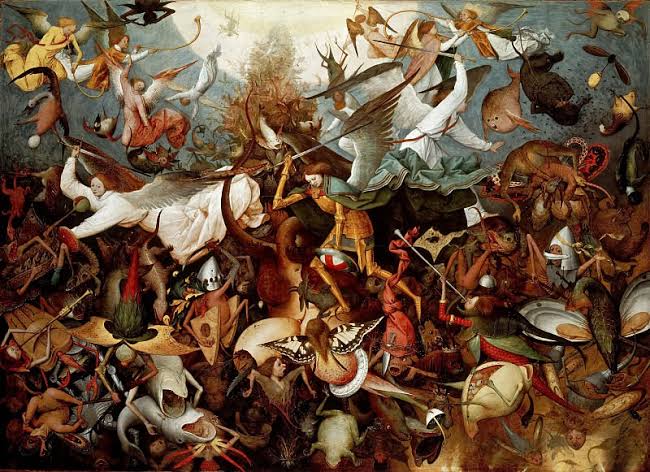
«The Fall of the Rebel Angels, ” 1562. Royal Museums of Fine Arts of Belgium, Brussels.
In this painting, Bruegel references a biblical narrative concerning the conflict between heavenly forces and evil—the expulsion of rebellious angels. The artist captures the moment of confrontation. At the center is an archangel battling a monstrous creature. Around him, rebellious angels fall and transform into demonic beings.
This creates an image of an entire world engulfed by the clash of two opposing forces. The familiar order gives way to chaos and terror.
When examining Bruegel’s works, attention should be paid to the details.In this case, chaos is created by the detailed depiction of fallen angels, who are gradually losing their familiar forms and taking on features of fish, insects, and birds. Some of these creatures are difficult to recognize because they intertwine with other characters. A description of the painting, published by the Royal Museums of Fine Arts, provides a quite accurate characterization, noting a «seemingly inseparable mixture of figures and forms.»Against the backdrop of all this disarray, the archangel stands out noticeably. He wears golden armor, has spread wings, and maintains a relatively calm and legible pose. He is not interrupted by the other depicted objects.
The canvas space is conceptually divided horizontally: the upper section relates to the heavens and is rendered in light, delicate hues, while the lower section is dark and saturated. This color contrast reflects the transition from a serene, divine world to terror and chaos.
However, it is the movement of the figures that amplifies the turmoil. Their limbs merge to form a unified mass that simply collapses downward. Through this dense filling of space, Bruegel depicts evil as a force that disrupts tranquility and creates universal chaos.