CONCEPT
In certain circles, there’s a running joke: «Don’t invite fans of ‘Blagiye Znameniya’ (Good Omens) to potato picking; they dig too deep.» Of course, there’s only a grain of truth to that joke. When I first watched this series back in 2019, I immediately fell in love, and that feeling wouldn’t let go of me for a long time. As a result, I knew every episode frame by frame. Despite this, every time I revisited it after upgrading my knowledge of screenwriting, acting, cinematography, editing, and even English, I always found something new. I value it precisely because, no matter what I do, this story will always be smarter than me.
As an artist, what matters most to me is dissecting the narrative embedded solely within the visual sequence of the work. To this end, I asked: how much was pre-planned in the script, and how much was created by the hands of thousands of professionals working in the production team?
The research hypothesis is that the screenplay is not an autonomous piece of material—it changes far more than once during filming.
I want to note that the first season is the only one for me; no continuations exist in my mind’s world, so I am only analyzing that one. This is due to the countless questionable and highly questionable decisions in every aspect of every episode beyond the first season.
FIRST SCENE
A rather excellent and quite unambiguous book for the script of Good Omens:
TITLE CARD: WARNING: THE CALL OF ARMAGEDDON MAY BE DANGEROUS
TITLE CARD: DO NOT TRY THIS AT HOME
GOD’S OFF-SCREEN VOICE EPISODE
Simple animation. First, we see the Big Bang and SCIENTISTS. The CERN particle accelerator. In the background, we hear the voice of a wise and thoughtful narrator. Could this be the voice of GOD?
GOD (OFF-SCREEN VOICE) Actual theories regarding the origin of the Universe suggest that if it was created, rather than just beginning—so to speak—unofficially, its birthday happened ten to twenty billion years ago. Earth, however, should be about four and a half billion years old. (sound cue) These dates are incorrect.
Now we see ancient scientists working with abacuses, scrolls, and parchment fragments…
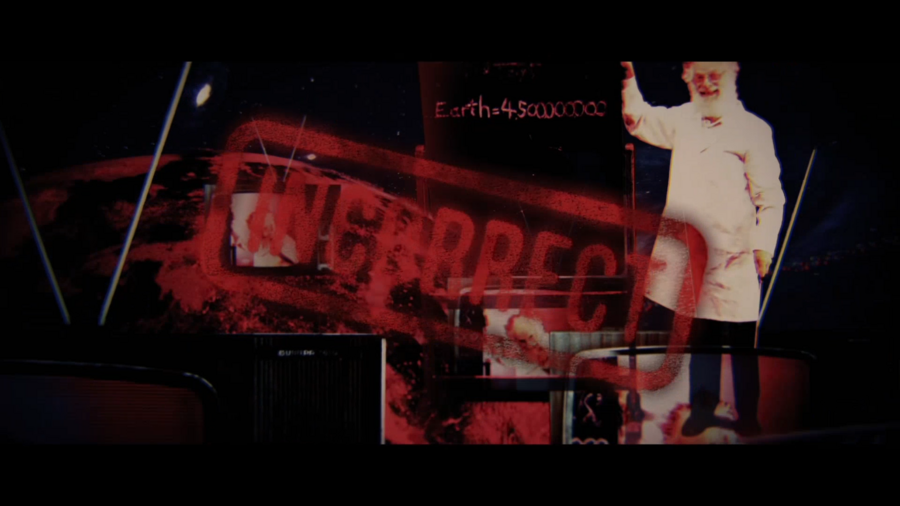
Still from the series [S1E1]
The piece features a narrator, who is God. According to the plot’s concept, the character of God is also the director of the play she presents to us. As a director and creator, she cannot, nor does she wish to, disrupt the internal fourth scene she has created by interacting with her characters. Therefore, she must always remain off-screen. The director and the artists had to decide what the audience would see.
God herself knows that the audience will form an opinion of her and her play based solely on this scene, so it is important for her to be likable to us. Consequently, she creates the introductory video herself. The production team’s task is to convey her character using various visual and cinematic expressive means.
Clip from the series [S1E1]
First and foremost, no religious motifs could be used as the main theme. The primary setting is contemporary life, and God cannot be explained using ordinary modern language. The work features locations from Heaven, Hell, and Planet Earth. However, God is omnipotent, and nothing reflects Her limitless abilities as effectively as the cosmos, which serves as the backdrop for the video.
The first thing we see is an untranslatable play on words. Initially, the word «WAR» (ВОЙНА) appears across the entire screen, which, as it recedes, transforms into «WARNING!» (ВНИМАНИЕ!). Indeed, the plot centers on an impending war. By the way, the pun was not planned in the script. The disclaimer below («Kids! Causing Armageddon can be dangerous. Do not attempt to replicate this at home.») is absurd and sarcastic, just like the horoscope for the final day before the end of the world discussing salad. This is superfluous, sometimes self-evident information that God gives us because She finds it amusing.
Frame from the series [S1E1]
The overall editing feels rather frantic and choppy: there are numerous details, both large and small, which were likely intended to showcase the richness and meticulous development of the God project. Every detail moves—sometimes seeming to hang or stutter. Sound effects are frequently audible, none of which could have been necessary. In other words, it demands our attention.
Ultimately, in those two minutes, we can conclude that God is eccentric; she loves chaos, excitement, stakes, absurdity, and irony. To summarize, this is quite cruel, just like almost every event she orchestrates. Later on, God will undoubtedly offer her audience several opportunities to laugh at the helplessness and despair of the characters she has driven to this point. Perhaps she is aware of her sadism—or perhaps not. What is important is that we grasp this from the very first minutes of the series; the narrative tone is set extremely effectively.
LOCATIONS
A fairly superb and quite unambiguous screenplay book for Blessed Signs:
It’s a grubby office. It’s pretty dark, which is good because we don’t want the beings Crowley is reporting to to be too clearly visible.
Scene from the series [S1E4]
No one said that Hell couldn’t have lava, heat, cauldrons, and irons for torturing sinners. That would make the conditions in bureaucratic departments truly unbearable. But perhaps the set designers and director decided it was too simplistic. Instead, Hell looks like a place that could conceivably exist in reality. All the rooms are cramped, and as if that weren’t enough, they are cluttered with things that will never be needed. And the equipment that is actually required for work is long outdated. In the dimly lit corridors, everything constantly breaks down. This makes being there even more painful because it creates the feeling that everything could be fixed if only Hell had employees with the proper qualifications. Demons do not know how to create comfort or even order, because there is no peace within their souls.
Hell is a dark labyrinth with no exit and no hint of an organized or structured approach, because all the demons lost a part of their sanity after their fall and are no longer able to function in a fully orderly manner.
A pretty excellent and quite unambiguous book on the script of Good Omens:
We are on the top floor of the skyscraper, from which the view overlooks London. Aziraphale’s business meeting is very similar. The décor is better.
Frame from the series [S1E4]
Paradise is empty. We don’t see a single human soul enjoying grace; we don’t even know if they exist anywhere. We hardly see any other angels who aren’t involved in the narrative. Those who are are inactive—they drift aimlessly on hoverboards, chat, or just walk back and forth, neither rushing anywhere nor talking on phones or holding anything. Perhaps they are exhibiting stereotyping, but until then, nobody cares. The angels have nothing to do in a job that is the meaning of their lives.
Furthermore, there is almost nothing in the office itself. Floor after floor is merely a concrete box with tile floors and a rug. It’s funny that they completely abandoned any décor mentioned in the script.
Frame from the series [S1E4]
The only thing that catches the eye is the view from the top-floor window—a sweeping panorama of all the wonders of the world and the most recognizable human constructions all at once. It doesn’t matter that such a view is impossible; what matters is that it remains a soulless corporate image, designed to please everyone, and therefore, remains incapable of eliciting any emotion.
The technologies in Paradise have moved further beyond the human, though they still actually operate on the power of a supernatural currency—the power of miracles. Their devices are beautiful, but useless, unlike the infernal ones.
Paradise is infinite, as is its stagnation. Everyone awaits a war for which each person had to suppress their identity. The space of Paradise is the echo of the first war between angels and rebels, who subsequently became demons. It is a tragedy that everyone keeps silent about, yet within which everyone constantly exists.
A quite excellent and fairly unambiguous scriptbook of Blessings:
His bookstore is chaotic, overflowing, magnificent, and dusty. He sits behind a table laden with books.
Still from the series [S1E2]
The details in the bookstore alone could fill an entire book. Of course, a secondhand bookstore must hold countless volumes, especially since it was allegedly opened back in 1793. But it also serves as Azirafael’s residence. A plaster bust, dozens of vintage pens, postcards, tablecloths, candlesticks, any kind of décor, and any assortment of items—this place could easily be a flea market, and no one would even be surprised.
Frame from the series [S1E2]
Many of these objects carry meaning. For example, Azirafael has a chariot statue on the shelf above his desk. It is inspired by Plato’s dialogue, «Phaedrus, ” where he uses the chariot as an allegory to explain his vision of the human soul. One horse represents rationality, and the other represents impulsiveness. The charioteer is that part of human consciousness responsible for guiding these horses—for stopping them from diverging in different directions. Out of everything a hedonist character could place at eye level on his workspace, he chose this specific figurine.
Frame from the series [S1E2] (winged mugs are on the top shelf)
There are things you can see just by paying close attention. One charming white ceramic mug with angel wings instead of a handle, which we are shown in close-up several times—that’s funny. Four others exactly like it in the background—that’s too much, even if no one directly mentions them. But that is the point. Aziraphale has taken deep root in this place, tangled up with his rather unhealthy hoarding, and there is hardly any force in the world that could evict him.
This book is the result of the work of dozens of people, and it conveys the depth of the character far more powerfully than even the most detailed textual description.
A pretty excellent and quite unequivocal script book for Blessed Signs:
Crowley’s apartment is perfect. It is very white and looks uninhabited. Everything is perfect. The only thing that looks better than perfect are the lush houseplants.
Still from the series [S1E2]
Crowley’s apartment isn’t just unoccupied—it resembles a museum of objects reminding Crowley of some past era rather than a home; everything is too stiffly austere.
Both the rooms and the interior look cold, with the exception of the throne. But even on the throne, where the creature moves with serpentine grace, it’s uncomfortable to sit because of the backrest set at almost 90 degrees. Crowley seems out of place in his own dwelling.
Overall, he never suggested that this place was important to him, so this oppressive atmosphere—which he brought upon himself—doesn’t raise any questions.
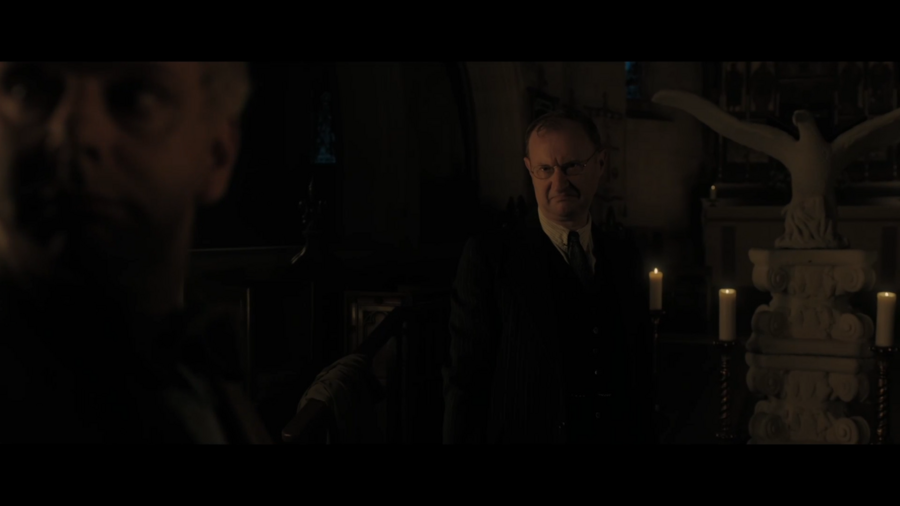
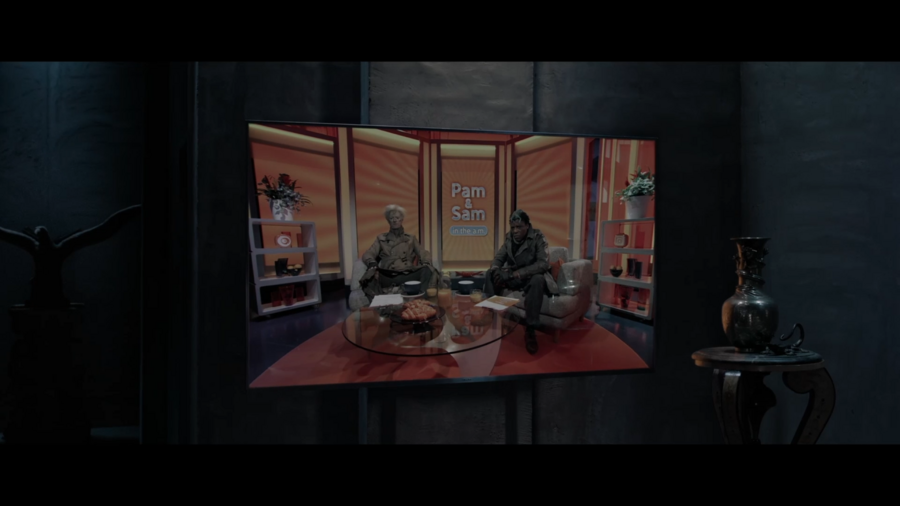
Stills from the series [S1E2 and S1E3]