«People are interested in rumors, scandals, intrigues, and investigations—something that allows them to distract themselves from real life and immerse themselves in a slightly fantastical world where someone else is dealing with the problems.» «We can all encounter bias when searching for information. When a person is looking for the answer to a question, they often already have a preliminary answer in their head, and they begin seeking confirmation for their existing beliefs.» S. Grachev, Media Expert
Terminology
- Fake (English: fake — counterfeit) — anything false, unreliable, falsified, presented as real, genuine, or trustworthy with the intent to mislead.
- Fake photographs — these are images that have been altered using digital processing or created using various software and tools to create an illusion or alter reality. An example of such processing is a «photo-fake» (photo-jab) — a type or genre of creativity, a humorous variant of photo montage, the slang term for the result of creatively reprocessing an image using a graphic editor or neural network by participants of a forum, blog, imageboard, or other resource, resulting in an image that looks funny.
- «Mnemonic — a stimulus for emotional memory, repeated feelings…» In the context of this study, the term «digital mnemonic» denotes an element of the digital environment—a visual image used by the creator as a «hook» that draws attention to a specific fake photograph and leads the viewer to believe in its authenticity.
- «Signature Move» or «Gimmick» («Fishka») — in contemporary youth slang, this term refers to a bright, memorable, distinguishing element that enhances the emotional appeal of a work of art, fashion presentation, etc. In meaning, this term is synonymous with the aforementioned «mnemonic.»
Research Objective: Using examples of the most famous fake photographs from the 19th–20th centuries, this study aims to analyze and identify the common reasons why humans perceive them as credible information. Because all the fake photographs used in this research were obviously executed at the highest possible technical level for their respective time periods, the quality of their execution will not be analyzed or compared.
Relevance of the Study Amidst the rapid technological advancement and increasing accessibility of the internet, the growing number of users necessitates changes in the information sphere, affecting both social and age demographics. Consequently, the ways information is presented online are also changing. A permanent component of online information is «fake news,» which has existed since the formation of the information environment itself, even in oral or printed formats. The internet has not only radically changed the technology used to create these falsehoods but has also amplified both the volume and speed of their dissemination, as well as the breadth of coverage from a single source. Regarding the speed at which fake news spreads online, one of the largest studies conducted on this topic in 2018, using Twitter messages over an 11-year period as an example, established that false messages require six times less time to reach 1,500 people than truthful ones. Experts regularly publish analytical data on the number of fake news items in the Russian segment of the internet. For instance, between January and September 2025, 3,162 unique fake news items were recorded—a 9% increase compared to the same period in 2024 (2,879). A simple calculation based on this data yields an discouraging result: approximately 12 fake news items appear daily on the Russian internet. Experts also note that a significant portion of fake news is disseminated in the form of manipulated photographs, which is the most widely accepted form of presented information. Accurately estimating the annual number of new fake photographs circulating online is impossible due to the lack of a unified tracking system for this type of content. However, even the data presented above illustrates the colossal scale of the issue.
Why People Believe Fake Photographs. «Turns out, people trust fake content more than the truth? Scientific studies and statistics speak to this. It’s because fakes are easier to remember and look more sensational compared to the truth.»
Elina Monakhova, Expert
Research Intern
Center for Neuroeconomics and Cognitive
Research, HSE University
Everyone, to some degree, is prone to consuming and sharing fake information, especially when it is presented in the form of a photograph, which always seems to be the most credible piece of evidence. As far back as 1826, A. S. Pushkin frankly admits in his poem «Confession»:
«… Ah, it is not difficult to deceive me! I am happy to be deceived myself!»
And he is not alone in his gullibility in the modern world.
In 2017, specialists from the University of Warwick conducted a study and found that 40% of people cannot distinguish whether a photo before them is fake or real. Why does this happen? Why do people easily perceive images in fake photographs as real or credible? A photograph always seems to us like «objective proof, ” but it is often subjective. Consumers of information are simply reacting to the trick embedded in a specific fake photograph. Why does this happen? Why do people easily perceive images in fake photographs as real or credible? A photograph always seems to us like „objective proof, ” but it is often subjective. Consumers of information are simply reacting to the trick embedded in a specific fake photograph. Furthermore, this trick can be shaped not only by the narrative and the image „captured“ in the photograph but also by the facts surrounding its appearance in the information space and the opinions of „authoritative“ experts. An analysis of available scientific literature dedicated to researching the reasons for perceiving fake photographs as credible allows us to formulate the most significant among them.
- Emotional Impact: Any photograph—especially those featuring children or shocking disaster footage—that evokes emotion, whether anger or joy, triggers an immediate reaction. The more extraordinary the fabrication embedded in the photo, the stronger the emotional response it provokes. Emotions, in turn, can suppress critical thinking.
2. Visual Certainty: A photo of a face, location, or scene affects the information consumer more powerfully than text. It forms an instant image and automatically constructs the viewer’s own hypothetical backstory and/or subsequent narrative for what is captured in the shot. Consequently, fake news embedded in the photograph is perceived as «authentic» because it aligns with the user’s existing vision or preconceptions.
3. Social Validation and Source Authority: When assessing the authenticity or fabrication of a photo, any information consumer unconsciously focuses on two main factors: the number of shares and likes on that specific photo—that is, the social validation of its veracity. The higher the count, the stronger the conviction that the photograph has been repeatedly verified and is true.
4. Source Authority: The presence of the photograph itself and the opinions of experts who have responded to it.
5. Lack of Subject Matter Expertise: The imagery and storylines of fake photographs can relate to various fields of science and human activity. Often, information consumers are either incompetent or insufficiently knowledgeable in these areas—the authority of the photo’s source and the opinions of experts are enough for them to deem a fake photo «credible.» It is also important to note that even if the sources or experts are not authoritative in a specific field upon closer examination, if their names are widely known within the information landscape, the mass consumer will rely on their opinion.
- Cognitive laziness is the brain’s instinctive drive to minimize mental effort by choosing the easiest and quickest route instead of thoroughly analyzing a visual image or solving a complex problem through brainstorming. This is not physical laziness—it is a natural characteristic of human thought. Consequently, it is naturally easier to rely on templates, stereotypes, the opinions of authorities and experts, and/or one’s own past experience, thus avoiding intellectual strain. In the context of fake photography, it is simpler to react emotionally—by liking or reposting like everyone else—than to dig for the truth.
- Technical ignorance, and unfortunately, the insufficient level of technical knowledge and practical skills required to recognize fake photographs, leaves the majority of consumers in the information sphere defenseless against their attacks.
Conclusions. It appears that all the reasons mentioned above are rooted in human nature—the associative nature of thought and sensory/emotional perception, which are based on life experience, cherished desires, and dreams. «A fake gains power through belief in it!» The source of belief in the authenticity of a fake photograph is the trick embedded within it. By creating a fake photograph, its author unconsciously or intentionally forms a hook that incorporates all the aforementioned «whys.» How brilliantly and successfully this hook is created determines the longevity of the fake photograph as something «authentic» and its reach within the sphere of information. Or, a lack of practical skills.
2. FAMOUS 19TH-CENTURY FAKE PHOTOGRAPHS AND THEIR TRICKS
«Man Juggling His Head» (1880), by an unknown artist
Based on the conclusions drawn, the following famous photo fakes from the 19th–20th centuries were analyzed to identify the components of the trick that contributed to their success. It should be noted that various photo gags and the first «photo memes”—which are very popular on the modern internet—emerged as early as the mid-19th century. However, the intent behind their creation was not the conscious deception of consumers regarding this visual information. Most of them were created altruistically for a small circle of friends and acquaintances purely for fun, often by amateur photographers. The provided copy of a „photo meme“ from the Metropolitan Museum collection
«The Great Moon Hoax»
Creator: Richard Adams Locke, a journalist and newspaper editor, although he never publicly claimed it, his close friend and biographer William Griggs insisted on this authorship in 1852.
Source of dissemination: the American newspaper «New York Sun».
Date introduced to public sphere: August 25–31, 1835
Creation technique: Photo engravings presented as photographs taken with a telescope.
Summary: A series of articles titled «Great Astronomical Discoveries Made Recently by Sir John Herschel and Other Scholars at the Cape of Good Hope.» The published photographs, purportedly taken through a telescope, illustrated accounts of bat-men (Vespertilio-homo—winged humanoids), unicorns, and other fantastic creatures inhabiting the Moon.
Purpose of creation and launch: To increase the circulation of a newspaper only two years old—this was achieved; by 1936, the newspaper’s circulation reached 20,000 copies, making it the largest newspaper; and to ridicule scientific and religious figures who made grandiose, unsubstantiated claims about the Solar System and presented them as fact.
Exposure: Several weeks later, John Herschel’s story reached Europe and Sir John Herschel himself, who refuted all the claims. It turned out that the journal «Edinburgh Journal of Science» did not even feature a person named Andrew Grant. Nevertheless, the «New York Sun» never published the rebuttal.
Feature Elements:
1. The high authority of print media in the 19th century; for instance, the New York Times deemed the published information «plausible and possible»;
2. The authority of a renowned scientist—astronomer, chemist, and mathematician—who also studied botany and photography: Sir John Frederick William Herschel, who was verifiably in South Africa at that time; the fact-based anchoring of the setting; the narrative told from the perspective of a satellite—a chronicler, secretary, or friend (a widely used literary device by Conan Doyle, Jules Verne, and others)—in this case, the fictitious scientist Dr. Andrew Grant, Herschel’s assistant;
3. A detailed technical description of the fictional telescope—a giant reflector with a 24-foot (approx. 7.3 m) objective and a «hydro-oxygen microscope» capable of 42,000x magnification; the abundance of pseudo-scientific terminology combined with a cohesive system of credible evidence and the logical flow of its presentation;
4. A detailed depiction of lunar landscapes: oceans, rivers, volcanoes, forests, palm trees, and temples built by human-bat-like figures, alongside flora and fauna, many of which resembled Earth species.
- the exploitation of human hope for the existence of kindred beings in space—preferentially non-humanoid forms—stimulated by numerous astronomical discoveries and reports of the proximity of discovering life on other planets in the early 19th century, coupled with incompetence in both astronomical science and its technical/experimental provision;
6. a report in the final article of the series concerning the cessation of observations following the destruction of a telescope, which was caused by sunlight igniting the observatory building through the objective lens—the reason was naturally simple, yet brilliantly conceived.
Spiritual Photography 1872
Spiritual photography is a distinct genre of «fake photographs» from the latter half of the 19th century, characterized by the alleged photographic capture of spirits or deceased individuals. The pioneer of this genre, who first purposefully utilized fake photographs for commercial gain, was the American professional photographer and former engraver William H. Mumler (1832–1884). Below is presented one of his most famous photographs in this genre—a portrait of Mary Todd Lincoln with the ghost of her husband, Abraham Lincoln.
Portrait of Mary Todd Lincoln with the ghost of her husband, Abraham Lincoln Creator: William H. Mumler Source of distribution: Private commission at William H. Mumler’s photography studio in Boston Date of release into the public sphere: February 1872
Technique: double exposure / layering two images onto each other in a single frame, creating the effect that both images were captured simultaneously.Synopsis: This photo portrait of Mary Todd Lincoln captures her spirit alongside that of her deceased husband, Abraham Lincoln—the 16th President of the United States, who preserved the unity of the U.S. during the Civil War and achieved the abolition of slavery.Goals: to generate commercial profit; to expand the client base of photography studios in New York and Boston; and to increase sales of photographs as items of devotion and visual curiosities both inside and outside the spiritualist movement.
Exposure: Parapsychology researcher Joe Nickel stated, «Mammer was exposed as a fraud when people realized that some of the allegedly deceased spirits were still among the living, ” yet, by a court ruling at the end of April 1869, the photographer accused of fraud was acquitted. Feature components: Exploitation of the desire of many believers who had lost loved ones during the American Civil War, and the need to establish some connection with them; exploitation of the public’s intense interest in séances during the latter half of the nineteenth century—the belief that a photograph could capture the soul of a deceased loved one, which, unlike a séance, allowed for unlimited visual communion with it; and the high authority of Abraham Lincoln, the 16th U.S. President, whose name, in other photographs featuring popular figures in the U.S. at the time, such as the famous medium Master Herrord, lent additional credibility to the „ghost photographer“ William H. Mammer.
3. FAMOUS FAKE PHOTOGRAPHS OF THE 20TH CENTURY AND THEIR TRICKS
Photography historians divide the evolution of photo-faking technology in the 20th century into two stages:
pre-digital montage—forgery was labor-intensive and often required physical manipulation of photographic material, involving various adjustments to film and chemicals;
montage using digital editors—since the first generation of Adobe Photoshop was released in 1988, the world has changed for the worse because fabricating photographic documents has become significantly easier.
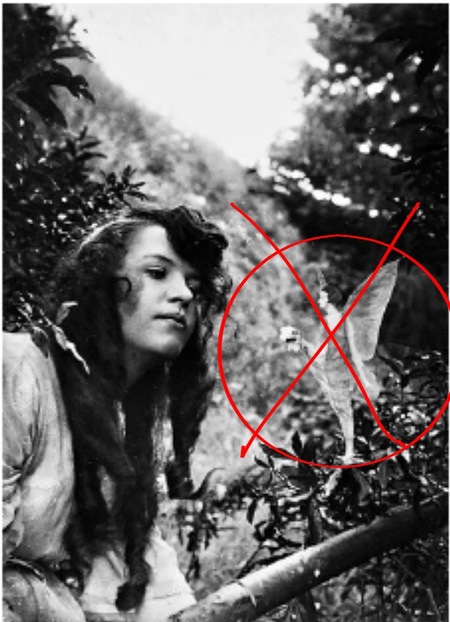
«Fairies of Cottingley» (1917)
The Foxie Fake—a survivor of over 60 years—"Fairy of Cottingley» is one of the most famous hoaxes of the 20th century.