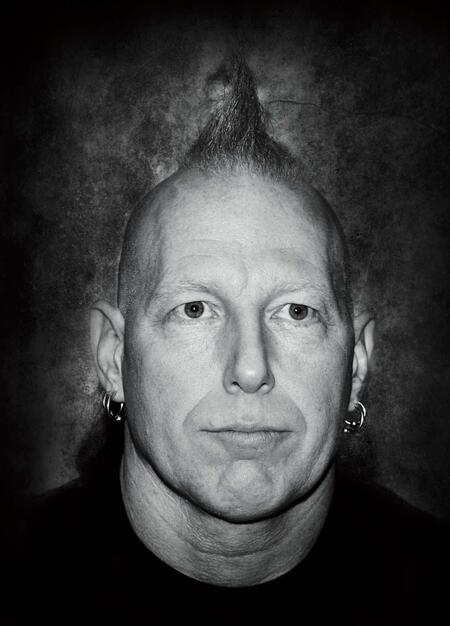
American drummer Mike Terrana has played in numerous rock, hard rock, and heavy metal bands since the late 1970s. He has lived in Europe since 1997. In addition to touring and studio work, Terrana conducts master classes—and he has come to Moscow three times for them. During one of those trips, he met with a correspondent from Back Beat magazine.

At drumming showcases like last night’s, drummers try to show the audience and their peers everything they are capable of, performing incredibly complex pieces that are hard to envision within a specific musical context. Will there ever be music that incorporates the achievements of those pushing drumming toward unexplored horizons?
On one hand, all these shows give people—especially young drummers—a distorted view of playing the drums. But that’s not what the same musicians do in the bands they work with. In those settings, the drummer in the background is playing what they are supposed to play. I still have my roots in rock and metal. I am not a drumming gymnast. Of course, I allow myself to do more at these showcases than I would in a studio or at a concert. And if I played with bands the way I do at drumming shows, I would simply be kicked out (laughs). In that sense, young people receive completely the wrong message. However, on the other hand, these shows inspire kids: it looks amazing, it’s interesting… So, it’s a «double-edged sword.» But, of course, young people don’t understand that. They see drumming stars at drum clinics and showcases: «Wow! I want to do that too!» A young man approached me in Italy and said that his dream was to teach drum masterclasses all over the world and get paid for it. When I was his age, I dreamed of being in a band… No, I understand that making albums today is a very questionable business venture. But it still seems rather strange.
What does the current state of the drumming world look like to you? How is it different from what happened thirty years ago?
Today’s drummers don’t have the opportunities that I had at their age. Back then, there were so many places where you could play. Even those who weren’t great musicians could still do it! And even earn some money for playing! You could learn from senior colleagues by watching them perform. Today, there are nowhere to play. In America, the legal drinking age was raised to 21, which drastically reduced the number of young people in clubs. Since any music can be downloaded from the internet, record labels aren’t giving young talent money to record albums—or to tour! It seems that young people study, try hard, and achieve great things, but there are no opportunities for self-realization. In my opinion, the road ahead for young people today is extremely difficult. Of course, I also dreamed of making drumming my profession. But even then, in the late seventies, I understood how difficult it was—paying the bills and filling the fridge by tapping a stick on various objects! Yesterday, I used the term «old school» from the stage… That is something that cannot be replaced by anything; you can’t fake it here (playing a simple beat on your knees). This is real! I don’t think you can gain this experience by playing drumming clinics. You only gain it by living a touring life, playing with different bands.
Mike, you told me about your recent trip to America and how you felt like an outsider in your own country. Does that mean you’ve partly become European?
It’s fascinating to see your homeland through the eyes of someone who hasn’t lived there for many years. People in America are overloaded with media information—the internet, television, newspapers, video games… Europe moves a bit slower, which is good. Europe is a very old continent; America is only a little over two hundred years old. It is still growing and experiencing its «growing pains»…
I’m glad I left there. In the sense that it gives me the opportunity to look at everything from the outside and see the difference. Don’t get me wrong. It’s a wonderful place to live, with amazing people and many incredible musicians… But I believe that in Europe, people have retained a good kind of hunger for musical experiments and the art of drumming, among other things.
You must be busy.
Yes, I’m always busy. There is so much in the world of drumming! I want to learn jazz. I’m a terrible jazz drummer and I’m constantly practicing things I don’t know how to do.
Do you listen to Elvin Jones?
I don’t play like Elvin, but I love listening to him. Otherwise, I prefer swing music. I listen to Sonny Payne, Buddy Rich, Lou Bellson. Or musicians who have absolutely nothing to do with the style I play or what made me famous. I love Latin American music, bossa nova. I often listen to music with no drums at all. I understand this is terrible for a drumming magazine. But it’s true.
I think that’s actually great for a drumming magazine. You know how sometimes drummers become obsessed with their own instrument. Maybe Mike Terrana’s perspective could broaden their horizons?
Well, yeah (laughs). Drums are a very loud instrument, very… I would say, dominant. And with drums, you can cause a lot of harm. You can hurt people, drive them crazy in the most negative sense. I believe that the drums perform a crucial function in an ensemble—generating rhythm. They create the structure onto which all the other beauties of music are layered—melody, harmony… And we must understand that. You can’t play a melody on the drums, but they can be musical in some primitive way.
I view the drums as a very primitive instrument. They don’t even require electricity (laughs)! It’s very easy to do what you already know how to do. It’s much harder and more interesting to engage in things you haven’t done before. It’s tough, but after an hour of that kind of work, you see a result and feel a sense of satisfaction. I don’t focus on sixteen notes across two kick drums—that’s boring; I’m not interested in blast beats. I’m much more interested in using double bass pedals in some kind of «broken» combinations. What Thomas Lang does with all his pedals is quite fascinating. And Terry Bozzio. I want to advance in that direction too; a lot of interesting rhythms are created there—polyrhythms. And I think all of that can be used if you are smart enough.
Mike, do you always follow your musical instincts? I’m talking about solos.
Only when I have nothing else to say. It’s better not to play a solo in those situations at all. But we don’t get to choose. I am trying to express myself. I think a drum solo should, precisely, reflect the musician’s personality. Of course, there are certain things I want to play. But I try to «frame» them appropriately to build a story that the audience can perceive and feel something from. To feel power, sometimes even aggression… At times I retreat «into the shadows.» Perhaps it’s because of all that that people enjoy my playing. I can’t know for sure. There are plenty of drummers out there who play better than me, and I don’t always understand why I am still successful. Live music, as an art form, has its own laws. The interest in live performance remains constant. There is a magic here. And the internet cannot recreate it. When it can—we will be in big trouble.