Verism in Late Republican Roman Portraiture: Age as an Image of Authority
1. Research Concept
Topic Selection.
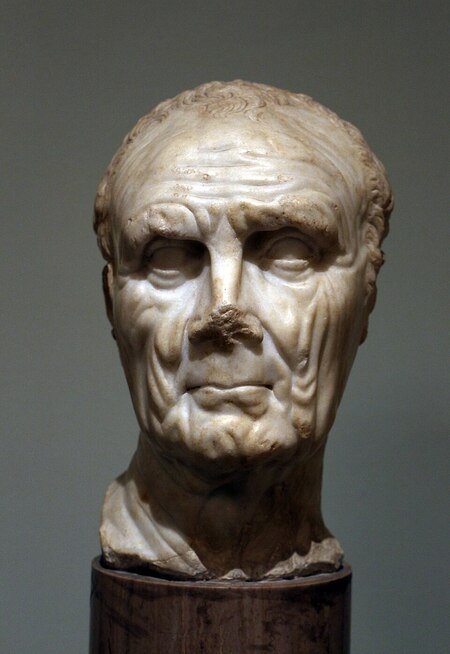
The face of the old man in Ozimo’s portrait is covered in deep wrinkles. They are not hidden or smoothed away—the sculptor makes them the central event of the surface. On the statue of the so-called general from Tivoli, the aged face is joined with a nude, powerful body. These two decisions raise a question: why do representative images of people retain signs of age, while their bodies are given an idealized form? This visible disparity, rather than the assumption that Roman sculpture always accurately portrays appearance, serves as the starting point for the research.
This paper examines verism in portraiture of the late Roman Republic. Here, verism refers to an artistic style in which the pronounced rendering of facial age characteristics contributes to the creation of a representative image. This working definition pertains to a specific historical tradition; it does not categorize every wrinkle on any ancient sculpture as a sign of verism. To understand the style, one must relate the facial structure to the dating and character of the monument [10].
Research Question
How does an aged face become part of an image of authority, and why might it be paired with an idealized body?
Hypothesis
It is hypothesized that in the late-republican representative portrait, the aged face and the idealized body amplify different facets of a single image. The face distinguishes a mature, recognizable individual, while the body elevates him beyond the mundane. If this is true, the statue’s primary expressive power arises in the transition from one to the other. The visual series investigates how this transition is structured and what information about the monument connects it to authority.
Material Selection
The foundation consists of two marble monuments from Italy: the head of an old man from Ozimo, dated to around the mid-1st century BCE, and the statue of a military leader from Tivoli, which J. Tanner dates to 75–50 BCE. The third object is the so-called pseudo-athlete from Delos, dating from the late 2nd to early 1st century BCE, according to T. Stevenson. It is included as a synchronous comparison from the Eastern Mediterranean. Its identity and status are unestablished; the hypothesis of an Italian merchant is not accepted as a proven fact. This small selection allows for a detailed examination of each monument, both in its entirety and in detail [2, p. 27; 7, Table III.1; 9, p. 50, Fig. 2].
Visual Sequence
The first section is dedicated to the face of the old man from Ozymandias—front view, profile, and close-up fragments. It establishes features that are later examined on the statue from Tivoli. The second section considers the face in relation to the body, drapery, and armor at the support. The third section compares this solution to the pseudo-athlete. Finally, the images are paired again so that the answer is based on visible differences, rather than solely on a retelling of the literature. The order is thematic; it does not depict the evolution of one monument into another.
Sources and Methodology
Museum and state catalogs are used to establish the dating, material, and provenance of an object; scholarly publications are used to verify terminology and historical context. Photographs serve as observational material, but their captions do not replace museum attributions. The analysis sequentially distinguishes three levels: what is visible in the photograph, what is reported in the source, and what interpretation is offered in the research. A person’s name, title, exact age, and moral qualities cannot be derived from facial features.
The core premise of this research is that the veristic face should be considered a chosen mode of human representation. A portrait can simultaneously convey age and elevate the subject. Therefore, the most convincing monument for this study is the general from Tivoli: the distinction between face and body is inherent in the statue itself, rather than being created by juxtaposing objects separated by centuries.
2. Characteristics and Scope of Work
Chronology
Late Republican period: late 2nd century to mid-1st century BCE within the selected series. For the general from Tivoli, the dating of 75–50 BCE is adopted based on J. Tanner’s publication; for Osimo—around the middle of the 1st century BCE according to the museum edition; and for Delos—late 2nd to early 1st century BCE according to T. Stevenson. Approximate dates do not equate to precise years. All three monuments predate the conventional boundary of the establishment of the Principate—27 BCE [2, p. 27; 7, Table III.1; 9, p. 50, ill. 2].
Geography.
Italy—Ozimo (ancient Auxim) and Tivoli (ancient Tibur); the comparative material features the island of Delos in the Aegean Sea. This pertains to the geography of the monuments' origins and cultural context. Modern locations of preservation in Rome or Athens are noted separately. This work does not extend Italian material to encompass the entire Roman state.
Subject Matter and Focus.
The object is late republican portrait sculpture, with synchronized comparative material from Delos. The focus is the emphasized age modeling of the face and its relationship to other elements of representational imagery.
Objective.
To demonstrate, using specific imagery, how facial age characteristics contribute to the creation of an authoritative persona and why they cannot be automatically equated with a precise human reproduction.Objectives.
Clarify the meaning of the term; identify visible features of an aging face; correlate the face and body in a full statue; verify the reproducibility of such a combination using a synchronous example; and separate observable characteristics from assumptions about the client and the viewer.2.1. Group of Monuments
Portrait of an Old Man from Ozimo. Circa mid-1st century BCE; marble; Ozimo City Museum. State card: 1100064384. It sets the initial model for studying aged faces.
Warlord from Tivoli. 75–50 BCE according to J. Tanner; marble; National Roman Museum, Palazzo Massimo, inv. 106513. The entire figure explores the combination of a portrait head, a powerful physique, and military attributes.
Pseudo-athlete from Delos. Late II—early I century BCE according to T. Stevenson; marble; National Archaeological Museum of Athens, Inv. 1828. It is needed for synchronous comparison; the identity of the depicted individual remains unknown.
The names of the authors of all three sculptures are unestablished. The titles «old man, ” „general, ” and „pseudo-athlete“ are not preserved ancient names of the depicted figures. The title „pseudo-athlete“ describes the characteristic combination of a portrait head and an athletic body; it does not prove that the person practiced sports [9, p. 50, fig. 2; 3].
2.2. What is Not Included in the Evidentiary Series
This section does not examine imperial portraits of Vespasian, Philip the Arab, and Constantine, Fayum painting, or Augustan monuments. The potential to encounter similar techniques later does not make these works evidence of the Late Republic. Later copies of Republican types are also excluded: in that case, one would need to separately discuss the time of the type’s creation, the time of the exemplar’s production, and the changes during copying. The chosen series explores a more focused objective for which this expansion is unnecessary.
2.3. Selection Amidst Other Republican Portraits
While reviewing the collection, we considered Pompey’s portrait from the New Glyptothek in Karlsruhe, inventory 733. His type is associated with the Late Republic, but the surviving marble head is a copy from the beginning of the 1st century CE according to F. Johansen’s catalog. The combination of individual features and a hairstyle reminiscent of Alexander would have made it useful for a separate topic on political imagery. Here, it gave way to Tivoli: an entire statue allows for a comparison of head and body, and the question of the late transmission of the republican type does not overshadow the main analysis [4].
The second candidate was the so-called Capitoline Brutus, inv. MC1183. The main museum card dates it to the 4th–3rd centuries BCE; another museum record notes later dating possibilities, extending up to the Augustan period. Attributing the portrait to the first consul lacks reliable evidence. For a small synchronous series, such uncertainty is too significant—the monument would require an independent attribution study. The choice of Ozimo and Tivoli maintains focus on the aged face and the head-to-body ratio [5; 6].
3. What is Verism? 3\.1. A Face That Emphasizes Age
Verism is a contemporary art-historical term describing a particular style of portraiture. Here, it is applied to late republican material: the face highlights age-related changes, asymmetry, hollowed cheeks, under-eye bags, or skin creases. J. Tanner notes the range of this style—from sharply modeled faces to the softer rendering seen in the general from Tivoli. Therefore, it is easier to recognize verism based on the overall organization of the face rather than by the mandatory presence of wrinkles or baldness [7, p. 19].It is easier to see the difference between these terms on Ozimo. The unique shape of the mouth and cheeks individualizes the face; a compelling alternation of protrusions and depressions creates corporeality. Veristic character arises where the signs of lived age become the primary plastic content of the portrait. In the statue from Tivoli, this method of representing the head is combined with another structure of the body. It is this combination—not the degree of external resemblance—that can be verified through surviving artifacts.
3.2. Portraiture in the Political Life of the Late Republic
For the Roman elite, the visible memory of ancestors was a public resource. Polybius describes how at the funerals of a noble person, participants in the procession wore depictions of ancestors adorned with the insignia of their attained offices. This served as a reminder of their merits, turning the family history toward those present. In such a ritual, a recognizable figure was connected to the name, actions, and status of the lineage. Polybius wrote in the 2nd century BCE: his testimony provides an earlier context, rather than a description of the funerals of Sulla or Pompey [1, VI.53–54].In the generations of Sulla, Pompey, and Caesar, the struggle for honor extended to imagery. Tanner presents a telling episode: after Pompey’s defeat, his statues and Sulla’s statues were removed from Rome, but Caesar ordered them returned to their original positions. A statue participated in the recognition or contestation of a person’s authority. Therefore, the Republican portrait should be considered alongside public honors and political relations [7, p. 28, note 45].
The age of the subject could be persuasive in this context as the image of an established figure. However, the portraits of different leaders varied in expressiveness. Pollini, for instance, views Pompey as a softer iteration of verism, considering his hairstyle and facial modeling. This heterogeneity is crucial to the present series: the late Republic does not offer a single mask of a stern old man for every influential person [8, pp. 259–260].
3.3. Imagines maiorum: Ancestral Faces and Memory
The Latin expression *imagines maiorum* means «images of the ancestors»; in this context, it primarily refers to the wax masks of Roman nobility. According to Pollini, this tradition represents a convergence of domestic sanctuaries, public ritual, and family memory. The faces of ancestors demonstrated lineage continuity and provided younger generations with models to emulate. This practice helped transform the family’s past achievements into an active social argument [8, pp. 238–240].
The term «verism» has its own historiography. In 1955, G. Richter discussed the possible origins of the Republican style, defining it through the emphasized depiction of wrinkles and physical characteristics. Pollini later returned to the connection between verism and depictions of ancestors, distinguishing between contemporary and posthumous wax masks. These studies raise different questions about the same material. In this work, imagines explore the culture’s focus on the ancestral face; the link between a specific marble head and a wax mask requires independent proof [11, p. 39; 8, pp. 237–240, 253–256].
3.4. Why the Face and Body May Appear Differently
In statues featuring heroic nudity, a strong body conveys the figure’s dignity through a stable artistic archetype. The aged head, conversely, retains individual character. Tanner examines this combination in the context of patronage and honors; T. Stevenson challenges explanations that reduce such phenomena solely to a conflict between Roman values and Greek artistic language. For the chosen series, it is more productive to examine how the two parts work together rather than preemptively declaring them contradictory [7, pp. 41–42; 9, pp. 45–46].
4. Ozimo: How the Aged Face is Organized
4.1. First—the Whole Head
The first monument poses the initial research question (Figure 1). In the frontal view, the gaze settles on several horizontal lines on the forehead, depressions near the inner corners of the eyes, and deep folds along the sides of the mouth. The face does not appear uniformly tense across all areas: smooth bulges alternate with sharp indentations. Consequently, this aged characteristic becomes not a discrete detail, but a method for organizing the entire face.Fig. 1. Author unknown. Portrait of an old man from Ozimo: front view and profile. Circa mid-1st century BCE. Marble. Ozimo City Museum. Photo: Sailko, CC BY 3.0; cropping and assembly.
The head of Ozymandias is dated to around the middle of the 1st century BCE. The photo title on Wikimedia contains «20–1 a.c.» and indicates an August timeframe, but the study adopts the interval 59–40 BCE based on the monument’s official catalog; the museum publication provides a close rounded date [2, p. 27; 3].
The identity of the person depicted in the portrait is unknown. Therefore, attention is focused on the choice of sculptor: the face is shown with deep age lines, and its recognizability is sustained by the relationship between the mouth, cheeks, and chin. In a row, the head serves as a starting point—it allows for an assessment of the age before encountering the complete statues.