Viennese Art Studios as a Model for the Synthesis of Arts: Ornament, Object, and Interior, 1903–1908
Navigation Menu
- Concept
- Introduction
- Ornament as a Visual Language
- The Object as Art
- Furniture: Between Object and Architecture
- Interior Design as a Synthesis of Arts
- Graphics and Postcards
- Conclusion
Concept
The project focuses on the Viennese Art Workshops as a key phenomenon in early 20th-century European design. The core of the research is not the history of the workshops in general, but their artistic principle: the drive to unify ornament, object, furniture, graphics, and interior into a single visual system. For the Viennese workshops, an object was not a neutral household item. Even a small piece—a teapot, a casket, a postcard, a piece of fabric, or a chair—became part of a broader artistic order where form, material, surface, and function adhered to a common logic.
The main idea of the project is that the Viennese workshops can be viewed as a transition from applied arts to the modern conception of design. The artist here functions not only as the author of a single work but also as an environmental designer. Ornament ceases to be mere exterior decoration; instead, it sets the rhythm, organizes the surface, and connects different materials and scales. The same principle can exist in fabric, paper, tableware, furniture, walls, or within the interior space. Because of this, objects are perceived not as isolated things but as elements of a unified artistic language.
The project structure is built on a progression from the small to the large. Initially, ornament is examined as the foundation of the workshops' visual thinking: repetition, grid, geometry, line, and the decorative plane. Attention then shifts to the object, where the artistic idea takes material form and becomes part of daily experience. The next level is furniture, which occupies a transitional space between the object and architecture: it relates to the human body yet simultaneously shapes the space around it. The concluding scale is the interior, where individual elements assemble into a cohesive environment. In such a system, architecture, furniture, light, textiles, and decorative surfaces do not exist in isolation—they form a unified ensemble.
The graphic work of the Vienna Workshops holds particular significance. Postcards, promotional leaflets, and printed materials not only disseminated the Workshop style but also translated it into a more accessible form. Through graphic design, the artistic language transcended elite patronage and became an integral part of the urban visual culture. Therefore, the project approaches graphic work not as a secondary application to other subjects, but as an autonomous field where the same principles of plane, rhythm, framing, and typography find new expression.
Thus, the Vienna Workshops are important not merely as a gathering of artists and artisans who created beautiful objects. Their significance is broader: they proposed a model of artfully organized everyday life. In this model, art is not separated from life but enters it through the object, the interior, print media, and the material environment. This is precisely why the experience of the Vienna Workshops can be viewed as an early example of a design system, where aesthetics, craftsmanship, production, and lifestyle converge into a unified program.
Introduction
Westend Sanatorium Dining Hall in Purkersdorf. Josef Hoffmann, 1904–1905; photograph predating 1931. Silver gelatin print. MAK, Vienna.
The Vienna Art Workshops were more than just a gathering of artists and artisans. They aimed to create a unified artistic way of life, where furniture, tableware, textiles, graphics, and interiors adhered to a single visual logic. Therefore, they can be seen as an example of a new type of workshop—one that produces not just objects, but a lifestyle.
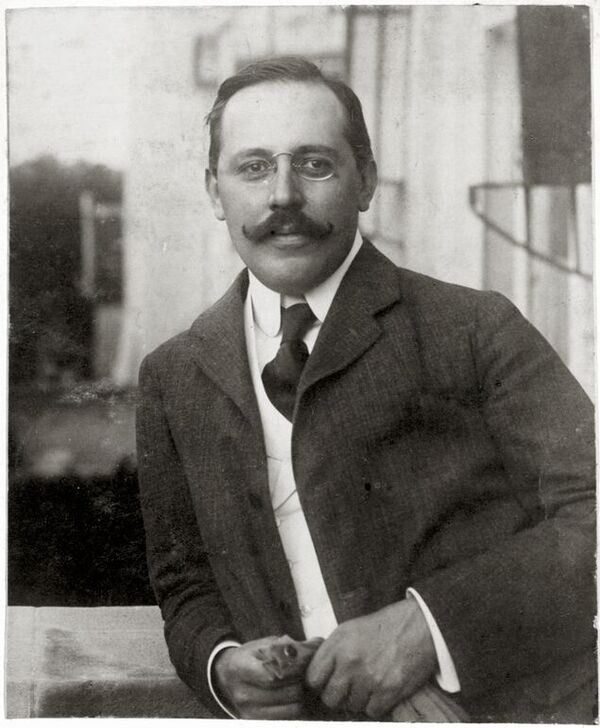
Left: J. Hoffman. F. V. Spitzer, 1903. Photograph. MAK, Vienna. (https://clck.ru/3ToMyA)
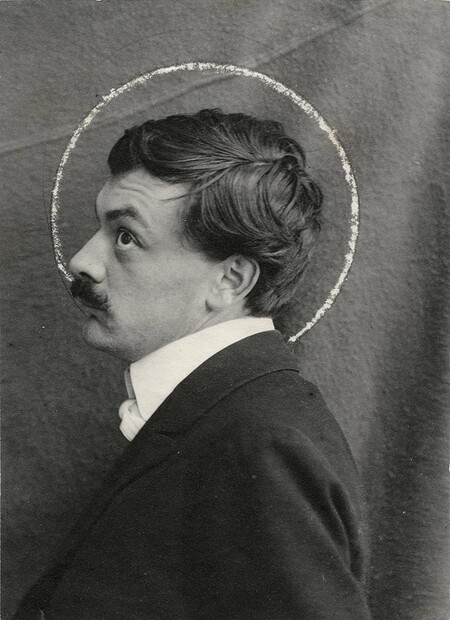
Right: K. Moser. Artist unknown, c. 1903. Photograph. MAK, Vienna. (https://clck.ru/3ToMxf)
Josef Hoffmann and Koloman Moser were pivotal figures of the Vienna Secession. Hoffmann worked as an architect and designer, while Moser functioned as an artist, graphic designer, and creator of decorative objects. They were united by a desire to understand art not as a discrete painting or sculpture, but as a system of forms capable of transitioning into objects, furniture, graphic design, and interiors.
K. Moser and F. Wörndorfer at the Vienna Workshop studio. Unknown artist, 1904–1905. Photograph. MAK, Vienna.
The Vienna Workshops were founded in 1903. A vital role was played not only by the artistic concept but also by the organizational model: the workshop needed to connect the author’s design, artisanal quality, and the sale of finished pieces. Therefore, it was not simply an artistic association, but an early form of design production.
Ornament as Visual Language
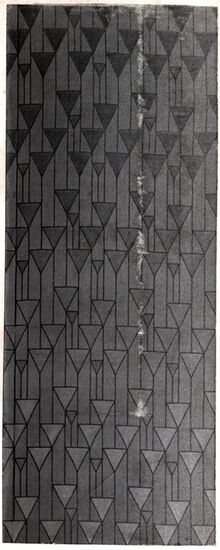
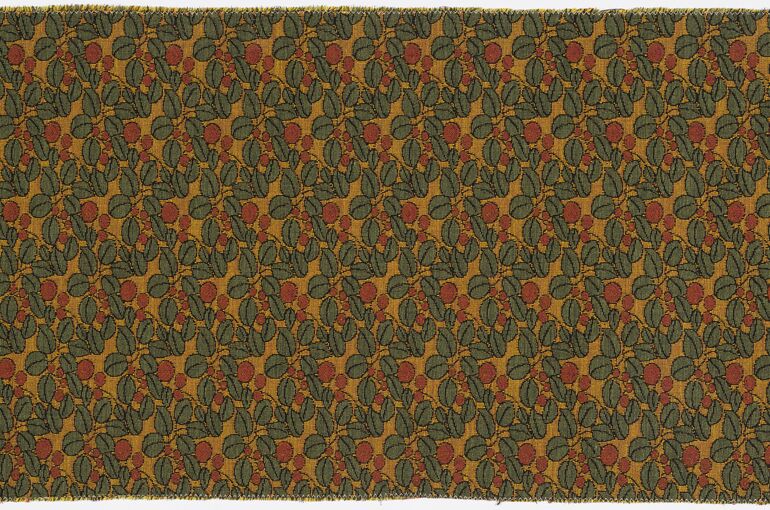
On the left: the «Streber» woven panel. J. Hoffmann, 1904. Photo of the fabric. MAK, Vienna. (https://clck.ru/3ToRYx)
On the right: the «Matisse» decorative fabric. J. Hoffmann. Fabric. MAK, Vienna. (https://clck.ru/3ToRa4)
The visual language of the Vienna Workshops is built upon ornament. The square, line, grid, repetition, and symmetry help organize the surface. Here, ornament does not merely decorate an object—it establishes a principle that can then be transferred to fabric, paper, tableware, furniture, and interior design.
Wrapping paper from the Viennese Workshops with a pink stamp. K. Moser, 1904. Paper, print. MAK, Vienna.
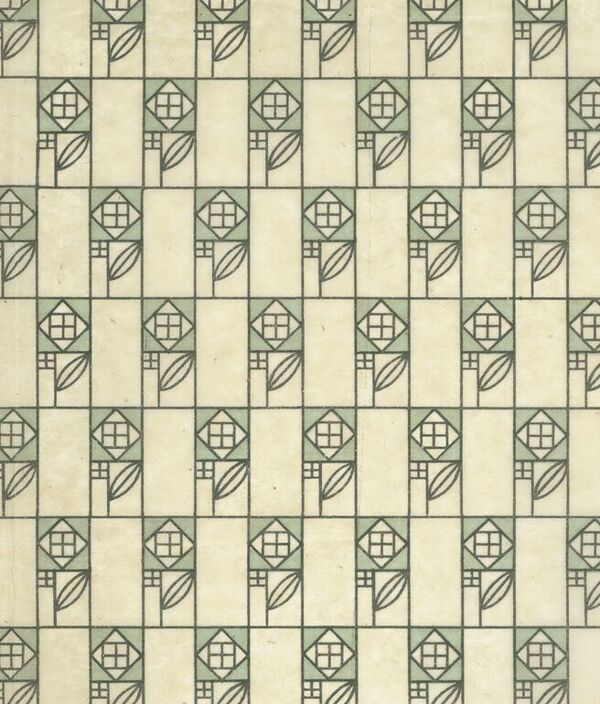
The decorative motif is simplified. Naturalistic qualities of plant forms are lost, and the line, shape, and repetition become more important than depicting a real flower or leaf. Because of this, the ornament is perceived almost abstractly—as rhythm, structure, and order.
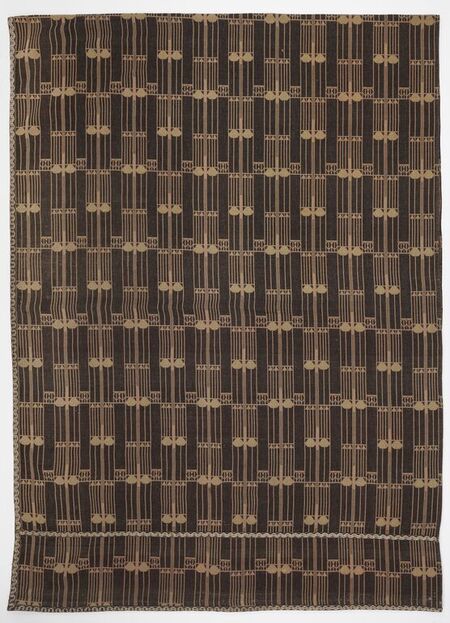
L: woven panel. J. Hoffman, 1904–1905. Cotton, wool. MAK. (https://clck.ru/3ToS3c)
P: wrapping paper. K. Moser, 1904. Silk paper, lithography. MAK. (https://clck.ru/3ToS48)
The same principle applies across different materials and formats. A recurring motif can exist on fabric, paper, a wall, or an object. This results not merely in a collection of beautiful patterns, but in a recognizable visual language for the studio.
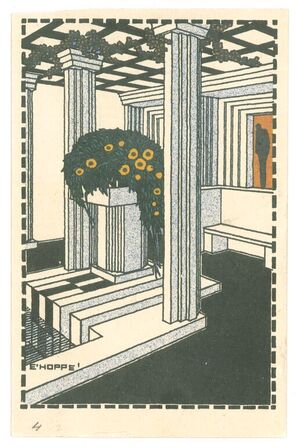
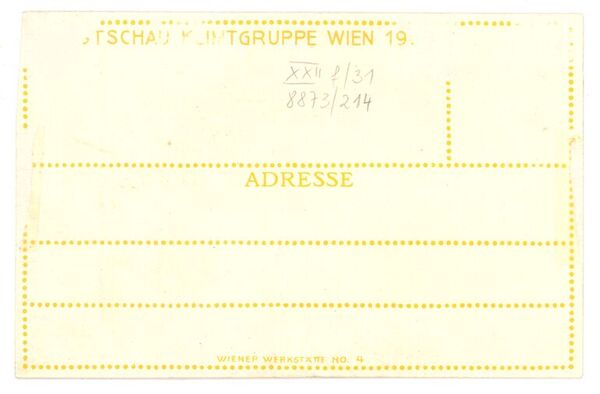
Postcard No. 4 from the Vienna Art Exhibition of 1908. E. Hoppe, 1908. Paper, lithography. MAK.
Ornament is not bound to a single medium. It transitions from fabric to graphics and organizes the entire object: image, frame, typography, layout, and reverse side. Therefore, even a small postcard becomes part of the overall visual system of the Vienna Secession.
Thus, the ornament becomes a connecting element—it unites different types of objects and makes them part of one system. The next step, therefore, is to consider the object itself as an artistic form.
The Subject as Artwork
Tea set. J. Hoffmann, 1903; manufacture: Viennese workshops. Silver, wood, ebony, coral, leather. MAK, Vienna.
In Viennese workshops, a utilitarian object ceases to be merely a useful thing. A kettle, a cup, a vase, or a jewelry box is designed as an artistic object. Its form is constructed through proportion, contour, geometry, and its relationship with space.
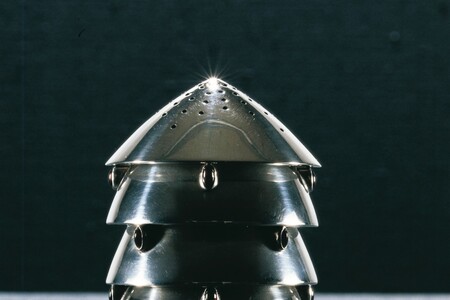
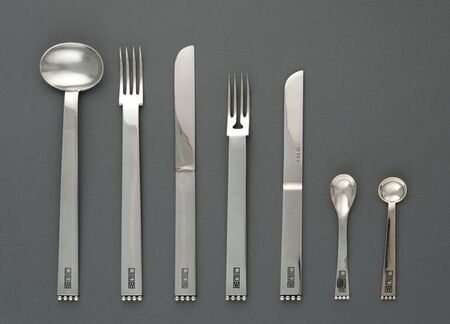
L: Pepper/paprika vessel. J. Hoffmann, 1903. Silver, carnelian. MAK. (https://clck.ru/3ToSMh)
P: Wendorf cutlery. J. Hoffmann, 1904. Silver, ebony. MAK. (https://clck.ru/3ToSNh)
Even the smallest details here are not arbitrary. The pen, the nozzle, the cap, or the edge of the device all adhere to the overall form of the object. The item seems constructed from simple geometric elements, which is why it appears sleek, clear, and modern.
Matchbox. J. Hoffmann, 1904. Photo of the object. MAK, Vienna.
Hoffmann’s small objects possess an almost architectural quality. They have a foundation, verticality, a defined silhouette, and a rhythm of details. This is how artistic sensibility manifests even in the most minor, everyday item.
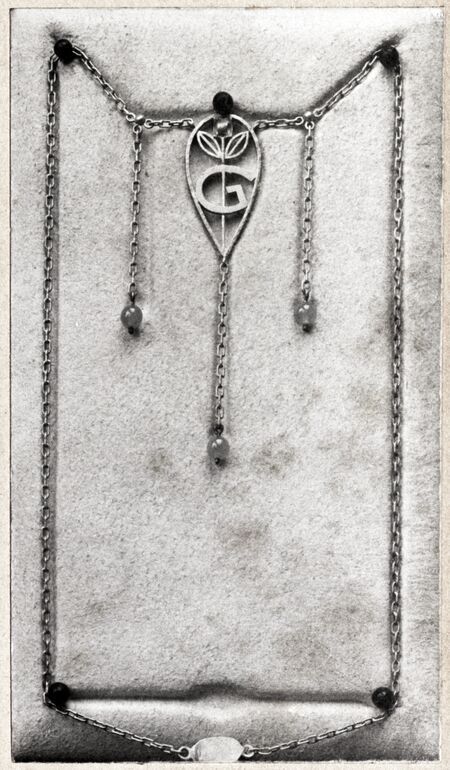
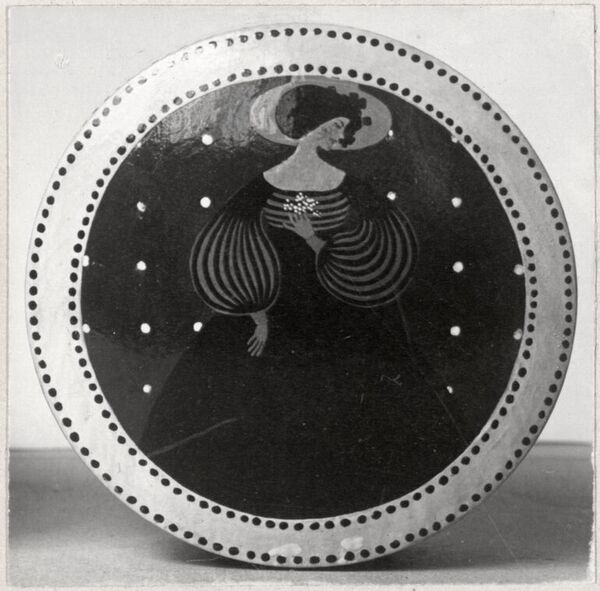
L: Pendant. K. Moser, 1904–1905. Photo, glass plate. MAK. (https://clck.ru/3ToSnN)
P: Box. K. Moser, 1904–1905. Photo, glass plate. MAK. (https://clck.ru/3ToSnr)