
«Valorate» is a Russian-language media source for people interested in professional Valorant who are currently finding it difficult to navigate seasons, regions, teams, and tournaments. The project does not aim to replace scoreboards. Instead, it explains which match to watch first, what is at stake, and which players or narratives to follow.
(No text provided for translation.)
The primary platform for the project is a Telegram channel associated with the «My VCT» bot. The channel provides brief context before and after matches, while the bot compiles a personalized viewing schedule based on user interests, available time, and spoiler tolerance. Extended analyses and archives are hosted on VKontakte to ensure the core materials are not dependent on a single platform.
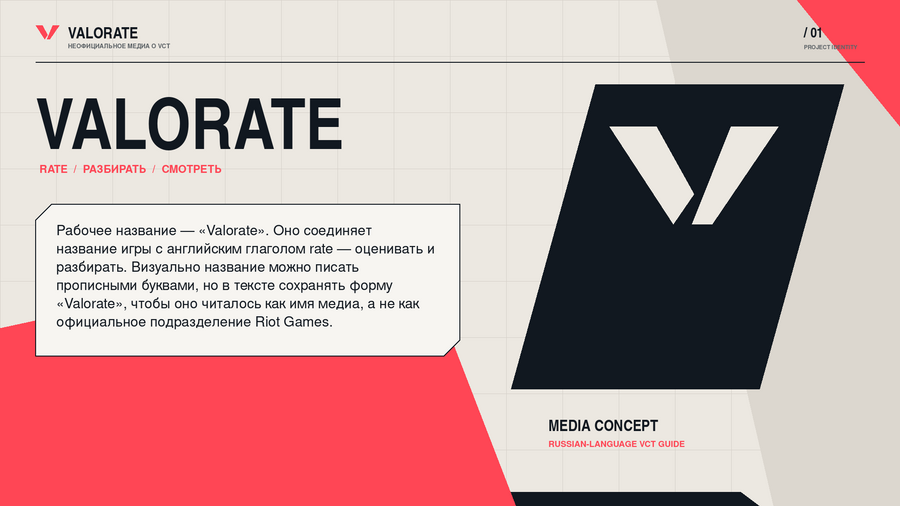
Project pitch: «Valorate» helps you start following the professional Valorant scene—choose an important match, understand its context, and stay on top of the VCT schedule.
The project’s goal is to lower the barrier to entry for professional Valorant. A person might know the game, agents, and maps very well, yet not understand how a regional league differs from Masters, why one series impacts the season while another does not, or which of several concurrent streams to watch. «Valorate» translates the scene’s mechanics into a sequence of comprehensible decisions.
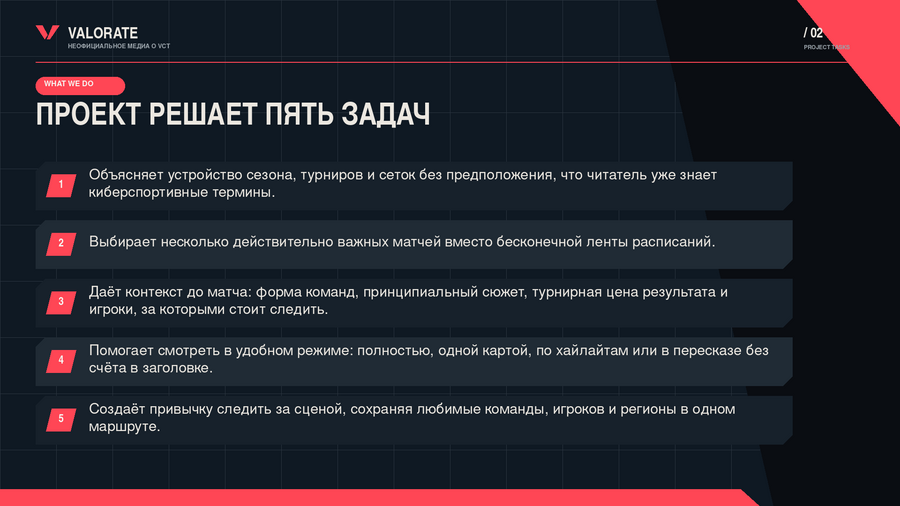
Initial hands-on experience: the user answers four brief questions, receives one recommended match of the week, and a «what to know before starting» card, either watches the live stream or saves the highlights, and then indicates whether they require a shorter or more detailed next route.
The broad scope of the project is gaming and esports. The segment is Russian-language B2C media for Valorant viewers. The narrow topic is entering the professional scene through a personalized viewing plan and editorial match breakdowns.
The project is not a feed of every transfer and score. It does not include in-game patch notes unrelated to the professional scene, guides for ranked play, betting and predictions solely for odds, unverified rumors without labeling, or a complete recap of every match in sequence. This limitation helps keep the promise: readers are shown not everything, but the necessary minimum for meaningful viewing.
Project names should describe the viewer’s action, not the underlying technology. They must be immediately understandable to someone encountering the VCT material for the first time.
Please provide the Russian text you would like me to translate.
Each piece of content answers a single question and concludes with a clear action: play the match, save a reminder, select a player to follow, view a detailed breakdown, or proceed further along the route. The text is not duplicated across platforms. Telegram features a brief version with a button, while VKontakte hosts the extended material, video clips, and archived navigation.
Automation solves the selection problem. A full calendar is useful for an experienced viewer, but it presents too many equivalent events for a beginner. The bot does not invent news or replace an editor. Instead, it selects vetted entries from the editorial database and assembles a suitable itinerary from them.

The editorial base stores the event, date and time, commands, tournament stage, match betting odds, key plot points, beginner difficulty level, recommended viewing time, source links, and a verification flag. For the first version, one major tournament and three route types are sufficient: first match, return after a break, and following a selected player.Personalization does not require a name, phone number, age, or place of residence. For the route, only interests, time, spoiler mode, and in-bot interaction history are necessary.
In Valorant, you must separate match information from its commentary. Schedules, format, and official results are verified on the tournament page and the official VALORANT Esports platform. Statistics are cross-referenced using public match pages. Transfers and statements are published with a link to the original source; unconfirmed information is clearly marked as «rumor.»
In «Valorant,» you must separate match information from its explanation. The schedule, format, and official results are verified on the tournament page and the official VALORANT Esports platform. Statistics are cross-referenced using public match pages. Transfers and statements are published with a link to the original source; unconfirmed information receives a prominent «rumor» tag. Before sending the card, the editor verifies the time in Moscow, the tournament stage, the spelling of usernames, the broadcast link, and the presence of a spoiler in the title. The bot only disseminates cards that have already been vetted. This is crucial because an automatic scheduling error erodes trust faster than infrequent publication.
Please provide the Russian text you would like me to translate.

Analysis was conducted using public Telegram channels, Russian-language esports websites, the official VALORANT Esports platform, and specialized match pages. Direct competitors were projects that allow users to regularly follow professional Valorant. Indirect competitors were services that handle a specific task—such as displaying schedules, statistics, or general news. Potential partners include large Russian-language communities and media outlets that already have a Valorant audience and the capability to launch a similar format.
Indirect Competitors
VALORANT Esports
Shows the official calendar, results, and VCT broadcasts, and allows score hiding. BUT: It provides facts and viewing, but not a Russian editorial guide for newcomers.
VLR gg
Aggregates schedules, results, rosters, rankings, and discussions from the international scene. NOTE: The interface and language are designed for a user who is already familiar with the teams, leagues, and terminology.