Navigator
- Research Concept
- What is Rococo?
- The Love Game in Rococo
- The Exaltation of Faith in Rococo
- Conclusion: The Universality of the Rococo Artistic Language
Research Concept
The selected research topic concerns the contemplation of the internal duality of Rococo style, which in 18th-century art manifests simultaneously in secular and religious contexts. Interest in this topic stems from the fact that Rococo is traditionally associated primarily with the aesthetics of pleasure, flirtation, and decorative lightness. However, a closer examination reveals that the same visual language is also employed in religious spaces, where it serves to convey a state of spiritual uplift and emotional exaltation. Thus, the research question arises regarding the boundaries and universality of the style’s artistic language.
The key research question is formulated as follows: why is the same Rococo artistic language equally expressive for depicting romantic play and religious experience? Based on this question, the hypothesis is put forward that the universality of Rococo lies not in its narrative subject matter, but in its capacity to shape the emotional environment into which the viewer is immersed. In other words, the style engages not with narrative, but with the experience of a state of being.
«Why can the same Rococo artistic language be equally expressive in depicting a romantic game and a religious experience?»
The principle of material selection for the visual study is based on juxtaposing two main directions: secular art (paintings of gallant scenes, mythological narratives, and leisure activities) and religious art (the architecture and decorative schemes of Rococo-era churches). Special attention is paid to works where the emotional intensity, decorative quality, and theatricality of the visual language are most vividly expressed. This approach allows for the identification of universal formal principles of the style, regardless of the narrative content.
The research’s rubrication principle follows a sequential progression from the general to the particular: starting with a definition of Rococo as a style, moving to an analysis of the love game as a secular manifestation, then examining religious exaltation, and finally comparing these two poles to formulate a conclusion regarding the universality of artistic language.
The principle for selecting and analyzing textual sources is based on art historical research concerning 18th-century culture, art history, and Rococo aesthetics. The texts are used not as a standalone object of analysis, but rather as a supporting foundation to clarify context and terminology. The primary focus of the research lies in the visual material—its comparative analysis and the interpretation of formal artistic techniques.
Thus, this visual study aims to reveal the internal logic of the Rococo style and demonstrate that its artistic language serves as a universal tool for expressing diverse emotional states—ranging from sensuous play to religious ecstasy.
What is Rococo?
Rococo is an 18th-century artistic style that originated in France and rapidly spread across Europe, encompassing painting, architecture, decorative arts, and interior design. Unlike the monumental and solemn Baroque, Rococo leans toward a more intimate, chamber-like, and sensual perception of the world. It is not interested in heroic action, but rather in everyday emotion, mood, and play.
The essence of the style lies in the pursuit of lightness and decorative flair. Rococo is characterized by curved lines, asymmetry, smooth transitions in form, a pastel color palette, and meticulous attention to detail. Ornament ceases to be mere embellishment; it becomes an integral part of the artistic language, creating a sense of movement and airiness. Space in Rococo is often perceived as fluid and «dissolved,» devoid of rigid boundaries.
Francisco Goya, «The Blind»
In Rococo painting, there is a pronounced focus on emotional atmosphere. Artists were interested in scenes of leisure, flirtation, strolls, musical activities, and theatrical social interaction. For example, in the works of Antoine Watteau, the image of a gallant celebration is formed, where the characters exist in a state of light melancholy and dreamlike play. His pieces do not capture a specific event but rather convey the mood of the moment.
Later, this trend develops in Jean-Honoré Fragonard, who intensifies the dynamism, sensuality, and theatricality of the depiction. In his works, the scenes become more vibrant and emotionally rich, and the compositions are built around movement and the immediacy of the impression.
François Boucher «Diana After Bathing»
In Rococo architecture, there is a drive toward decorative unity within the interior. The spaces of churches and palaces transform into complex visual ensembles where painting, sculpture, and ornamentation merge into a single whole. For example, the interior of the Church of Wies is built upon a sense of light, lightness, and the continuous movement of decorative forms. Architecture ceases to be a heavy structure and becomes an emotional environment.
Thus, Rococo can be defined as a style focused not on the strictness of form or narrative clarity, but on creating a sensual experience. It fosters a particular type of artistic perception where the atmosphere, rather than the events, and the state of being, rather than the plot, is what matters.
Antoine Watteau, «The Capricious»
The Rococo Game of Love
One of the central themes of Rococo art is the game of love. Eighteenth-century artists depicted not deep dramatic experiences, but rather light flirtation, coquetry, pleasure, and a festive atmosphere. Love during this period symbolized an elegant play where gestures, glances, unsaid things, and theatricality were of key importance. This is why the works of this era are characterized by lightness, dynamism, and emotionality. The Rococo style is typified by the depiction of aristocratic leisure: strolls, dates, dances, and garden amusements. Artists created an idealized world, free from serious conflicts and everyday problems, where the main goal was to create a pleasant and sensual atmosphere.
One of the most famous Rococo works is the painting «The Swing.» The canvas depicts a young woman swinging in a garden while a man watches her from below. The composition is filled with movement and playfulness. Delicate pink hues, lush vegetation, and soft light create a feeling of carefree abandon and romantic play. Dynamics play a special role: the girl’s dress seems to dissolve in the air, and the entire scene appears as an instantaneous episode from a theatrical performance.
A key feature of the work is the emotional quality conveyed through the details. Jean-Honoré Fragonard utilized fluid lines, airy fabrics, and a light palette, which lends the scene a light and almost unreal quality. The artist was not aiming to reproduce real life, but rather to create an atmosphere of pleasure and flirtation.
«Pilgrimage to the Isle of Cythera, ” Etching, Jean-Antoine Watteau
Another significant example is the painting «Pilgrimage to the Island of Cythera.» The canvas depicts loving couples in a park on the island of Venus, the goddess of love. The space of the painting is filled with soft light and the fluid movements of the figures. The characters are not engaged in active action; the mood of the scene plays the main role. Jean-Antoine Watteau creates a sense of dreaminess and emotional delicacy. Pastel tones, the light landscape, and the graceful poses of the figures underscore the Rococo atmosphere of romantic play. The artist presents love not as a profound feeling, but as a beautiful and aestheticized ritual of interaction.
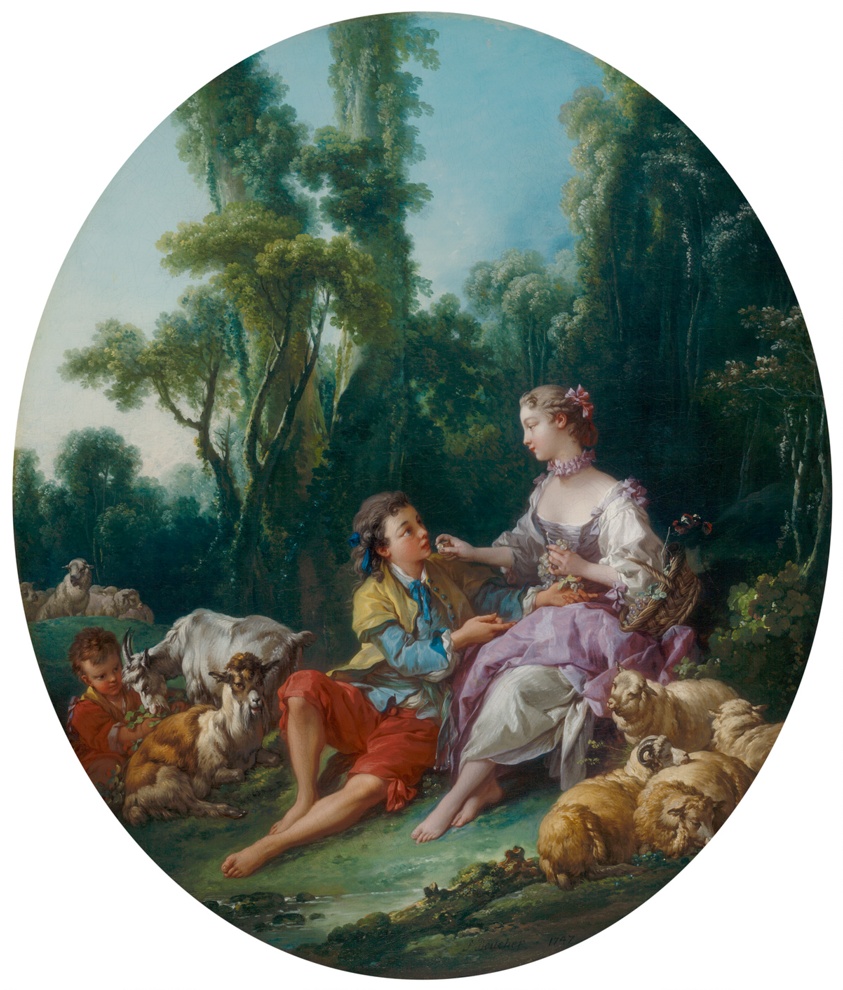
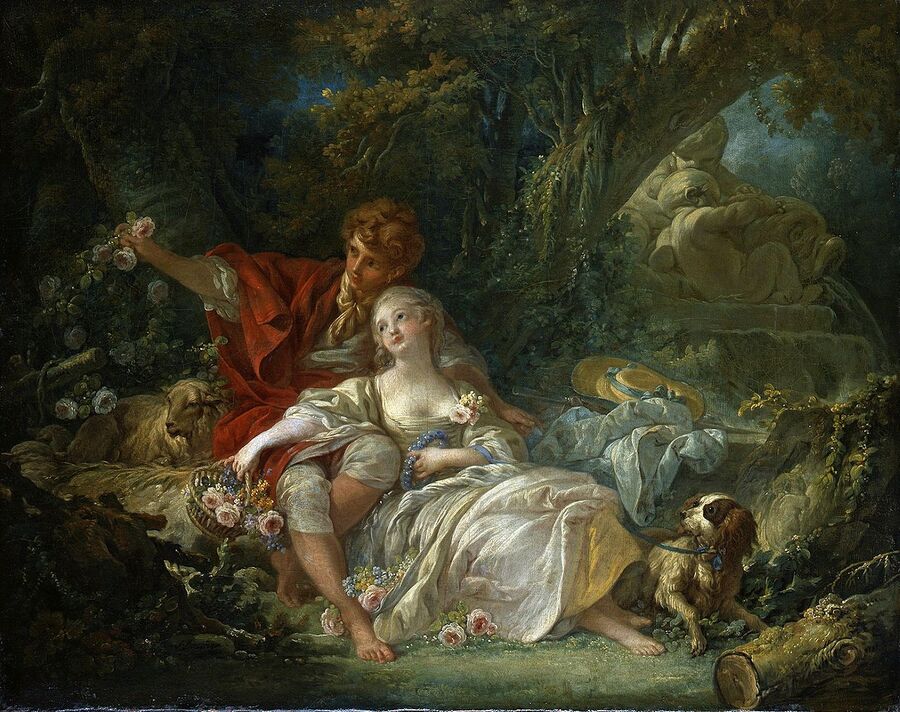
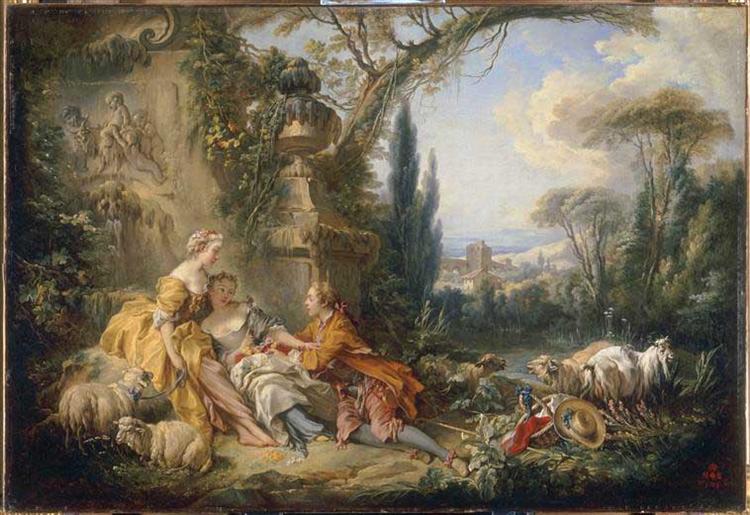
The theme of sensuality is also strongly evident in the works of François Boucher. His paintings are characterized by their decorative quality, soft color palettes, and idealized figures. For instance, in his depictions of Venus, the artist utilizes a light palette, fluid bodily lines, and an abundance of decorative detail. As a result, even mythological scenes resemble an exquisite play built upon the aesthetics of pleasure and beauty.
«Music Lesson, ” 1770, Phragnon Jean
Another significant work from the Rococo period is «Music Lesson.» The artist depicts an intimate scene between a man and a woman. The painting’s space is suffused with soft light, warm golden hues, and decorative interior details. In Rococo, music often symbolizes flirtation and emotional closeness. The figures are in close proximity, and their poses and gazes create a sense of delicate romantic tension. A characteristic intimacy, typical of the Rococo, is especially evident in this piece—the viewer’s attention is drawn not to the action itself, but to the emotional atmosphere of the moment.
«Stolen Kiss,» Jean-Honoré Fragonard
The themes of play and flirtation are also evident in the painting «Stolen Kiss.» The artist depicts a secret kiss, hidden from prying eyes. The composition is arranged so that the viewer feels as though they are stumbling upon the scene by chance. The interior is filled with draperies, soft light, and decorative elements, creating a sense of intimacy and coziness. Thanks to the dynamic poses of the characters and the lightness of the painterly style, the scene appears lively and emotional. Here, the characteristic Rococo theme of fleeting pleasure and theatrical emotional play is especially vivid.
«Triumph of Venus,» 1740, François Boucher
In François Boucher’s work, mythological themes—reworked into sensuous decorative scenes—hold a prominent place. For instance, in the piece «Triumph of Venus,» the artist depicts the goddess of love surrounded by putti and sea nymphs. The composition is filled with movement, airy drapery, and pastel hues. Despite the mythological subject matter, the primary themes of the painting become beauty, sensuality, and the enjoyment of life. The artist employs soft pink, blue, and golden tones, which gives the work a light and decorative quality.
«Society in the Park, ” 1717, Antoine Watteau
The painting «Society in the Park» also explores the theme of refined social interaction. The artist depicts aristocrats strolling and relaxing in nature. The characters are conversing, making music, and flirting. The composition is light and free, and the landscape becomes an integral part of the overall atmosphere of celebration and pleasure. Like Watteau, Langre portrays an idealized aristocratic world where life transforms into a beautiful spectacle.