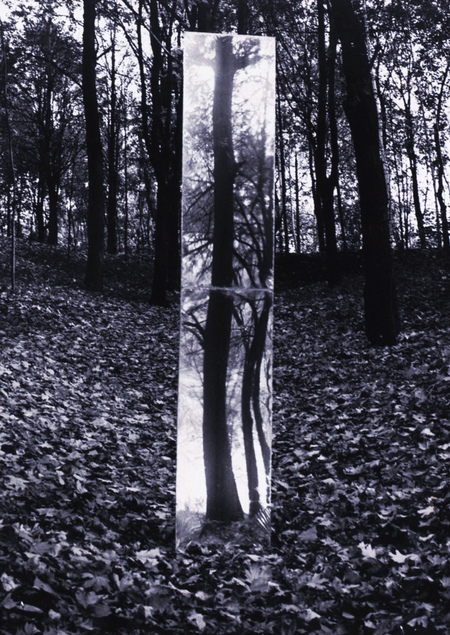
From March 22 to 29, a creative lab hosted by the HSE Art and Design School took place, involving 15 artists led by Francisco Infante.
As part of the lab, participants were able to explore the creative methodology of Infante through meetings with the artist himself, as well as meetings with the curators of the exhibition «Francisco Infante. Metaphors of Infinity» at the State Tretyakov Gallery, and by visiting the exhibition itself. The outcome of each participant’s activity was a series of photographic works inspired by the interaction with the experienced artist.
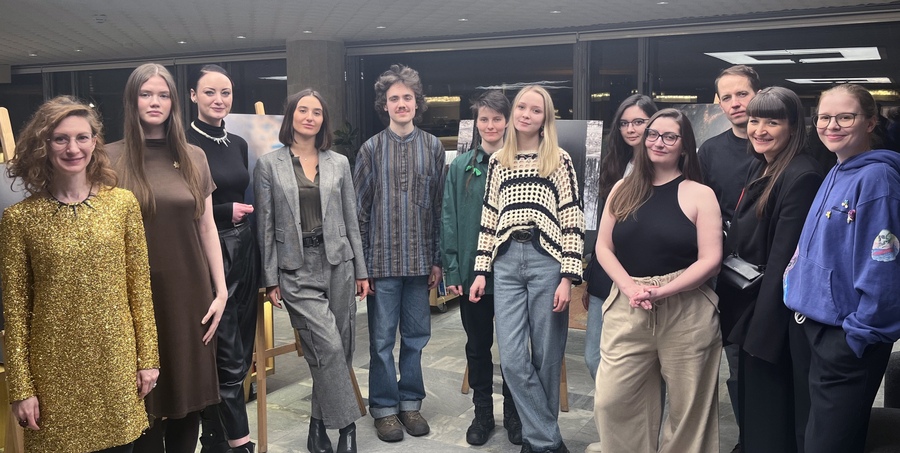
Following the laboratory session, an exhibition of participant projects was held at the New Tretyakov Gallery.
We viewed the archive as an opportunity to study Francisco Infante’s methodology and develop a flexible theoretical foundation for the project. The methodology for working with the archive was structured according to the following objectives: 1/ To define and analyze the role of photography in Francisco Infante’s practice. 2/ To define and analyze the core themes in Francisco Infante’s practice. 3/ To examine the phenomenon of artistic association. 4/ To investigate the structure of Francisco Infante’s creative process.
When selecting the format, we considered the desire to merge collaboration with young artists and Francisco Infante, as well as to lend practical significance to the archive work.
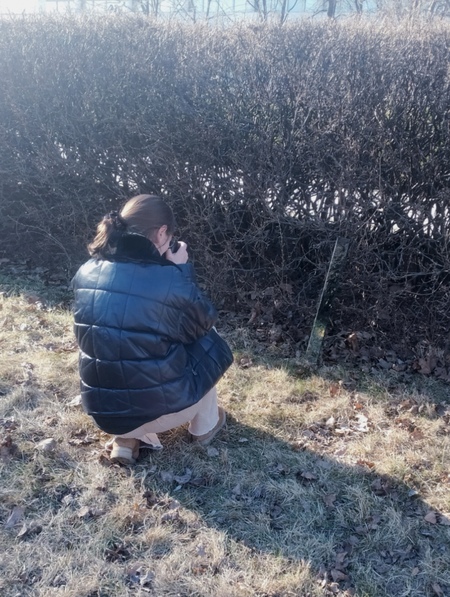
The Creative Lab is an intensive, short program that allowed participants to immerse themselves in Francisco Infante’s methodology, interact directly with the artist and invited speakers, develop new strategies for their practice, create projects in collaboration with the curatorial team, and participate in a final exhibition at the New Tretyakov Gallery.
Photography is the primary medium for Francisco Infante, and it also allows for the realization of projects within a short timeframe.
The initial work on the lab proceeded in several stages, which can be outlined as follows: 1/ archive work 2/ development of theoretical material 3/ design of the lab program 4/ creation of an open call 5/ selection of the theoretical material format
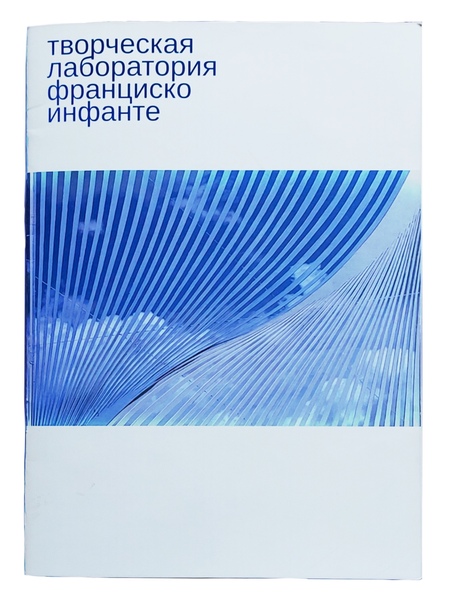
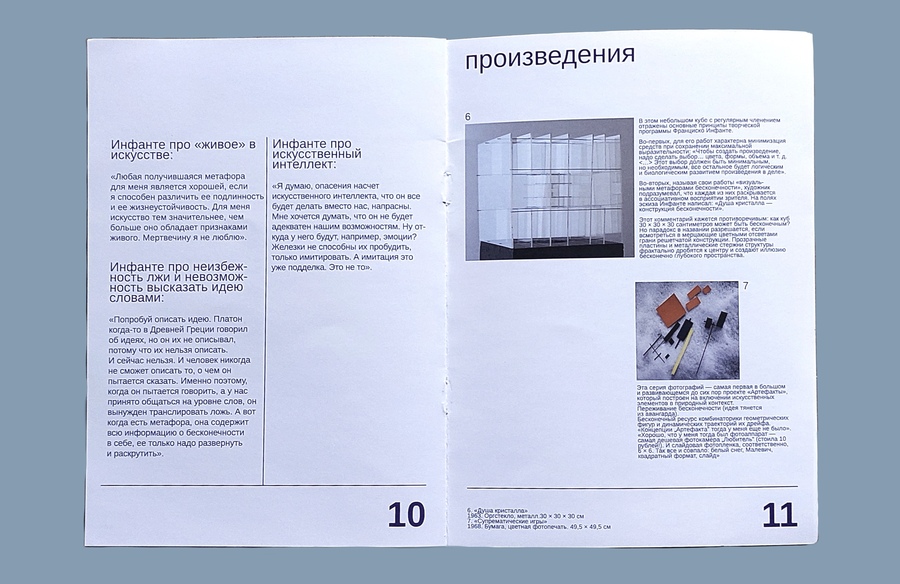
As supporting material for the laboratory, we chose the zine format, which incorporated theoretical content for the participants. The materials included in the zine were developed through work with the archive. We adhered to the following principles when writing the texts: 1/ Structure 2/ Clarity of Expression 3/ Practical Relevance
During the development of the zine, we selected a series of references that determined the final product design. The design included imagery to accompany each section.
The contents of the zine corresponded to the key structural elements provided for the participants' lab project work: metaphor, artifacts, photography, excerpts from interviews, works, and their descriptions.
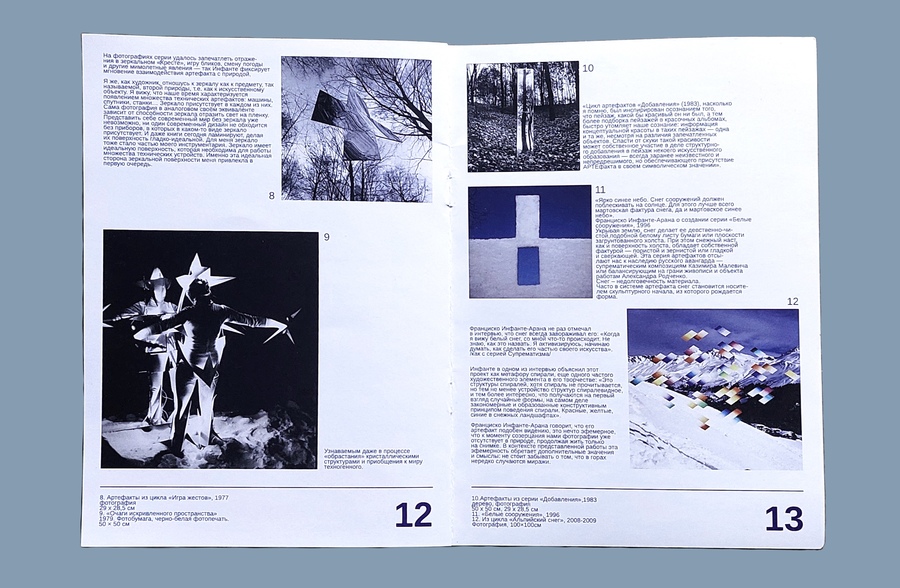
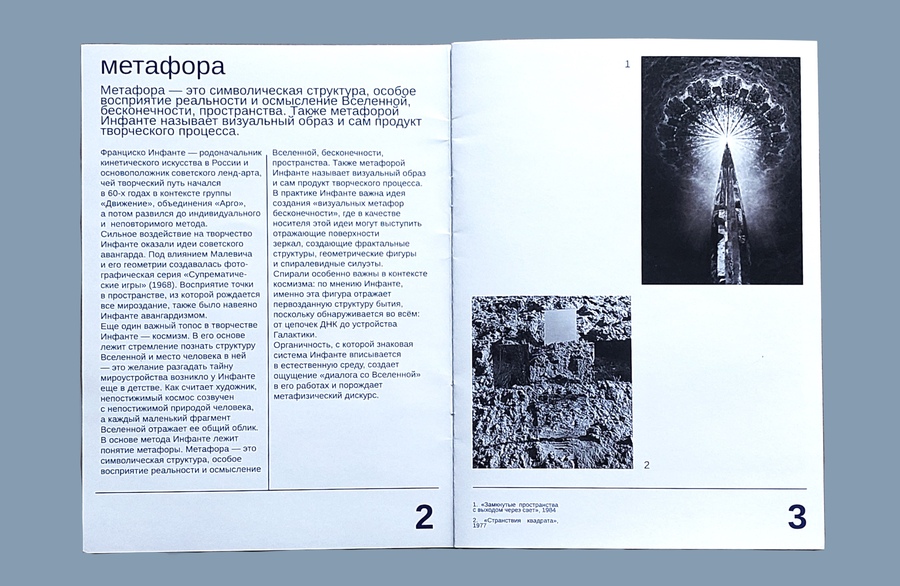
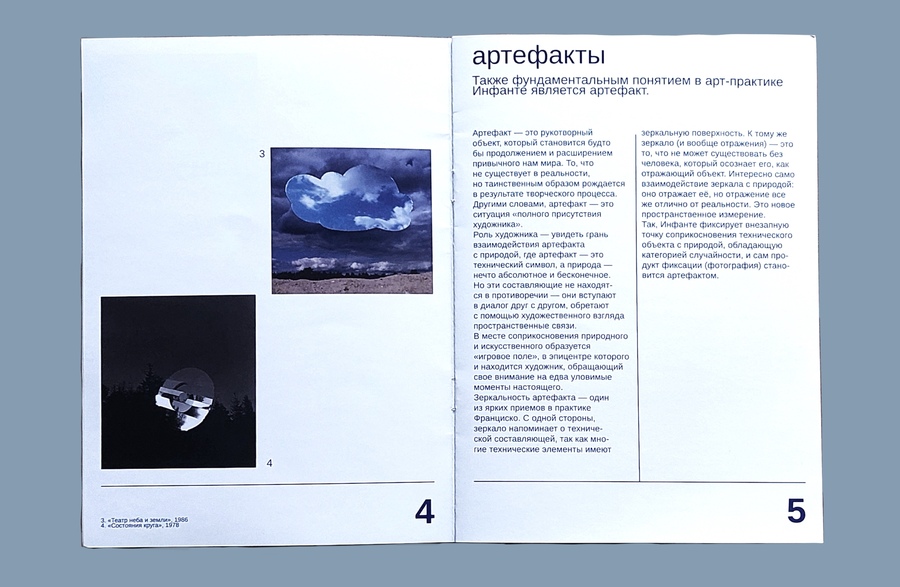
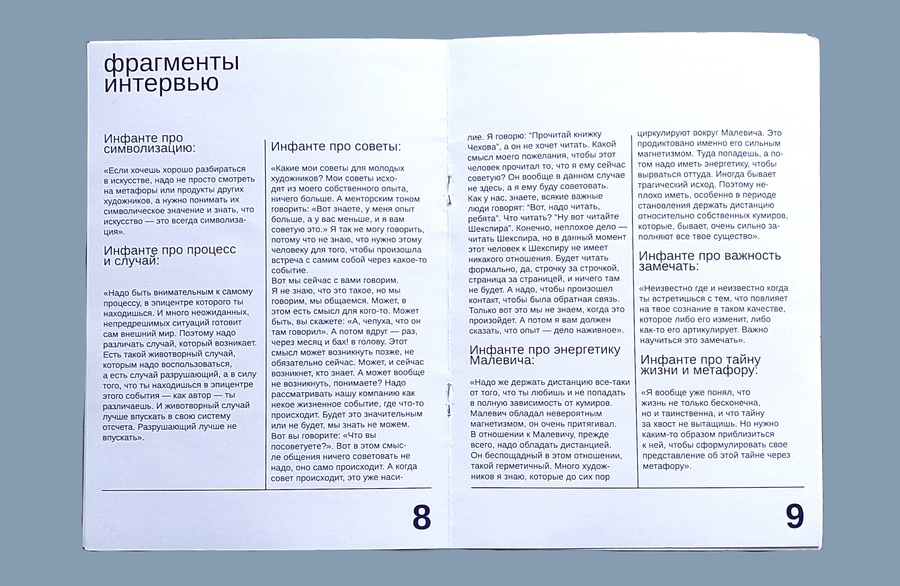
An open call was selected to gather participants for the lab, targeting the broadest possible audience. The strategy aimed to attract creators of any level or age. Following the open call, a selection of participants was planned.
The lab’s description and program were posted on the School of Design’s website and social media channels. Targeted advertising was also launched. To apply, applicants were required to submit a portfolio and a statement of purpose.
We received 15 applications as a result of the open call.
The laboratory program addressed the following objectives: 1/ immersing participants in the methodology of Francisco Infante 2/ introducing participants to Francisco Infante’s exhibition at the Tretyakov Gallery 3/ consulting participants on projects developed within the laboratory framework 4/ supporting participants with technical issues related to photographic equipment
The laboratory program includes the following sessions:
1/ Exhibition tour with Maria Heller 2/ Artist talk with Francisco Infante 3/ Workshop with Alla Afonina 4/ Meeting with Irina Gorlova 5/ Consultations with the curatorial group 6/ Final session with Francisco Infante and artwork discussion
A significant part of the laboratory program’s development involved studying archives to immerse ourselves in the methods of Francisco Infante, achieving a finer understanding of his relationship with the chosen medium, and examining his group work experience.
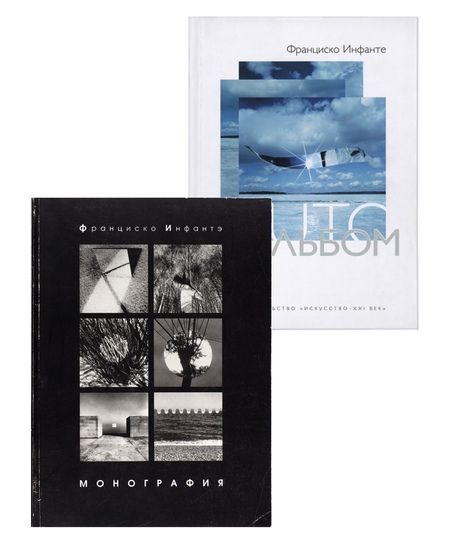
Research utilized materials from the archives of Garage Museum, the Russian State Library, and various interview transcripts and articles.
Based on the analysis of the archival materials, we developed interview questions for the artist that were conducted before the laboratory, and we created a zine for participants explaining the core concepts explored by Infante.
Furthermore, following the archival work, we designed hypothetical project trajectories for participants related to the laboratory’s theme.
The first area of inquiry involves a detailed examination of the concepts of «metaphor» and «artifact, ” which are central to Infante’s practice of eschewing narrative in favor of working with systems of signs.
Artifacts are the central themes in Infante’s work—man-made objects autonomous from nature. They do not exist in the world as we commonly know it, yet they function as an extension and expansion of it. The singular semantic core of the artifact series is the artist’s drive to uncover new metaphors for the perfection of existence.
A metaphor is a symbolic structure—a way to perceive the form of reality that was inaccessible to the human eye before the artifact’s creation. It is also the product of the creative process itself. The idea of a metaphor cannot be embedded into a narrative or expressed in ordinary human language, but it can be conveyed through a striking visual image and understood via emotional perception.
Second line of inquiry: gathering information on the role of photography in Infante’s work.
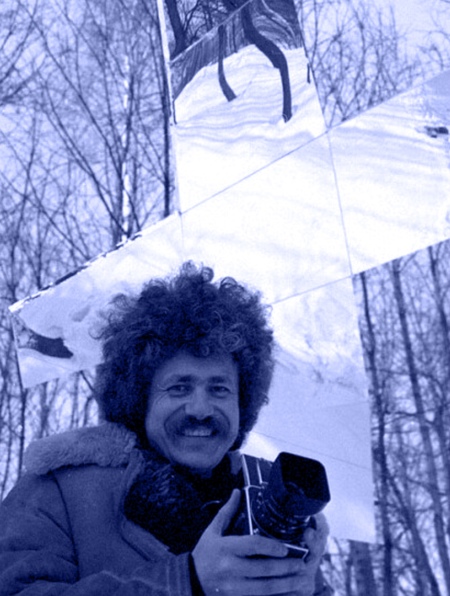
Photography serves as a means of capturing the fleeting state of artifacts and installations. This medium also functions in the artist’s practice as a vehicle for expressing the moment between past, present, and future.
For Infante, discontinuity—the discrete moment, the unique and singular state—is of interest. Discreteness encompasses categories vital to Infante, such as «suddenly, ” „abruptly, ” „instantaneously, ” and „chance.“
An indispensable element of Infante’s photographic practice in conveying discreteness within photographic series is the allowance for moments of improvisation during shooting and the absence of editing.
The third avenue of inquiry: investigating the context of work creation that interests the curatorial team and is potentially useful for the lab participants.
This part of the archival work allowed us to select the works from Infante’s overall creative legacy that were included in the zine as illustrative material, references, and sources of inspiration.
As part of the preparation for the laboratory session, the curatorial team conducted an interview with Francisco Infante, during which the artist discussed various factors influencing his creative work.
The questions were divided into several blocks: 1/ creative process 2/ sources of inspiration and education 3/ activities within art associations and in tandem with Nonna Goryunova 4/ Infante’s view on the contemporary art scene.
During the interview, Infante answered questions from the curatorial team: 1/ Art, in Infante’s opinion, is always symbolic and does not require a narrative; it is often «accidental.» 2/ Sources of inspiration are «living action”—spontaneous encounters with something that elicits a strong emotional response. 3/ Participation in art associations is difficult for the artist as an individual; collaborative work can only be realized through constant dialogue among artists as individuals. 4/ Freedom in understanding art is necessary—less text in the visual environment.
Based on the interviews, some hypotheses were confirmed while others were refuted. This allowed the curator team to adjust its plans regarding how to organize the work with lab participants and the future exhibition.
The first meeting of the lab participants took place at the New Tretyakov Gallery.
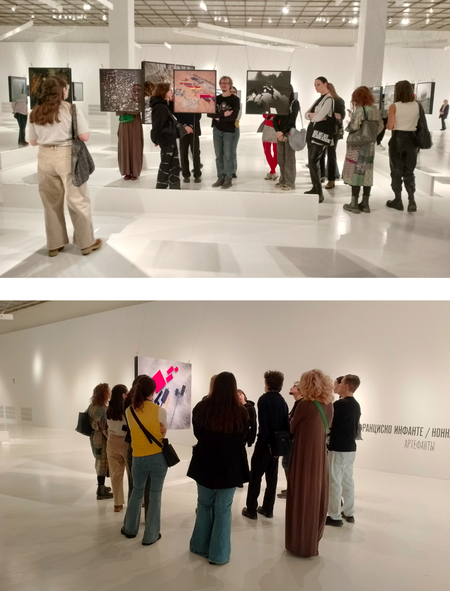
To immerse the artists in context and introduce them to the creative methodology of Francisco Infante, curator Maria Heller conducted a tour of the exhibition «Metaphors of Infinity.» She provided the laboratory participants with a detailed account of Infante’s creative stages and the genesis and development of the artifact concept.
«Metaphors of Infinity» is an extensive exhibition showcasing Infante’s photographic works, his kinetic installations, along with the artist’s diary entries and photographs from his family archive.
Maria Heller thoroughly briefed the laboratory participants on the stages of Infante’s creative career, explaining how the concept of artifacts originated and how his method evolved during his participation in, and subsequent departure from, various artistic associations.
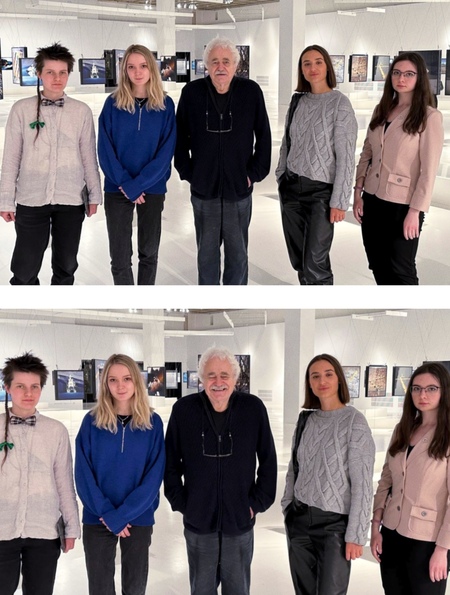
After the tour, participants met with Infante at the Art and Design School.