Visual Research
Purism was founded in 1918 in France by Charles-Édouard Jeanneret (Le Corbusier) and Amedeo Sant’Elia. This artistic movement expressed a drive toward order, integrity, balance, and clarity. Purist representatives emphasized simplicity, clean lines, minimal detail, and strict geometric forms.
The culmination of purism was the «Esprit Nouveau» (New Spirit) pavilion, built by Le Corbusier in 1925 for the International Exhibition of Decorative and Industrial Arts in Paris. The pavilion was a laconic white cube with distinct geometric lines and extensive glazing. The interior lacked decorative paintings; Purist still lifes by Le Corbusier and Amedeo Sant’Elia were displayed on the plain walls.
Art Object Location
The project is dedicated to the water tower located on Batareynaya Hill in Vyborg, which was built in 1930 based on the design of the city architect Väinö Keinänen. Following the wars of the 20th century, Vyborg’s water supply system changed, and the tower lost its original function.
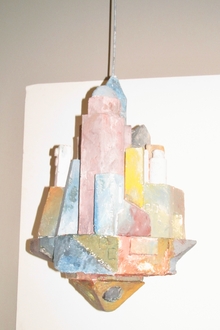
The central motif of the exhibition is the water droplet. A dynamic installation composed of schematic art objects shaped like droplets is placed within the stairwell of the water tower. These pieces are intended to reintroduce the image of water—the tower’s lost function—into the space. Each droplet reflects a different direction of art, and their combination forms an overarching composition where various exhibits become part of a single concept.
Concept
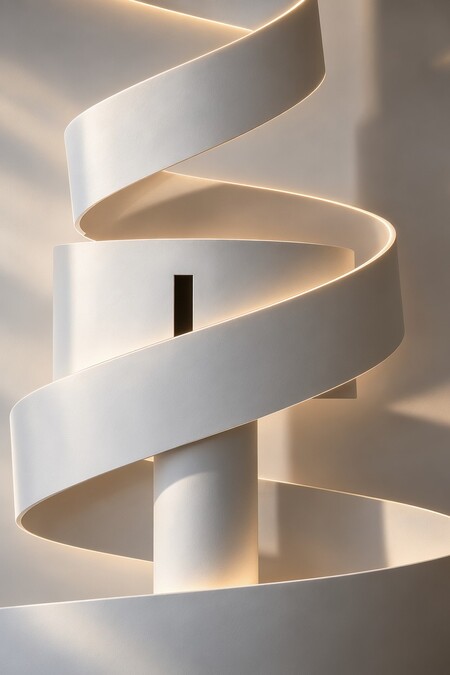
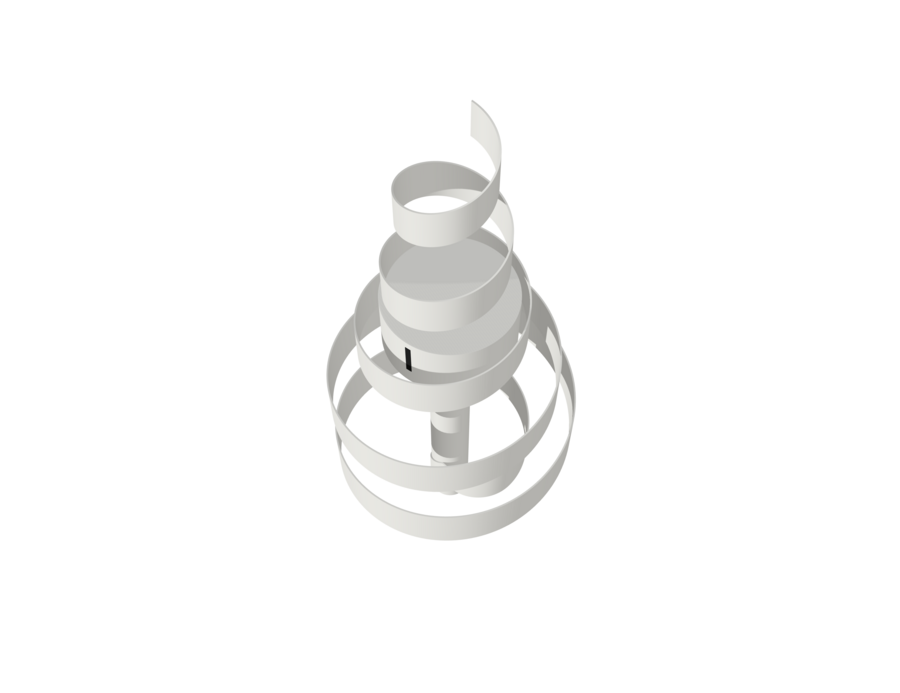
In creating this art object, I drew inspiration from one of Le Corbusier’s most significant structures: the Villa Savoye (Poissy, France, 1928–1931).The white, spiral form of the staircase became the foundation of my piece—from it, the silhouette of a drop was formed. The white tower at the center echoes the curved white walls on the villa’s roof, which cap the building. The rectangular window in the tower recalls the ribbon windows of the architectural structure—one of the five principles of Purism. The object is entirely white: in Purism, this color signifies the purity of form and the rejection of everything superfluous. The tower itself is anchored on a support and does not touch the floor. Thus, I conveyed another principle of Purism—the pilotis.
Villa Savoye greatly influenced Le Corbusier’s success. In it, he embodied the five principles of modern architecture, and in 2016, UNESCO added the structure to the World Heritage List. This is why I based the object on the purist elements of this building: they became for me a symbol of an architect’s journey toward the pinnacle of creative achievement. The spiral ascends, narrows, and reaches its point of ascension.
Sketches
3D Mockup
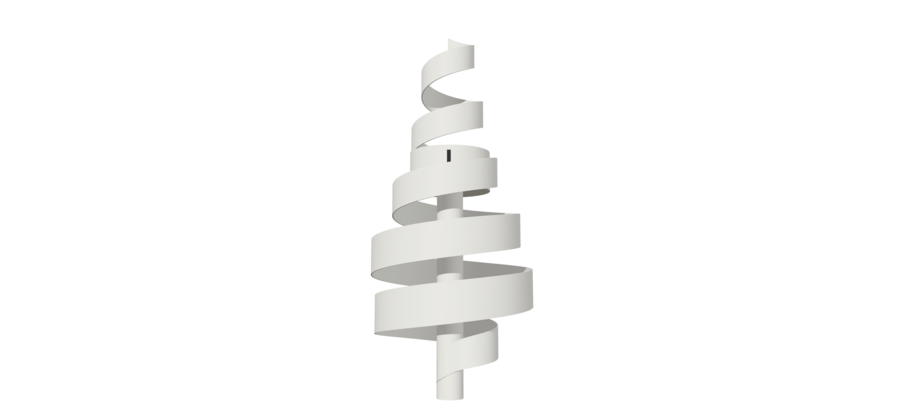

Вид спереди
Workflow