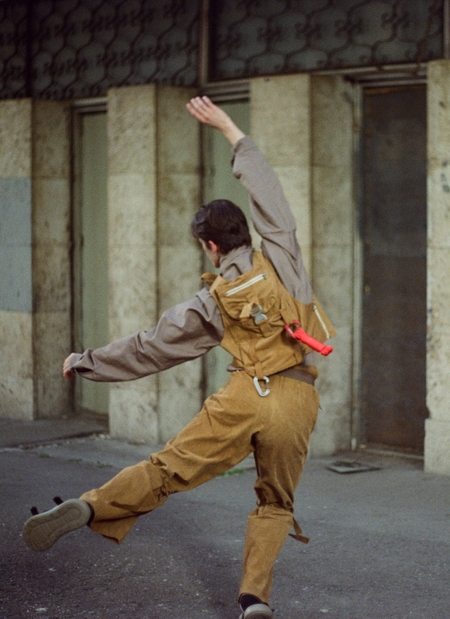
Were you born Hamlet? Perhaps you are more Hamlet-like within yourself.
Concept
In Deleuze’s «Anti-Oedipus, ” the phrase „Were you born Hamlet? Perhaps you actually gave birth to Hamlet within yourself?“ deeply resonated with me. It perfectly captures the prevalent use of the Hamlet archetype in culture—the mythological programming of this central character without granting him the ability to forge his own identity.
I found the theme of protagonist identity to be particularly relevant, so I decided to base my project on it, choosing one of the most popular archetypes. The image of Hamlet has been adapted and used countless times—from theater, such as Robert Wilson’s „Hamlet Machine,“ to modern cinema, like Dune.
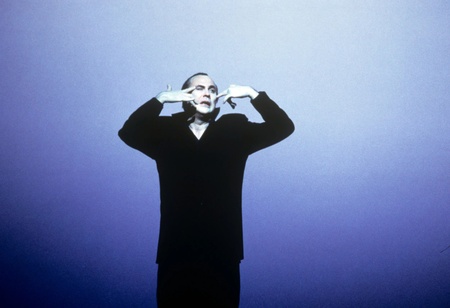
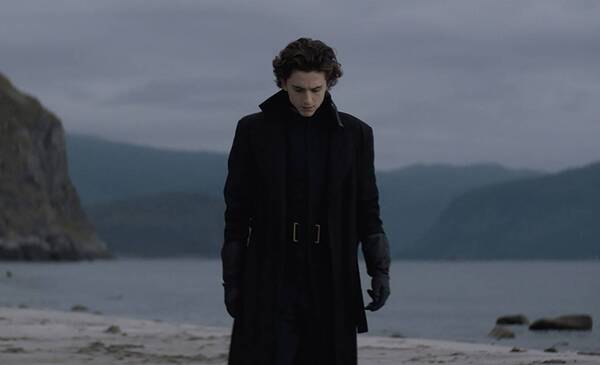
1. «Hamlet Machine,» Robert Wilson 2. «Dune,» Denis Villeneuve
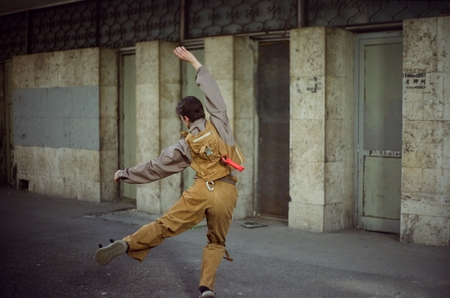
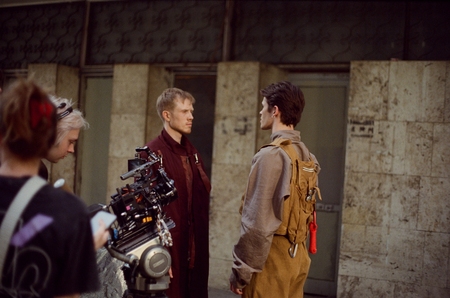
Inspired by contemporary musical practices that engage with established archetypes and narratives—particularly Robert Wilson’s opera productions, Anna Imhof’s neo-operatic performance of «Faust,» and Bernard Parmegiani and François Bayle’s electroacoustic album «Divine Comedy"—I decided to create an electroacoustic music album accompanied by a video performance. This performance will feature choreographers in original costumes performing to compositions that integrate musical declamation and spoken word. Ultimately, I aim to expand this work into a live opera-performative production.
Performance
In my diploma visual research, I studied and analyzed how voice, text, and narrative are employed by contemporary composers to structure compositions.
Starting in the mid-twentieth century, contemporary composers have actively moved away from literary-centrism and the classic narrative structure of composition, favoring experiments with musical form, sound, and performance techniques. Furthermore, archetypes and plots are radically reinterpreted.
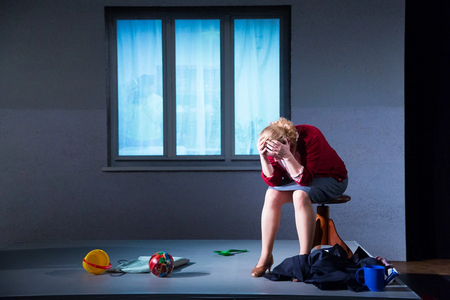
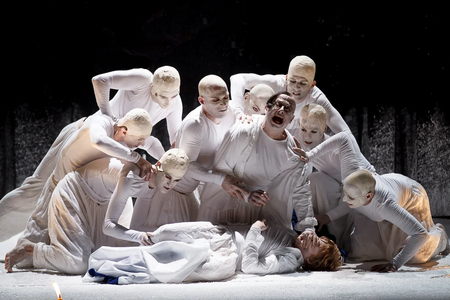
Photos of contemporary opera, Werner Kmetich
Therefore, it was important for me to base my work on a specific concept from Hamlet—one that wasn’t related to the linear plot, betrayal, fatherhood, or death.
Libretto
P — Psychoanalyst; G — Hamlet P: Are you Oedipus? G: Who? I don’t know anyone like that. P: Let’s start over. Who are you? G: There is an entire theater inside me—a multitude of us, a whole pack.
Every adaptation of Hamlet is a dialogue with the original and with all the other adaptations. It is an act of entering a vast cultural network of adaptations.
The original text is repeatedly deformed, inverted, rewritten, and reformulated. Therefore, the text is built upon a polyphony of Hamlet’s voices—that is, the main characters from numerous adaptations.
Performance
I approached Nikita Kolchanov, an HSE faculty member, about this. Nikita composed a monologue of Hamlet centered on reinterpreting the key question of the Shakespearean tragedy, «To be or not to be?», as well as a dialogue between two archetypal characters—a psychoanalyst and Hamlet—in which the protagonist argues with someone trying to define his identity and his fit into a certain personality type.
Shamil Bagmanov’s Costume
G: The answers are not as important as the properly asked questions. To be or not to be? An incorrect question, and consequently, a false problem. We are a body without organs; we are conjoinly connected to one another; we become. It’s not just Hamlet. We absorb the entire world, the entire theater. To be and not to be. The hero always shimmers, slipping away…
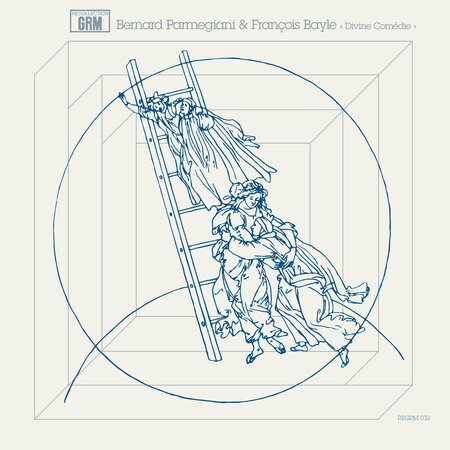
I wanted to focus specifically on electroacoustics because I was profoundly inspired by Bernard Parmegiani and François Bayle’s album, «Divine Comedy,» which drew on Dante’s extremely well-known narrative. What particularly interests me in the composition is the sonic quality found in the album—the manipulation of acoustic instruments and the work with the voice.
The progressive rock group King Crimson also inspired my interest in using intricate percussion and dramatic melodies. Ultimately, I realized that I want to create an album that integrates instrumental elements, their sonic processing, and a deep engagement with text and meaning.
I recorded the arpa, flute, harmonica, kalimba, drum kit, guitar, bass guitar, ukulele, vocals, SOMA Enner, Pulsar, Lyra synthesizers, and the Deepmind synthesizer from Behringer for the album. A cassette recorder was also used during the recording process—an approach inspired by the 2000 film adaptation of Shakespeare’s character, Hamlet.
Cover of my album, drawn by Arseny Ruga
For the album featuring the flute and harmonica, electric acoustic musician Yan Vorobyev performed. Daniil Nizamov, a composer, played the harp. I recorded the vocals, dialogue, and monologues with HSE Sound Art students Svyatoslav Modestov and Alexander Malevich, as well as with Valeriy Bezrukov, a Fashion student.
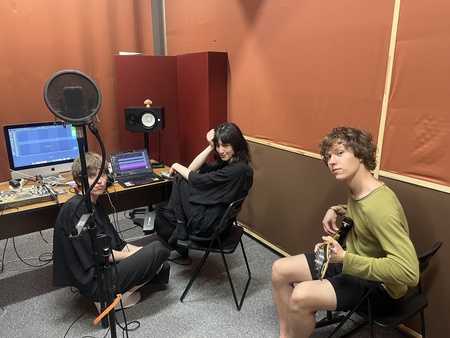
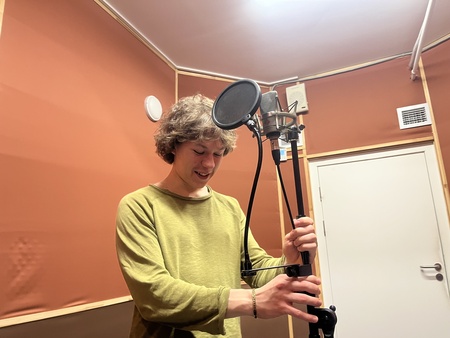
I’m in the studio with Svyatoslav Modestov and Alexander Malevich.
The use of numerous acoustic instruments is justified by the polyphony and timbral richness I desire in the sound. In this way, I demonstrate the multiplicity of Hamlet’s voices (adaptations).
Performance