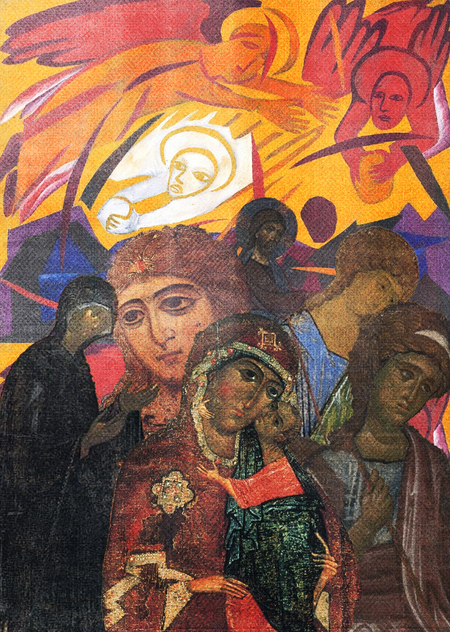
Concept
This study is an attempt to trace an inconspicuous visual connection between two eras separated by centuries, yet speaking a surprisingly similar language of human body deformation.
In Byzantine and Old Russian icon painting, the body was intentionally stripped of flesh, weight, and anatomical accuracy. Elongated fingers, weightless feet, and geometric folds in the clothing—all served a single purpose: to make the body a transparent conduit for divine energy. The less it resembled ordinary matter, the more accurately it conveyed its primary function—to be a window into the celestial realm.
A century ago, avant-garde artists of the early 20th century made a similar move: they too rejected realistic anatomy, but for different goals—functionality, dynamism, and a new industrial plasticity. The body became a machine, a construction, a vector of force. The central research question is: why did two such disparate eras—the sacred Medieval and the revolutionary-industrial—employ the same visual techniques to work with the body? What connects Theophanes the Greek’s icons with Varvara Stepanova’s costumes? And how does this legacy live on in contemporary design?
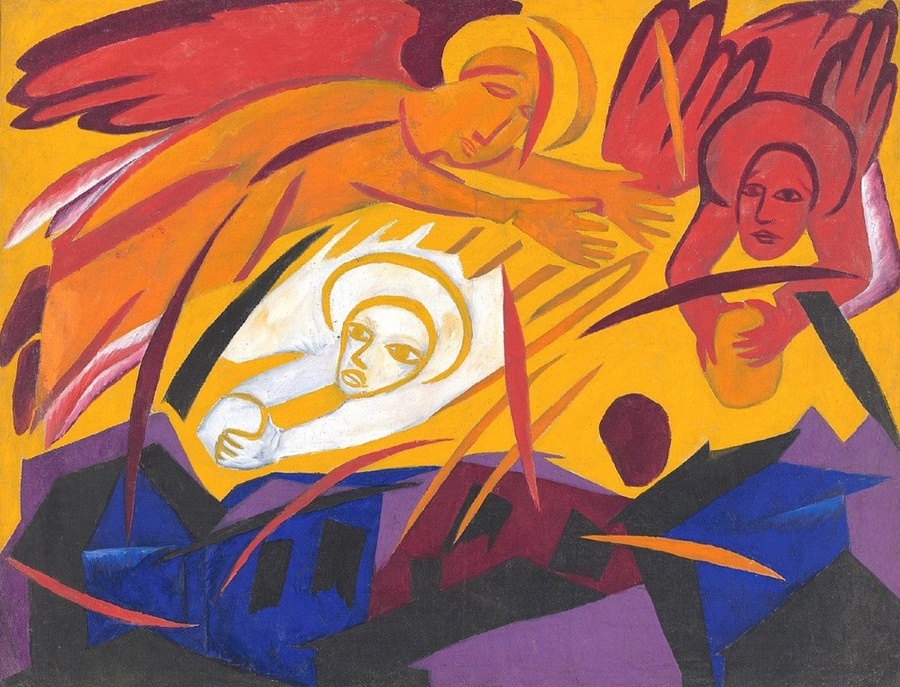
3. Angels Throwing Stones at the City, 1911. Natalia Goncharova
Navigation
Introduction
I. Anatomy of the Spirit: Voluntary Renunciation of Flesh
II. Geometry of Folds: Clothing as the First Construction
III. Weightlessness: The Body Beyond the Laws of Gravity
IV. The Shock of Discovery: Stripping Away the Veils of Olify
V. The Body-Machine: A Manifesto of Biomechanics
VI. The Suit-Spacesuit: Stepanova and Popova
VII. Visual Rhyme: Layering Eras
VIII. Digital Deconstruction: Echoes of the Avant-Garde in Contemporary Design
IX. Two Poles of a Single Deformation: Conclusion
X. Bibliography
INTRODUCTION
The Body as the Primary Object of Transformation
15. The Resurrection of Lazarus. 12th century. Wood, tempera. Byzantine and Christian Museum, Athens
19. The Crucifixion. Two-sided icon of «The Mother of God, Hodegetria. The Crucifixion.» 14th century. Wood, tempera. Byzantine and Christian Museum, Athens
Throughout the history of art, the human body has remained the primary field for visual experimentation. Artists of various eras intentionally distorted anatomy, rejected realism, and warped proportions—yet they did so for completely different purposes. In Byzantine and Old Russian icon painting, the body was deliberately stripped of flesh, weight, and anatomical fidelity. It became a transparent conduit for divine energy. Elongated fingers, weightless feet, and geometric drapery folds—all these elements served to create an image of spirit, rather than matter. Centuries later, the avant-garde artists of the early 20th century made a similar move: they too abandoned realistic anatomy, but for different ends—functionality, dynamism, and a new industrial plasticity. The body transformed into a mechanism, a structure, a vector of force. This study is an attempt to trace the visual connection between two eras separated by centuries, yet speaking a surprisingly similar language of deformation.
I. ANATOMY OF THE SPIRIT
The Rejection of Flesh as the Highest Form of Truth
36. Andrei Rublev. The Trinity. Icon. 1411 or 1425–1427
37. Saviour Not Made by Hands. Novgorod Icon Painting School, c. 1100.
38. The Apostles Peter and Paul. Icon from the mid-11th century. Novgorod Museum.
For the modern viewer, accustomed to Renaissance traditions, Byzantine iconography might appear «incorrect»: disproportionate figures, strange poses, and lack of volume. But it was precisely this «incorrect» language that offered the medieval master the only valid way to speak about truth. The body in icon painting was never a portrait of a specific individual. Instead, it became a sign, a symbol, a conduit. And the less it resembled ordinary flesh, the more accurately it conveyed its primary function—to be a window into the higher realm. In this chapter, we will examine the fundamental techniques of sacred deformation: frontality, hierarchy, elongation of proportions, and the geometry of drapery. Each of these techniques served a single purpose—to make the body transparent to the spirit.
61. Spas on the Throne, 16th Century. Tver
A Gaze Toward Eternity
59. The Last Supper. Icon from the Dormition Cathedral of the Kirillo-Belozersky Monastery. 1497. State Russian Museum
Frontality is the first and most obvious characteristic of the Byzantine icon. The figures look directly at the viewer, their bodies presented strictly frontally. This is not a coincidence nor is it an inability to paint in a three-quarter view—it is a conscious rejection of the fleeting moment. This frontal pose creates a sense of presence: the saint is not frozen in the past; they are here and now, looking at you. This hierarchy, this stillness, works like a magnet: the viewer’s gaze becomes fixed, and they themselves become part of the sacred space.
II. FOLD GEOMETRY
56. The Don Icon Turn. The Dormition of the Theotokos.
54. The Martyrs Paraskeva, Varvara, and Ulyana. Late 14th century. GTG.
Clothing as the first construction
Particular attention in icon painting was paid to the folds of drapery. They were never rendered according to the laws of physics—they did not fall under the influence of gravity, nor did they cling to the body. Instead, they evolved into an independent graphic system. The broken, angular folds in Theophanes created tension and dynamism. The smooth, rhythmic lines in Dionysius dissolved the body into a flow. In both cases, the clothing functioned as a construction that did not conceal, but rather revealed the figure’s inner energy. This technique—transforming fabric into a geometric system—would later become one of the primary discoveries that avant-garde artists would make through ancient iconography.
III. WEIGHTLESSNESS
52. Deesis. Mid-14th century. GRM.
51. Nicholas the Wonderworker in the Life of Saints Cosmas and Damian. Icon from the Ozyeryovo Cemetery. First half of the 14th century.