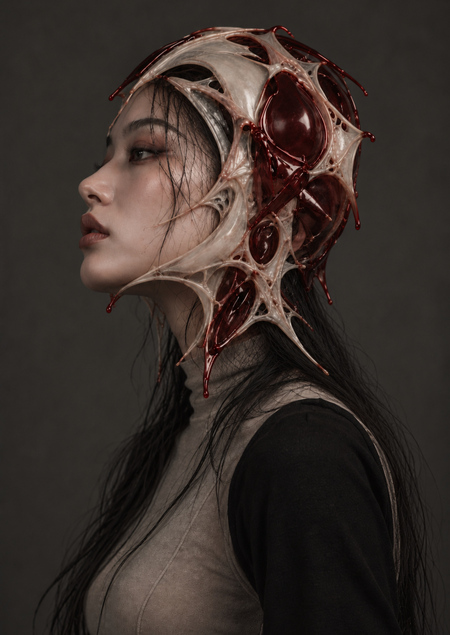
CONCEPT
SYMBIOSIS explores the moment an accessory ceases to be perceived as a discrete object and becomes an extension of the human body. The core concept of the collection is the idea of a symbiosis between the human and foreign organic structures. Three accessories interact with different parts of the body: a bag grows onto the side, a headpiece mirrors the anatomy of the skull, and a belt wraps around the waist, extending down the hips.
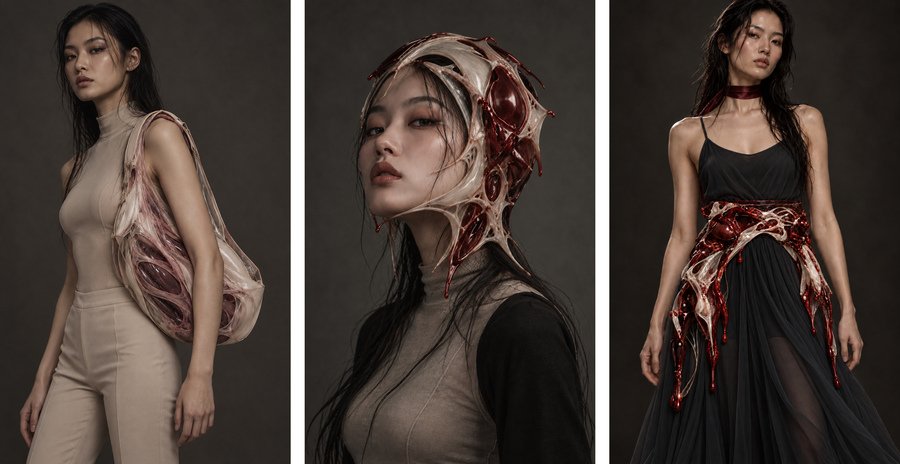
The collection’s primary contrast lies between control and organic growth. While the human imbues the object with purpose and method of wear, visually, the form seems to exist according to its own biological laws. Strict, functional construction is concealed beneath chaotic interweavings, semi-transparent membranes, and fluid volumes.Another crucial contrast is softness versus rigidity, allure versus repulsion, the natural versus the artificial. Flesh tones sit beside deep blood-red, smooth surfaces contrast with textured protrusions, and light, transparent casings meet dense internal structures.Each accessory represents a distinct mode of interaction with the body: attachment, incubation, and capture.
HOST
HOST embodies attachment and dependence. The bag seems to feed on closeness to the body, yet simultaneously adapts to it. Its form exists somewhere between an object, skin, and an independent organism.
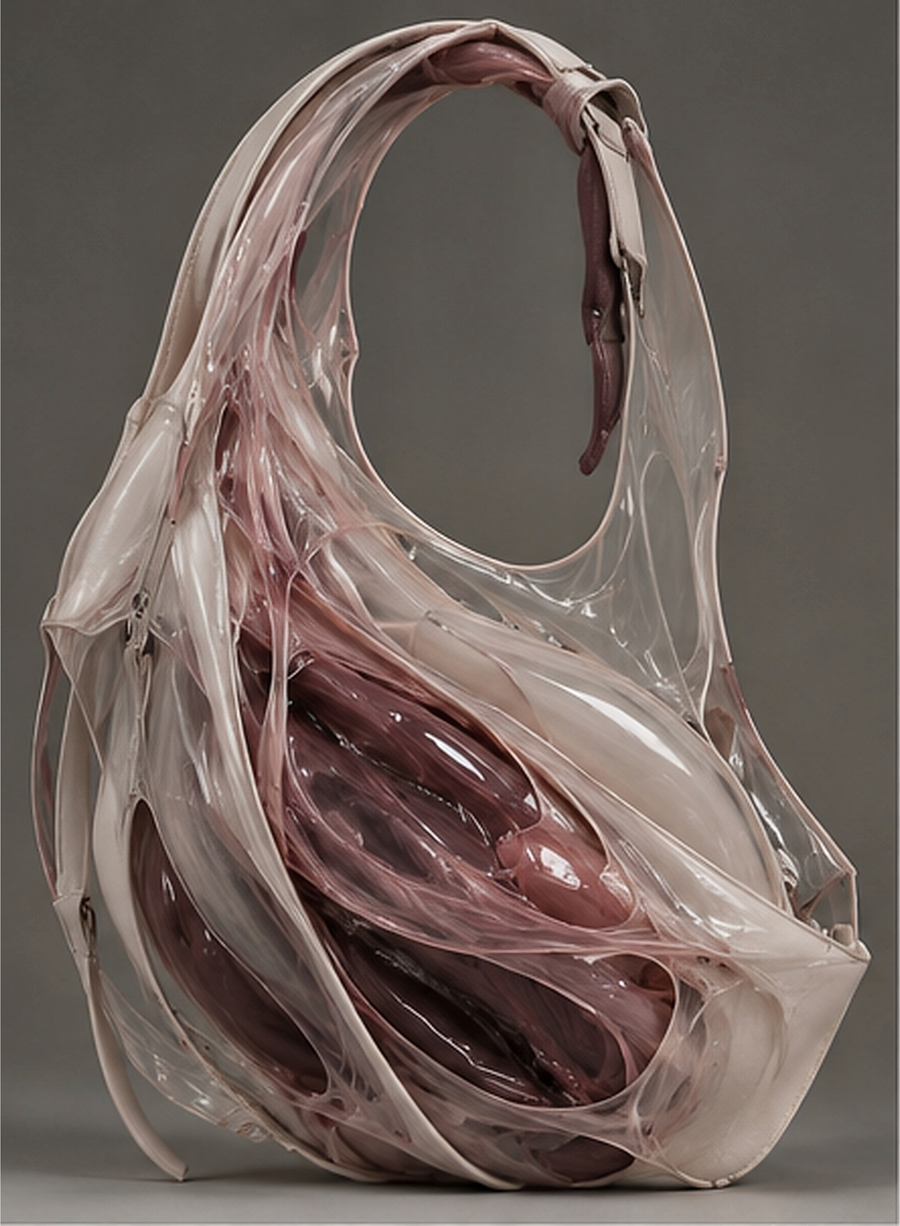
Its asymmetric form echoes the line of the shoulder and gathers the main volume toward the hip, visually continuing the human silhouette. The sculptural surface resembles stretched, peeling fabrics that reveal an internal structure.A contrast emerges between the bag’s functionality and its almost biological appearance. The object is designed to hold personal belongings, yet externally it resembles a living shell within which an unknown organism develops.
HOST — an asymmetrical bag with an elongated teardrop shape, designed to be worn over the shoulder, hugging the side of the body.The upper section forms a large, loop-like handle that smoothly transitions into the body of the bag. There is no sharp visual boundary between the handle and the main volume; the entire structure is perceived as a single, organic mass.The core of the design consists of semi-transparent membranes in beige, milky, and muted rose tones. They interweave to form elongated openings, thin struts, and areas of visual tension.Beneath the outer layers, denser burgundy volumes are visible. The contrast between the transparent shell and the saturated inner color creates the impression of hidden anatomy.The surface has an uneven texture: some sections appear smooth and taut, while others gather into bulges and folds. The semi-transparent elements sometimes resemble thin skin peeling away from the main form.Despite its sculptural nature, the bag maintains a functional interior volume. Access to the compartment is provided via a concealed side zipper.
Proposed structure and materials:
Outer shell—polyurethane-coated eco-leather.
Translucent elastic elements—coated Biflex.
Voluminous sections—EVA foam and soft foam.
Interior—textile lining.
Adjustable handle, hidden strap, and side zipper closure.
CHRYSALIS
CHRYSALIS symbolizes a transitional state. It is not a complete organism, but a casing within which change occurs.
The object balances between the image of a protective cocoon and a foreign structure gradually enveloping a human head.
The title references the pupa stage—an intermediate state where the organism’s familiar structure breaks down and reforms.The headwear resembles the exoskeleton or protective casing of an unknown biological creature. It echoes the lines of the head but simultaneously disrupts them with protruding elements, membranes, and asymmetrical formations.The main tension of the piece is between protection and vulnerability. The shell seems designed to guard the head, yet its open areas, delicate membranes, and seemingly sharp protrusions evoke a sense of fragility and incompletion.
CHRYSALIS — a sculptural headpiece featuring an open facial area and an asymmetric spatial structure.
The main form conforms to the upper and side portions of the head, echoing the lines of the skull, cheekbones, and neck. Individual elements extend below the jawline, forming elongated relief terminations.
The exterior surface is composed of two visually contrasting types of elements.
The first consists of light, translucent membranes in a milky beige hue. These form thin, taut sections, connect the structural framework elements, and resemble organic tissue.
The second comprises dense, glossy, dark-red volumes. These are embedded between the membranes, evoking capsules or internal organs encased within a protective shell.
Due to the combination of these elements, the headpiece is perceived as an object with its own internal anatomy.
The asymmetry is particularly significant. The left and right sides differ in the placement of volumes, the thickness of the connectors, and the direction of the projections. This creates the impression of a form that is still growing and has not yet reached a final state.
The face remains open. This preserves a visual connection with the human form, causing the accessory to be perceived as an enhancement to one’s appearance rather than a complete mask.
Proposed Structure and Materials
Contact layer — soft neoprene with a textile lining.
Volume elements — lightweight EVA foam.
Membranes — stretched biflex.
Surface coating — elastic polyurethane.
Fit — hidden adjustment strap at the nape of the neck.
Soft internal supports for load distribution.
CONSTRICT