Свеча как смысловой центр картины у утрехтских караваджистов и Жоржа де Латура
(01) Concept
Following Caravaggio, artists moved the light source inside the painting. I compare how Utrecht Caravaggisti and Georges de La Tour paint a candle, checking whether it merely illuminates the scene or imbues it with meaning.
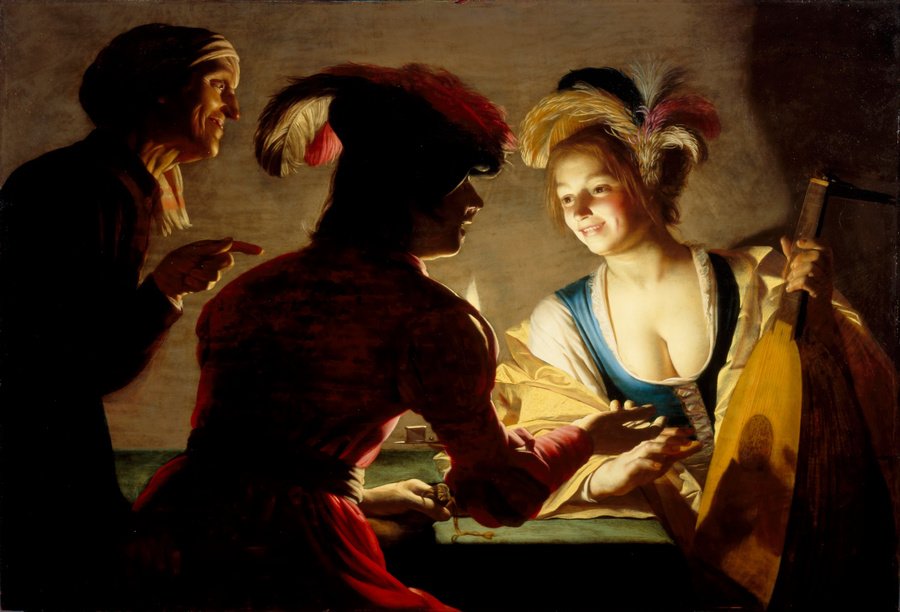
Gerrit van Honthorst. Group portrait. 1625. Centraal Museum, Utrecht.
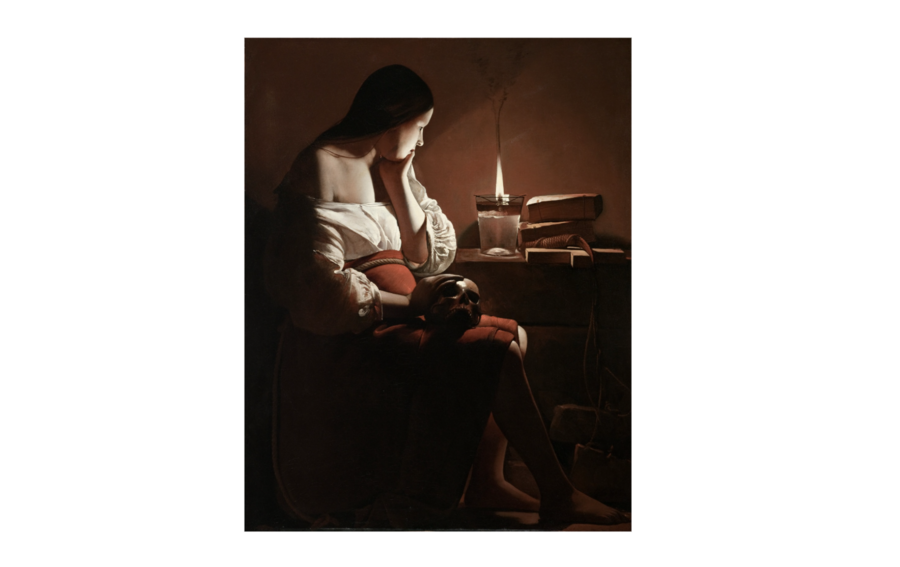
Georges de La Tour. Magdalen with a flaming taper. c. 1635–1637. Los Angeles County Museum of Art
Both paintings are illuminated by a single small flame, yet they appear almost opposite. In Honthorst’s piece, the candle illuminates a richly dressed young woman with a lute, while the old cloister and the client remain in shadow. In Latour’s work, Magdalene sits before the lamp, one hand resting on a skull, and nothing happens in the painting. My research began with this comparison.
Why a Candle?
Caravaggio himself rarely showed the light source; his rays appear to fall from an unseen window. His followers reintroduced the candle into the paintings. I am interested in what happens when the light source becomes a visible object. It can be hidden behind a hand, placed between characters, or used as a symbol. Each painting of this kind reveals where the fire is, where the shadow falls, and what lies outside the circle of light, making the candle useful for visual analysis.
Material Selection Process
I am comparing two groups of artists. The first group consists of the Utrecht Caravaggisti: Gerrit van Honthorst, Hendrick ter Brugghen, and Dirk van Baburen. In the 1610s, they worked in Rome, and by 1620, they had returned to Utrecht [1; 7; 9]. The second group includes one artist, the Lorraine master Georges de La Tour (1593–1652). I ground my comparison in three arguments. All works were created approximately between 1617 and 1650. Both groups developed from the Caravaggesque tradition, and La Tour is constantly discussed in literature alongside the Northern Caravaggisti [8; 11]. Finally, they depicted the same subjects—for instance, the Christ Child with a candle next to Joseph, the «Adoration of the Shepherds, ” or a nocturnal scene around a table. The selection includes paintings where the source of light is visible or clearly implied. Two paintings featuring a lamp and one featuring a torch were included as controls. These paintings illustrate whether the object itself is significant or how the surrounding scene is constructed around it.
How the Research Works
The structure is thematic. Each section is dedicated to a specific function of fire, progressing from simple to complex. First, light is hidden behind a hand; next, a candle stands between two figures; then the fire burns in a genre scene; later, it becomes a symbol of ephemerality and accompanies a scene of wonder. The final section brings together large facial fragments because the difference in handling light is best observed on them. In every section, the works of Utrecht painters are displayed alongside the works of Lauter.
My Sources of Reference
The first group of sources includes monographs and exhibition catalogs, primarily «Georges de La Tour and His World» [8] and the book by J. Tuillier [13]. The second group consists of academic articles, including works by M. A. Demidova on La Tour [3; 4] and articles by Wang Yizhi on Utrecht Caravaggisti [1; 2; 14]. The third group comprises scholarly descriptions of paintings found on the websites of the museums where they are housed. From these, I extract dating information, details on technical studies, and iconographic data. The descriptions and analysis of the paintings in my long-read are my own work.
Question and Hypothesis
Does the candle in the painting merely illuminate the scene, or does it define its meaning and mood?
My hypothesis is this: For the Utrecht artists, the candle often functions as a theatrical device. It spotlights faces, creates the effect of a night scene, and is connected to play, seduction, and revelry. For Latour, the candle itself becomes the object of contemplation. It reduces the scene to silence and stillness, and the flame transforms into a symbol of life’s finiteness and divine light.
(02) Hidden Light Source
The hand shielding the flame appears in both Honthorst and Latour. Yet, one presents the miracle openly, while the other constructs it on the premise that the fire is hidden.
Gerrit van Honthorst. The Childhood of Christ. c. 1620. State Hermitage Museum, St. Petersburg
The narrative that both Hunthorst and Latour referenced provides a convenient point of departure. The Boy Jesus shines upon Joseph in the workshop. In Hunthorst’s version, this is a wide, horizontal canvas. Joseph is leaning over a board; Mary and the angels stand beside him, while the boy holds a candle, shielding the flame with his palm. Light spills across the faces and hands in patches of russet and red. The figures are arranged along the canvas like actors on a stage, allowing the viewer to see everyone at once.
Gerrit van Honthorst. Childhood of Christ (Fragment). c. 1620. The State Hermitage Museum, St. Petersburg
In the Hermitage annotation, the scene is called «almost intimate, ” and the candlelight is linked to the words „I am the light of the world“ (John 8:12) [5]. This means that even for Honthorst, the candle carries a Gospel meaning. This leads to the first amendment of the hypothesis, because the symbolic fire is also present in Utrecht.
Latour and the Same Subject
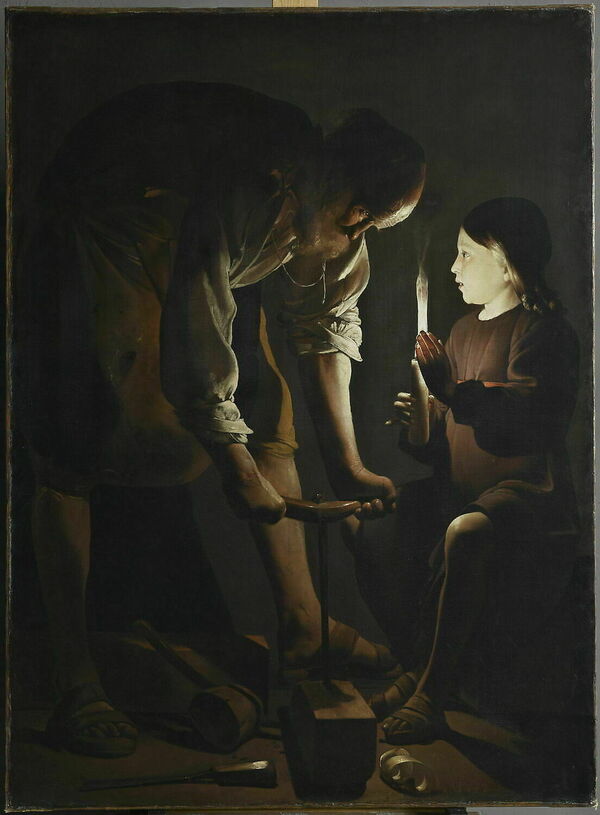
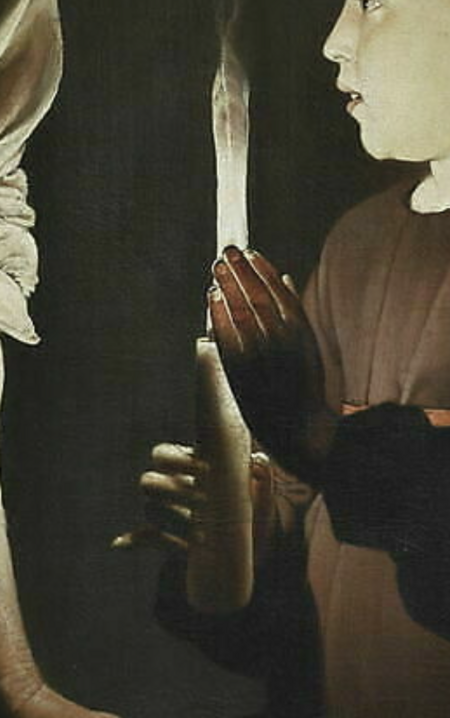
Georges de La Tour. Saint Joseph the Carpenter. c. 1642–1644. Louvre, Paris
Latar leaves two figures in this scene and shifts to a vertical format. Joseph is drilling a beam, and the boy sits opposite, holding a candle while shielding the flame with his left hand. The background is dark and empty, with almost no space between the figures.
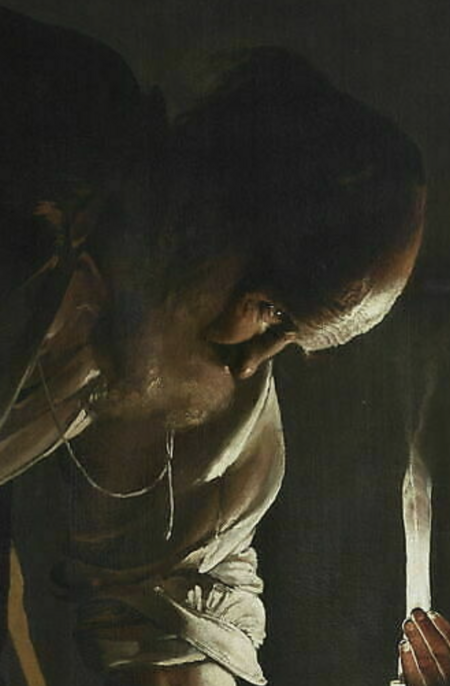
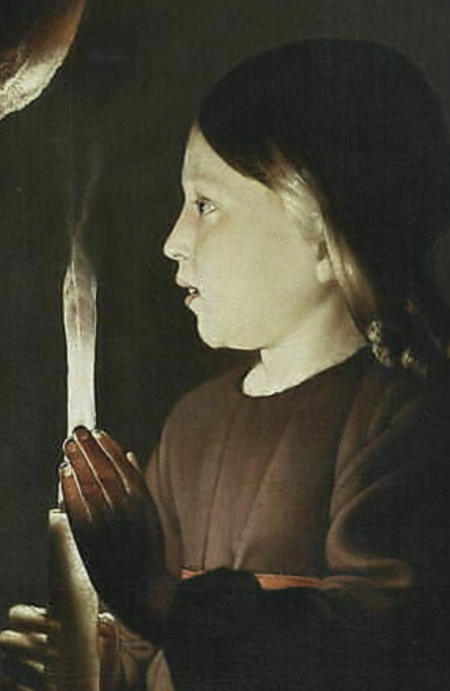
Georges de La Tour. Saint Joseph the Carpenter (fragments). c. 1642–1644. Louvre, Paris
The fragments show light passing through a child’s fingers, coloring them red, while the sliding light stretches the wrinkles on an old man’s forehead. This contrast between wrinkles and smooth skin is noted in the Louvre’s description. The painting is also connected there to the Catholic Reformation’s pursuit of «touching hearts» through the relatable familiarity of everyday life [23]. The child’s face is illuminated most brightly, even though his own hand covers the candle, giving the impression that the light comes from Christ himself. Honthorst needed a title for this very meaning, whereas Latour uses a single light source.
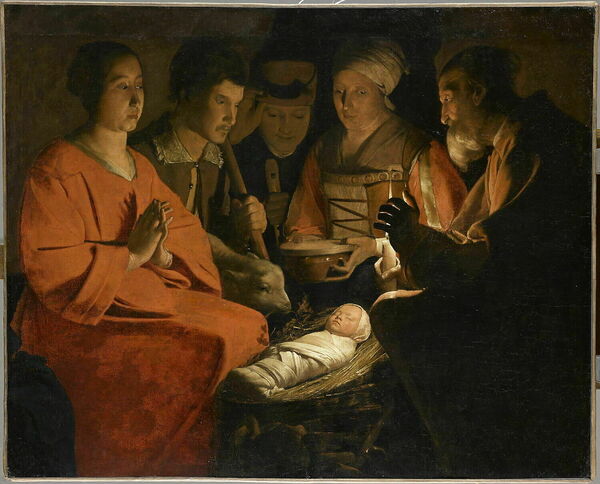
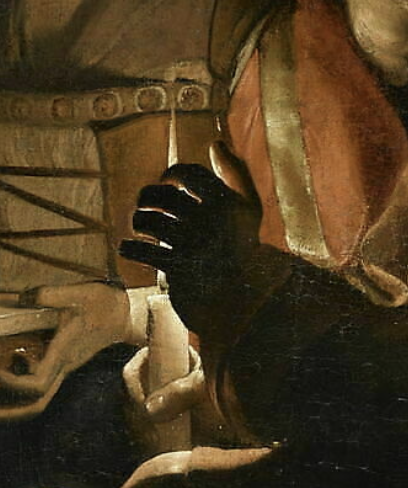
Georges de La Tour. The Adoration of the Shepherds. c. 1644. Louvre, Paris. Georges de La Tour. The Adoration of the Shepherds (fragment). c. 1644. Louvre, Paris.
Joseph holds the candle here, also shielding it with his palm. At the Louvre, this gesture is associated with the idea of a «hidden God.» The flame represents Christ, and the adoptive father conceals the divinity of the Son just as his hand conceals the fire [21]. The figures stand in a semicircle above the basket holding the Infant, their heads nearly level. Mary’s red dress and the shepherds’ brown cloaks are evenly lit; the fire itself is barely visible.