Essay
Mornings on the Community Avenue begin with movement. Forum participants hurry along the pathways—some head toward lectures, others rush to the start of workshops. But there is one spot almost everyone visits sooner or later—the cafeteria at the intersection with Good Deeds Street, near the «Inspiration» space.
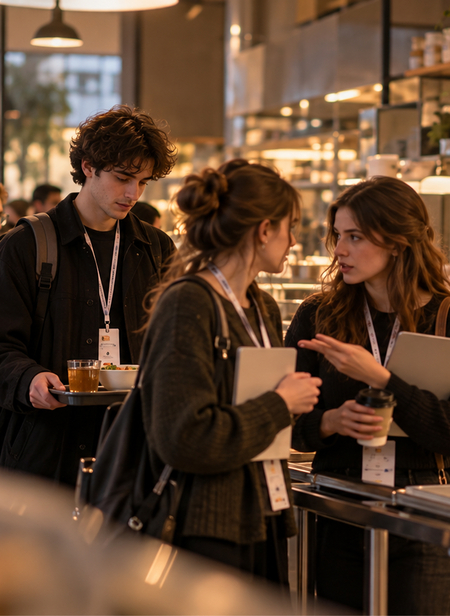
Inside, the air is filled with the scent of fresh food, trays clinking, and voices blending. There are no stages, no microphones, and no rigid speaking schedule here. Instead, there are tables, a line, and people who can finally pause. Some choose their lunch, some look for an open seat, and some have already struck up a conversation with a stranger.
The line moves slowly, and this time is rarely wasted. Two people notice the same name tags and realize they are working on similar projects. Someone recalls an interesting point from the morning lecture, and the conversation gradually attracts new listeners. Sometimes an acquaintance begins with a simple question about which dish is best today. Within minutes, people are discussing ideas and exchanging contact information.
In the cafeteria, forum participants become a bit different. During lectures, they listen to speakers, jot down important thoughts, and strive not to miss anything valuable. Here, however, people can speak freely, without worrying about how much time is left until the next event. Sometimes, the best ideas are born during lunch—ideas that never made it into the official program.
People from completely different fields find themselves around the same table. Initially, the conversation revolves around food, then moves to topics discussed at the forum, and finally turns to a shared venture that no one intended to start that morning. Some suggest pooling their efforts, others promise to help with organization, and some unexpectedly find a future partner.
By evening, the dining hall fills with people once more. After a packed day, they return here to have dinner and share their experiences. Amidst the buzz of voices mingle snippets of discussions, jokes, and plans for the next day. For some, it’s simply a place to eat; for others, it’s an opportunity to continue a conversation that had to be interrupted for the next event.
If you try to recall the forum later, what remains in memory will not just be the presentations and formal meetings. You’ll remember a random remark in line, a chance meeting at a shared table, and an idea that struck between the first and second courses.
The Community Avenue dining hall seems like an ordinary spot, but it is precisely here that one can clearly see how a genuine community is formed. Sometimes, large halls and rousing speeches are unnecessary for this. A few free minutes, shared food, and people who have something to say to each other are enough.
Legend. The dining hall on Dobrykh Del Street: phrase of the day
On Community Avenue, where Kind Deeds Street meets the «Inspiration» space, stands a cafeteria with glass doors that fog up with steam by nine in the morning. Inside, there are long communal tables, a serving station with a gleaming counter, and a chalkboard by the register. Every morning, a single line appears on it. It is called the «Phrase of the Day.» At opening, a line gathers at the doors: some with a folder under their arm, some with an unread brochure, some with faces that have not yet fully woken up. It smells of hot bread, tea, and a hint of cinnamon. Miron arrived at the forum alone. He didn’t know anyone, and the morning lecture passed him by: he jotted down a question on a piece of paper, raised his hand, waited for the lecturer to nod, and then dropped it because others had already started talking nearby. Teams were gathering around—everyone understood each other at a glance. Miron crumpled the paper, slipped it into his pocket, and headed toward where the smell of hot bread was coming from. At the entrance, he hesitated, grasped the cold handle, and considered just turning around and leaving. Through the glass, he could hear laughter, the clinking of spoons, and someone’s debate about something decidedly non-academic. He pulled the door open.
The line snaked along the wall. He took a tray from the edge, ran it along the cold runners, and stood behind two girls. They argued in low voices without turning around. — The project is about urban stories, — one said. — But we can’t come up with a title. — Because there are two of us, and each one is pulling in a different direction, — the other replied. — We need a third. Miron looked at the board. Chalk lay in the groove; there were no lines. A cook, Valentina Ignatievna, whom everyone called Aunt Valya, worked at the serving station. She wrapped a hot pot in a towel, ladled the thick soup into a bowl, and placed it on Miron’s tray. — Are you alone? — Yes. — We don’t have loners in line. The line isn’t for standing; it’s for meeting.
Valentina Ignatyevna pulled a worn notebook out from under the counter, quickly jotted something down, and put it away. Everyone knew about this notebook—Aunt Valya had been recording everything she heard in line for many years. Miron took a piece of bread, placed a glass of compote beside it, and walked to the table. There were hardly any empty seats left, so the girls sat across from him. A young man with a camera around his neck placed a plate next to them.
— I’m David. I photograph everything, — he said. — Why are you both so glum? — We don’t have a title, — Kira sighed. Miron listened as the two girls brainstormed titles: «Courtyard, ” „Map, ” „Window.“ They all sounded flat. He stirred his soup, recalled how, in lines, everyone unconsciously turned toward the person next to them, and suggested: — What if we call it „Queue“? The most honest story of this city starts with people standing together. The girls fell silent. One pulled out her phone; the other, a pen. — What’s your name? — the first one asked. — Miron. — Alyona. And this is Kira. You’re with us now. — Me too, — David added. — Someone has to take the pictures. Alyona pushed the napkin closer and wrote in large letters: „Queue.“ Kira sketched three small figures in a row beside it, and David added a fourth, slightly off to the side. — That’s you, — he told Miron. — No, — Miron replied. — I’m in the middle. The soup had long since cooled, but no one noticed.
Aunt Valya walked by with a tray of empty plates, heard his words, stopped, and returned to the blackboard. In large, forceful letters, she wrote with chalk: «The most honest story of the city begins with people standing side-by-side.» By lunchtime, the line was read in the «Inspiration» area. By evening, it was repeated in lectures. A four-person team, who had conceived the title and assigned roles during one breakfast, presented their work that evening. Miron walked onto the stage, took the same crumpled piece of paper from his pocket, smoothed it on his knee, and finally posed his question—not to himself, but to the audience. The hall responded with laughter and the warmest applause of the day. The next morning, the blackboard by the cashier was clean, and everyone stood in line, guessing what line would appear that day. Miron arrived earlier than anyone else. He took a paper ticket for breakfast, wrote down a phrase he heard in the queue on the back, and slipped the ticket into his pocket. Aunt Valya noticed him tracing the words with a pen and nodded. «Are you taking this home?» «Yes. May I see your notebook?» Valentina Ignatyevna pulled it out from under the counter and opened it to the middle. The pages were filled with various handwriting, the lines crowded against one another, and there were spots from compote visible in the margins. «This is all of our queue over many years, ” she said. „Not all of it, of course. Only the best.“ Since then, it has been the tradition in the Dining Hall of Good Deeds: whoever takes a ticket writes a line on the back, and Aunt Valya transfers the best ones to the blackboard. And they say that in this queue, people don’t wait—they meet.