MEDIEVAL MARGINALS AND THE MOTIF OF THE REVERSED WORLD: THE EXAMPLE OF THE «GORLESTON PSALTER»
Visual Research Concept.
Rationale for Topic Selection The motif of the «upside-down world» in Gothic marginalia is captivating because it reveals how medieval artists commented on the social reality of their time through humor and absurdity. In an era where visual content plays an immense role, studying the historical mechanisms of visual commentary is especially relevant for the creative industries. Material Selection Principle The research focuses on a single manuscript—the Gorleston Psalter (British Library, Add MS 49622)—created in Eastern England around 1310–1324. Twenty of the most expressive illustrations from the manuscript, which depict the upside-down world motif (animals and reversals), were selected. Structure Principle The work is divided into an introduction, the manuscript’s context, a detailed visual analysis of the main motif, other manifestations of the motif, and a conclusion. Source Selection and Analysis Principle Fundamental academic works, officially digitized materials from the British Library, and the library’s blog were utilized. The primary method employed is the author’s visual analysis of the images. Key Question and Hypothesis Key Question: How do the animals and reversals in the Gorleston Psalter marginalia function as social commentary? Hypothesis: The upside-down world motif serves not only as entertainment but also as a means of gently criticizing social norms and hierarchies through visual absurdity.
Introduction
Marginalia are drawings found in the margins of medieval manuscripts, often appearing as whimsical or strange illustrations. However, beneath this apparent simplicity lies a complex visual system. Following the instructor’s recommendation, I focused my work on a single manuscript—the Gorleston Psalter (British Library, Add MS 49622). This allowed for an in-depth visual analysis.
Medieval marginalia are often perceived as mere ornamentation or artistic jokes. However, upon closer examination, they reveal themselves as a complex visual language through which artists commented on the surrounding reality. Of particular interest is the motif of the «world turned upside down» (monde renversé), where animals behave like humans and conventional hierarchies are inverted. In this work, I conduct a visual analysis of this motif using the Gorleston Psalter—one of the richest English Gothic manuscripts from the early fourteenth century—as an example. The main focus is on how animals and reversals function as social commentary.
Gorleston Psalter: Context and General Manuscript Design
The page demonstrates the typical structure of a Gothic manuscript: a central text, an initial, and rich marginalia. It is evident even here that the margins are utilized as an autonomous space for visual expression.
The blending of the human and animal body violates natural boundaries. This is one of the fundamental techniques of the «inverted world,» emphasizing the constructed nature of social categories.
Animals play musical instruments, parodying human activities. This serves as a social commentary on the hierarchy of entertainment and culture.
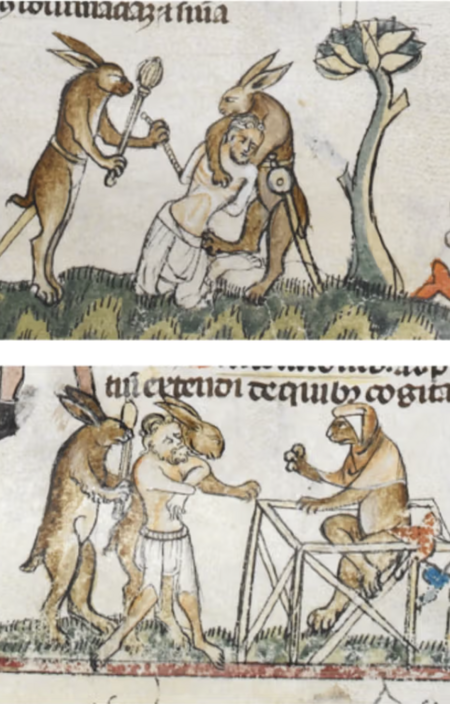
Rabbits hunt people. A weak animal becomes the hunter—a vivid example of a world turned upside down.
The monkey parodies the knight. It is a mockery of the chivalric ideal and social status.
Analysis of the overall design of the Gorleston Psalter reveals that the marginalia are not arbitrary embellishments. They actively engage with the central text, creating an additional layer of meaning. Even at the compositional level, it is evident that the artist intentionally uses the margins as a space for visual commentary. The chosen images demonstrate a variety of «world turned upside down» motifs. This confirms that the marginalia in this manuscript constitute a deliberate system, rather than a chaotic collection of jokes. Thus, we can proceed to a more detailed analysis of a key motif.
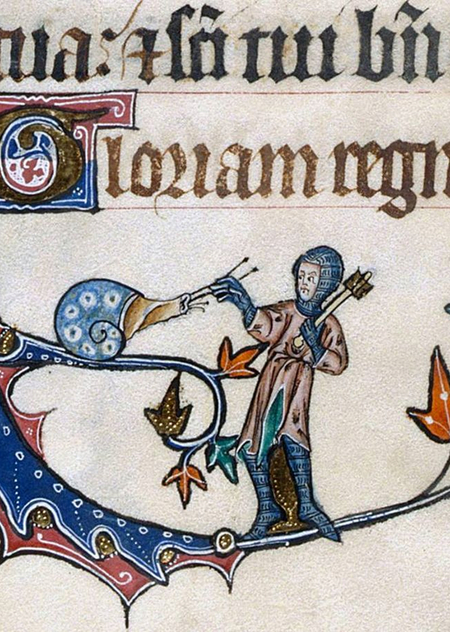
The main motif is «Knight versus Snail»:
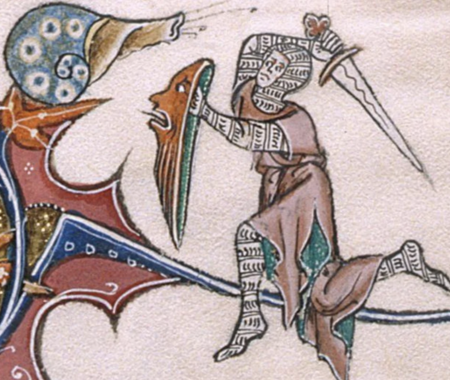
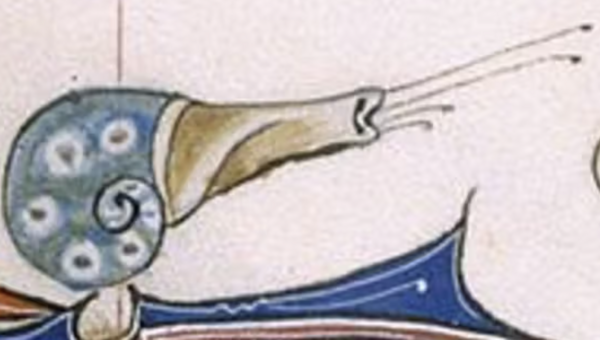
Knight versus enormous snail. An inversion of military hierarchy and a comparison of scale.
The snail holds a steadfast position, its horns aimed like a weapon. This is a visual parody of a knightly duel.
Here, a knight is kneeling before a snail. The pose expresses capitulation—a strong warrior surrendering to a weaker opponent.
The horns function as spears. The artist uses this technique to emphasize the absurdity of the situation.
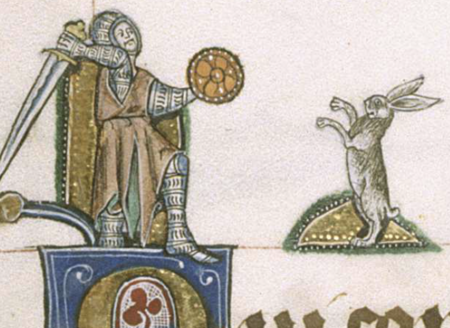
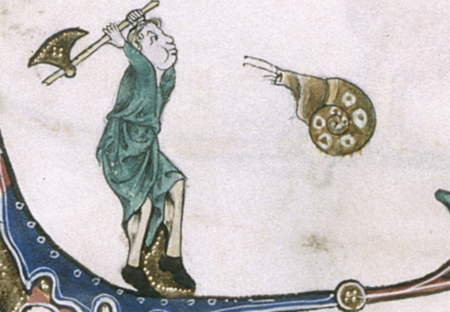
Here, the contrast between two similar marigolds is shown: on one page, confrontation; on the other, defeat. The motif develops as a visual narrative.
A detailed visual analysis of the «knight versus snail» motif confirms that the artist employed scale, placement height, and gestures to create a striking effect of reversal. The snail, as a «low» creature, consistently towers over the knight—a symbol of power and status. This is not merely a humorous scene; it is a visual social commentary. Comparing the different variations of the motif reveals a consistency in the approach. Thus, the hypothesis regarding the systematic nature of the motif receives its first serious confirmation.
Other manifestations of the world’s opposite motives:
Fox as a priest. A parody of religious authority.