«СПАТЬ НОРМАЛЬНО»
Медиа о сне для тех, кто устал даже отдых делать правильно
Media Concept
Our media outlet is dedicated to the culture of sleep and recovery in modern life. We explore how the digital environment, work habits, stress, and daily decisions affect the quality of rest. Our core mission is to make scientific information about sleep understandable, accessible, and applicable to real life. We do not offer universal prescriptions, romanticize productivity, or turn sleep into just another obligation.
Goal
To help the audience approach their sleep more consciously, understand the causes of fatigue, and form healthier relationships with rest.
Audience
Young people, students, and working professionals who deal with sleep deprivation, information overload, and challenges in recovery.
Positioning
A science-backed sleep media presence that avoids fear-mongering, pseudoscience, and the pressure of an idealized lifestyle.
Value Proposition. A media platform about sleep culture that explains scientific research in simple language, debunks myths, and helps improve rest quality without pressure or complex rules.
Channels and Rhythm. The main channel is Telegram, with 2–3 posts per week. Additionally, there will be short videos, infographics, and polls.
Sections. «Sleep Science, ” „Myth or Fact? , ” „Sleep and Technology, ” „Restoration Rituals, ” and „Why We Don’t Get Enough Sleep.“
For this assignment, it is important that: the media relies on scientific data, so AI assists in searching, collecting, and structuring information, while a human verifies the facts, formulates conclusions, and is responsible for the final content.
Data sources for media
Our media is built upon scientific research on sleep, official statistics, and audience experience. Scientific sources help create credible content, while subscriber questions and analytics show which topics are most relevant. In total, we rely on nine primary data sources.
Source Verification Principle. We verify scientific facts against primary sources, and we do not present subscribers' personal experiences as established patterns. AI assists in gathering and systematizing data, but the editor makes the final decision on its use.
Data Schema
Every piece of media we produce goes through a seven-stage process. The machine handles repetitive tasks—gathering research, sorting information, extracting facts, proofreading the text, and scheduling posts. The human decides on the topics, verifies the data’s accuracy, frames the conclusions, and is responsible for the final editorial content.
The boundary operates on one principle: the machine works with data, while the human works with meaning. Since media addresses issues of health, the selection of a topic, the verification of scientific facts, and the formulation of recommendations are not fully transferred to the AI.
Exception: The AI can assist in creating illustrations and infographics, but the author verifies their accuracy, edits them, and approves them before publication.
Practical example from the Content track of the second Design Project
Title: Example: Post «Can You Trust Sleep Score in an App?»
Subtitle: How a piece from the «Sleep and Technology» feature is processed through seven stages.
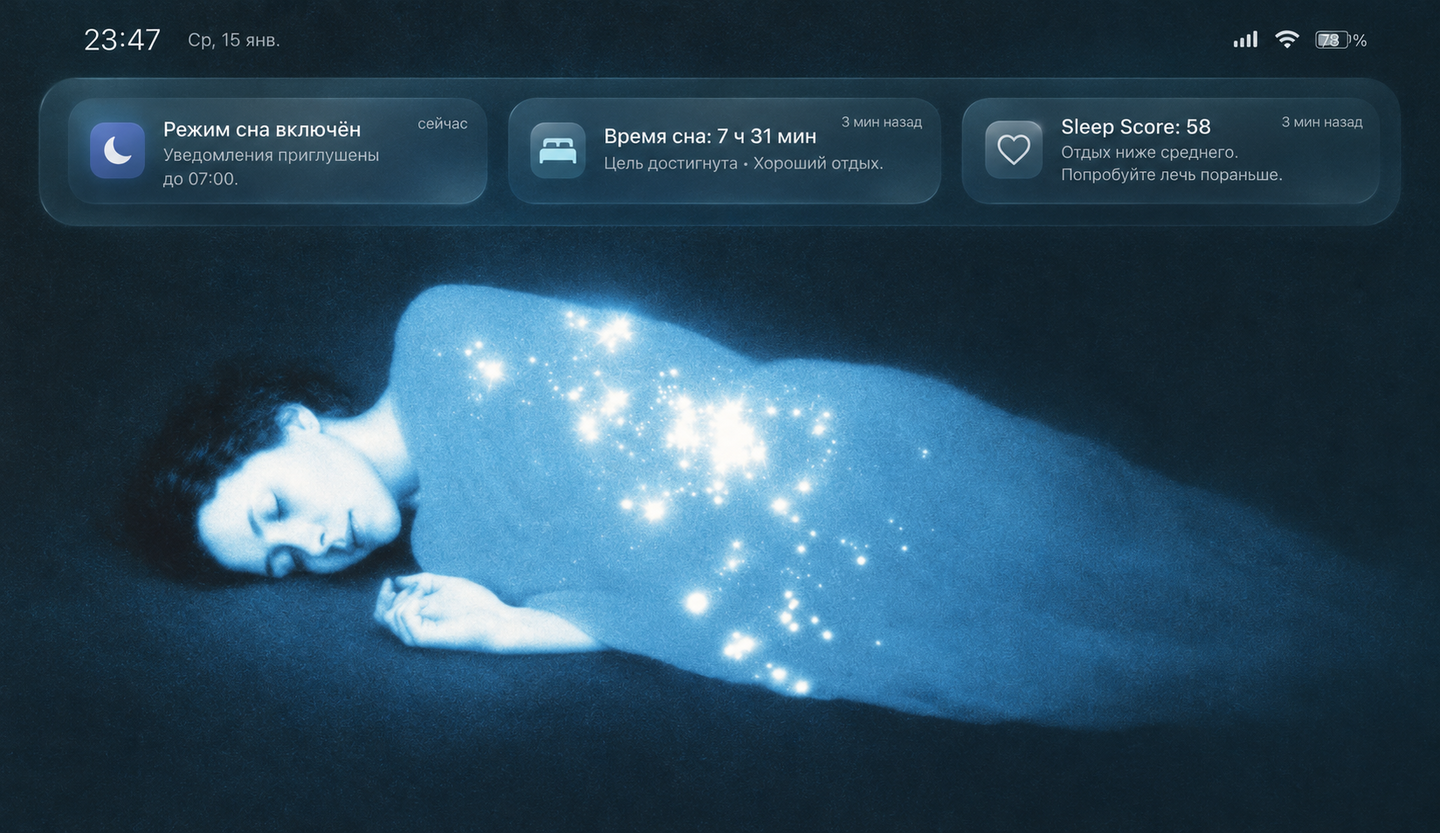
1. Collection. The author selects the topic: sleep evaluation in apps. The system gathers scientific materials regarding sleep trackers and the principles of measuring sleep quality.2. Selection. The AI groups the found information and highlights the main questions. The author selects the central one: how accurately does the app evaluate sleep quality?3. Preparation. The system compiles a brief summary of the research. The author verifies the primary sources and formulates the core idea: an app’s assessment is not equivalent to medical diagnosis.4. Creation. The author writes the text and creates cards featuring an example of Sleep Score 58. The AI assists in preparing the structure and adapting images for the publication format.5. Review. The system corrects typos and verifies links. The author cross-references the scientific claims and proofreads the material.6. Publication. The approved post is automatically published on Telegram. The author responds to subscriber questions and proposes a discussion on using sleep trackers.7. Analytics. The system collects views, reactions, and discussion results. The author decides whether to continue the topic of smartwatches and sleep apps.
Guidelines for Each Service
Guidelines for Automated Services
Automation in our media helps gather scientific data, draft documents, and analyze publications, but it does not make editorial decisions autonomously. Below are six general rules and instructions for each service in our scheme.
General Guidelines 1. Conclusions and final text are the author’s responsibility. AI does not formulate independent medical advice. All scientific assertions and the final material are verified by a human.2. Every fact comes from a primary source. Statistics, research findings, and recommendations are accompanied by citations. The author verifies their accuracy and context.3. Personal data is not transmitted to neural networks. Before processing comments and surveys, names, contacts, and other personal information are removed.4. All machine-generated content is labeled. AI outputs include a date, source, and the status «draft.» Generated illustrations are marked upon publication.5. One task yields one result. For each service, the input data, processing rules, and a unified output format are defined.6. Media operates without automation. Any stage can be performed manually. If repeated errors occur, the service shuts down pending verification.
Draft Outline Request Template
You are an assistant editor for a popular science media outlet focused on sleep.
Before you is a scientific publication: [title, text, and link].
Identify up to seven key facts about sleep and recovery.
For each fact, include an exact quote from the study and specify its location within the text.
Separately, note the limitations of the research.
Do not invent data, offer medical advice, or state your own conclusions.
If information is missing, write «not specified.»
**Format: ** fact — quote — limitation — source.