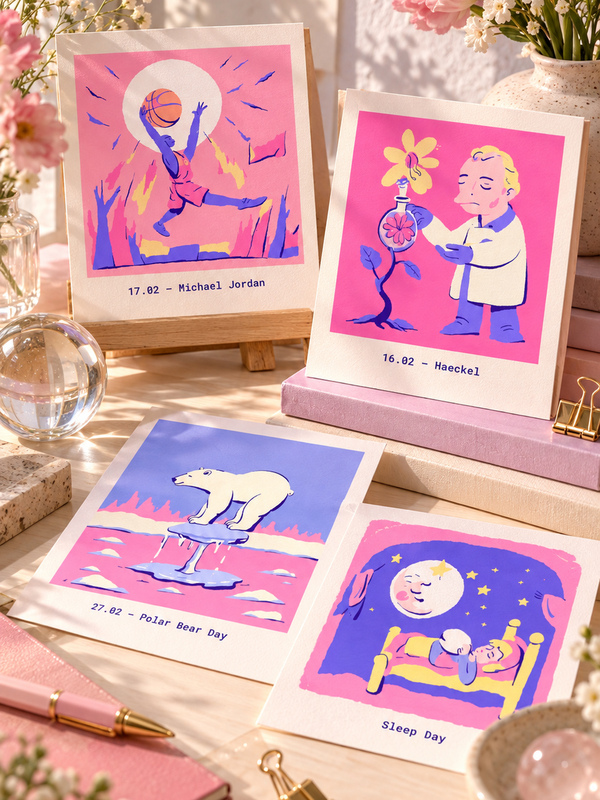

The calendar continues—an experiment training Stable Diffusion XL on my original series of 22 calendar illustrations dedicated to the holidays and birthdays of famous figures.
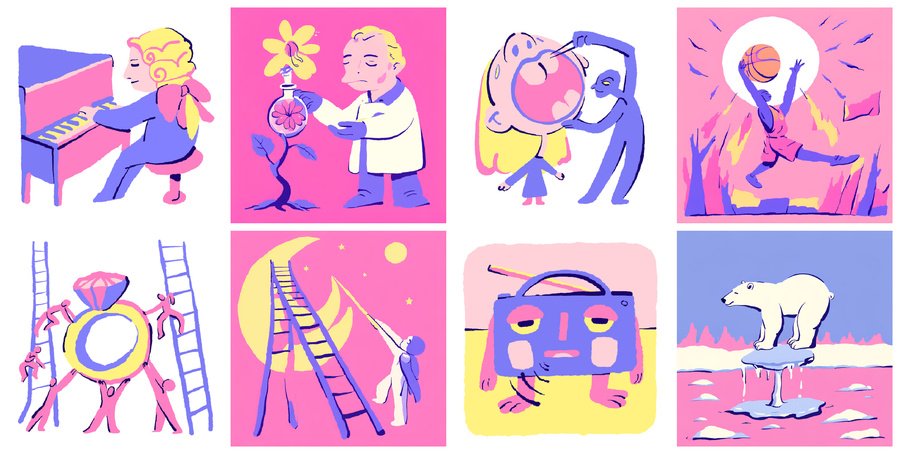
The core of this project is my series of 22 square illustrations designed for a calendar, sequentially distributed from January 23rd to February 13th. The subjects for the illustrations were holidays, significant dates, and birthdays of notable figures. The primary goal of the original series was not to literally depict the event, but rather to find a simple visual metaphor. Each narrative revolved around a single image or action: an object might change its function, scale up, connect with another object, or transform into something unexpected.
I wanted to test whether the model could capture not just a limited palette, an uneven line, and conceptual characters, but the entire principle of the project—constructing an image around a single, simple visual metaphor.
Holiday Calendar: Illustrations Created with AI and Human Input
Original Series
Holiday Calendar, Hand-Drawn Illustrations
For this project, I used 22 of my own illustrations, each sized at 700 × 700 px. All images were created before working with the neural network and share a cohesive visual system: a limited color palette, flat color fields, dark irregular outlines, simplified characters, and concise composition. Despite the varied subject matter, a unifying principle remains throughout the series: the center of each image typically features a single visual situation that must be quickly decipherable, yet not entirely literal.
Holiday Calendar from January 23 to February 13, hand illustrations
Dataset Preparation
The dataset included only individual square illustrations, without calendar grids, dates, or typography. This was done specifically so that the model would train on the images themselves, rather than on the calendar design. An automatic caption was created for each image using BLIP. This caption was supplemented with a general style marker:
metaphorical flat illustration in KSCALSTYLE style
The automated captions were not always accurate. The model particularly struggled to describe images based on metaphor—it frequently listed objects and characters literally, failing to grasp the relationships between them.
This stage alone demonstrated the difference between object recognition and understanding a visual concept.
Model Training
For this project, Stable Diffusion XL was utilized with the DreamBooth LoRA method. LoRA allows for the fine-tuning of a base model on a custom set of images without retraining the entire Stable Diffusion model. This process creates a separate, small weights file that is then connected to the original SDXL for image generation. The training was conducted in Google Colab on a T4 GPU. Key parameters for the initial training included: — Dataset: 22 images — Training Resolution: 512 × 512 px — Steps: 500 — Learning Rate: 1e-4 — Mixed Precision: fp16 — Custom captions were used — Intermediate checkpoints were saved after 250 and 500 steps. After 500 steps, the file pytorch_lora_weights.safetensors was generated.
Generation
A Comparative Analysis of Manual Illustrations and Neural Network Styles
After the training, I began using the KSCALSTYLE marker in new prompts. Initial experiments revealed an interesting characteristic. The model quickly adopted the external features of the series—the colors, the line quality, and the character types—but it did not always maintain the principle of visual metaphor on its own. For instance, if the prompt only contained the holiday name, the model might create a decorative composition made up of numerous thematic symbols. Consequently, the prompt structure gradually changed. Instead of a general request like: «a metaphorical illustration for Valentine’s Day in KSCALSTYLE style, ” I started describing a specific visual scenario, such as: „two small figures assembling one heart from two separate pieces, ” or: „a person climbing a ladder toward a small moon.“ Additionally, I incorporated phrases into the prompts like: „simple composition, ” „one central visual metaphor, ” and „white background.“ This brought the generations closer to the compositional principles of the original series.
Final Series
What the model was able to absorb
The palette proved to be the most consistent result. The new images consistently feature the pink, lilac, yellow, and dark blue colors from the original project.
Other formal characteristics are also well preserved:
— flat blocks of color;
— dark, drawn outlines;
— simplified human figures;
— absence of realistic volume;
— intentionally slightly naive plasticity;
— large objects and a disruption of conventional scale.
In some images, the model accurately continues the series’ compositional principle: one figure interacts with one significantly enlarged object, and this interaction becomes the metaphor.
What turned out to be harder
The model fails not in reproducing the visual style, but in grasping the logic of the metaphor. It can perfectly replicate a palette and line work, but when given too general a prompt, it substitutes the metaphor with a collection of obvious symbols. For instance, the theme of love easily devolves into numerous hearts, and the theme of space into a decorative arrangement of planets. Therefore, learning from an artist’s series does not mean the model has automatically absorbed the method of conceptualizing images. To achieve the most convincing results, the metaphor first needed to be articulated in text, and only then was the model asked to render it within the studied visual language. This became one of the project’s primary findings.
Variability of Outcomes