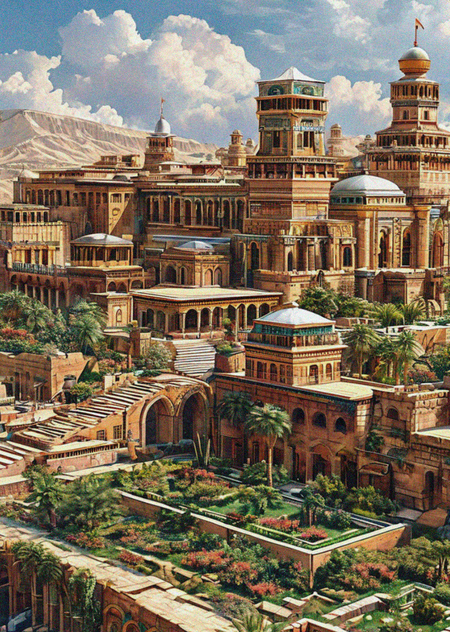
Refrigerator
- Concept 2. Similarities and differences in palace complexes: — Crete — Assiria — Babylon — Egypt 5. Conclusion 6. Bibliography 7. Image Sources
Concept
The ancient world includes a period from the emergence of the first nations to the collapse of an ancient society. It is the architecture of this time frame that has to be addressed in this visual study. For comparison, nations such as Assiria, Babylon, Egypt, and Crete have been identified. The main challenge is to look in detail at the palace complexes of the time, to find similarities and differences in: — the presence of the protective fortresses and walls — the location of the palace — its symmetry/asymmetry — the interior spaces — the embroidery/freckles/sculptures — I have highlighted these aspects, because I think they play an important role in describing each palace complex and can best explain the nature of the building. It would also facilitate the task of comparing all four States.
What is the palace complex? These are several buildings for the ruling family, ceremonies, and meetings with important guests. Temples, water bodies, orchards and servants ' homes may also be located in the compound. It can be said that palaces are not only an architectural pride of the state, but also a symbol of power and power. They emphasized the greatness and multidimensionality of the king’s capabilities, for when inviting ambassadors from other States, the achievements of civilization must be demonstrated. One of the most famous palace complexes is the Knoss Palace on Crete Island. He would like to place a special place in this visual study, as it has become a symbol of the power of the Mino civilization.
In order to fully address the subject and reach out to each of the four States, I decided to share each one in turn, going back to the previous one and comparing it. In this way, it will be possible to go through all aspects without breaking the link between them. In the conclusion, take stock and write briefly about differences and similarities.
Similarities and differences in palace complexes
Crete
Crete culture flourished during the first six centuries of the second millennium B.C.E. During that time, the palaces of Crete were repeatedly destroyed by a large number of earthquakes, so each time the palaces changed, albeit slightly. It’s very difficult to recognize the original species.
In order to ascertain the characteristics of the Crete Palace complexes, the following were taken: the Knoss Palace, the Palace of Mali (constructed at the beginning of the second millennium B.C.E. once) — the Palace of Festus (the first built in the second millennium B.C.E., the second in the sixteenth century B.C.E.)
The Knose Palace Today
The Throne Hall at the Knoss Palace
Knoss Palace, reconstruction of Arthur Evans
The Crete Palaces are complex complexes. This is particularly evident in this reconstruction, as many insuls are seen to be connected by different transitions. All these insules connect around a rectangular court oriented northwards. It turns out that the composition from the unsymmetric building is ringing around the central court.
Insula is a Latin island, similar to a modern apartment building. In this case, a group of premises with different purposes (for the housing of rulers, servants; for the storage of supplies and valuables)
Fresca in Knossk Palace
Because of the red color, the painting seems bright, but the ornaments themselves are not very fancy, so the palace is decorated fairly harmoniously.
Mali Palace, reconstruction
Here we also see the central rectangular court. On the ground floors of the palace there were mostly sweets. This large area of storage facilities has made the Malia Palace a rural building. However, this does not change the fact that there are front halls in the complex. For example, an archaic hall is placed in front of the central court: the entrance to the van and the hall are perpendicular to each other.
«Phystal hall is a multi-column hall with a series of nephs.»
The palace complex itself has two entrances: the old messed-up north and the new straight south.
The Palace of Festus
All of Crete’s palace complexes are built on high ground. The Palace of Festus was no exception because it occupied the top of a high hill. It also preserves the feature of a central court.
Also, reconstruction shows that the palaces are not surrounded by serf walls. They’re surrounded only by parks and squares.
Assiria
The military nature of the State has left some prints on the construction and location of the palace complexes, and not only: more and more fortified palaces and fortress cities are being built.
Dur-Sharrukin. Sargon Palace, 712–707 B.C.E.
You can see that the buildings look monumental, indestructible. This feeling is also reinforced by the serf wall.
The palace has no clear symmetry, which reminds us of the palace complexes of Crete. But even more similarities to the plan are added to the yards. Of course they don’t ring around all the constructions, but you can see that each of the backyards has a few small structures around them. It seems that several of Crete’s palace complexes have been connected while losing the central court.
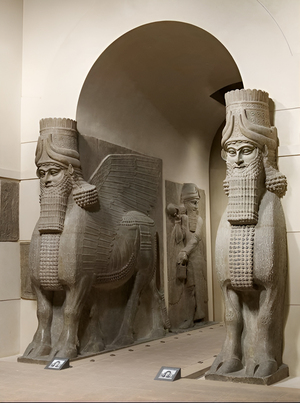
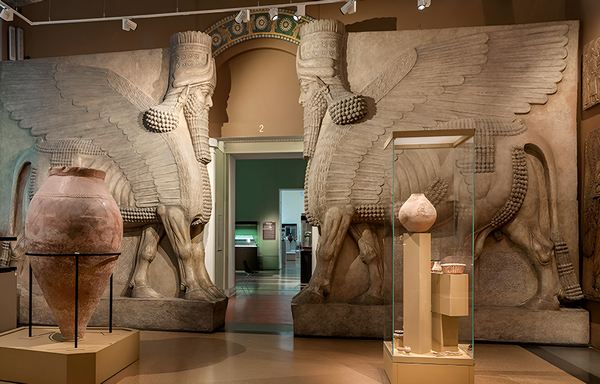
Winged bulls in Louvre (left) and in the A.S. Pushkin GMII (right)