Contents
- Concept
- Silent film.
- 1930s–1950s, early period. A. Beauty and the Beast, 1946
- 1950s–1980s. A. In the Company of the Wolves, 1984 B. Valeria and the Week of Wonders, 1970 C. Alice, 1988
- Conclusion.
Concept
The visual study, «Fairy Tale as Dream: Fantasy in European Cinema, ” investigates how European directors construct distinct artistic worlds on screen—worlds where the boundary between reality, fantasy, and dream becomes virtually indistinguishable. The primary focus is on the interplay between fairy-tale aesthetics and surrealist artistic language, as well as the visual techniques used to transform ordinary reality into a space that is uncanny, irrational, and symbolic.
Fairy tales and dreams share common characteristics: they allow for the violation of established laws of space and time, unexpected transformations, the presence of fantastical creatures, and the animation of inanimate objects. Events may unfold not according to logical cause-and-effect, but rather according to the principles of association, memory, and imagery. In this context, the fairy tale transcends being merely a plot foundation, evolving into a distinctive method of organizing screen space where familiar objects, settings, and characters acquire new, often enigmatic, meanings.
The analysis of space occupies a special place in the investigation. Castles, forests, corridors, rooms, and other fairy-tale locations are viewed as independent artistic motifs, reflecting the inner state of the characters and creating the sensation of being inside a dream. Architecture can take on fantastic forms; familiar spaces can become labyrinths, and the surrounding world may abide not by physical laws, but by the logic of imagination.Particular attention is paid to the material world and visual metamorphoses. Ordinary objects in fairy-tale and surrealist cinema often lose their everyday function: they come alive, change form, become symbols, or take on an independent role in the narrative. Equally important are the character images—their costumes and makeup—through which boundary figures between human, fantastic, and fairy-tale worlds are created.
The study will examine films by European directors who engage with the aesthetics of the fantastical and the dreamlike, including Jean Cocteau’s Beauty and the Beast (1946), Jaromil Jirschá’s Valeria and the Week of Wonders (1970), Jan Švankmajer’s Alice (1988), and Neil Jordan’s Company of Wolves (1984).
The research will be structured around several visual avenues: the architecture and space of dreams, fairy-tale characters and their transformations, costume and makeup as tools for constructing the fantastic image, the animation of objects, color symbolism, visual effects, and the dream logic of storytelling. Each section will allow for an exploration of a specific aspect of the interaction between fairy tale and surrealism, a comparison of the artistic choices made by different directors, and the identification of common principles for constructing a fantastic world.
Silent Film
Fantasy is a relatively modern definition for the film genre, one that solidified toward the end of the 2000s following the release of The Lord of the Rings, Harry Potter, and numerous subsequent magical films. In the 1990s, the term fantasy was generally understood to refer to the «sword and sorcery» subgenre. However, these films were quite disparate in tone—they could range from mystical horror to fairy tales. Before cinema, fantastical narratives were disseminated through oral storytelling and public performances; opera and ballet; theatrical productions; painting and book illustration.
All of this had already accustomed the audience to the inherent attributes of fantasy—settings, costumes, and fantastical characters. Therefore, when cinema emerged, the fairy tale already possessed a rich visual and theatrical tradition. Film simply became yet another medium through which the fantastic could be realized.
The first documented fantasy film was the short film «Cabbage Fairy» from 1896. Another one of the earliest known fantasy films in history is «Cinderella, ” which was directed by Georges Méliès.
In addition to the outstanding works of Georges Méliès at the turn of the 20th century, there were interesting experimental films created by Emile Cole, Chester and Sid Franklin, J. Cyril Douley, Max and Dave Fleischer, Enson Airy, Paul Terry, Tex Avery, and many others up until the 1930s. Most of these films were short—five to ten minutes long—and were made to «warm up» the audience after feature films began to appear. They were shown before the main film and were intended to elicit laughter through unusual plot twists and funny gags.
Full-length fantasy films began to be made in Europe, with the Italian film Inferno—an adaptation of Dante’s divine comedy—being the very first. In Sweden, the mystical film The Coachman was released in 1920, as was the German film Nibelungen by Fritz Lang, which became the first epic science-fantasy film in history.
The dreamlike narrative structure allows the director to create a unique cinematic world where the fantastic is not separated from everyday reality, but grows out of it—from memory, fear, desire, experience, and the character’s inner state. In conventional storytelling, the viewer typically understands where reality ends and fantasy begins. In a dreamlike structure, this boundary becomes fluid: events can shift from one state to another without clear explanation. This allows the director to simultaneously tell an external story and reveal the character’s inner world.
The dreamlike narrative structure serves to unify the fantastic, psychological, and mundane within a singular artistic space. It allows the director to present fantastical events not as isolated magical adventures, but as a visual extension of the character’s inner world. Everyday circumstances become the genesis point for fantastical imagery, and fairy-tale motifs acquire psychological and symbolic meaning. By blurring the boundary between dream and reality, the viewer perceives the unfolding events simultaneously as external occurrences and as a reflection of the character’s internal experience.
1930s–1950s, the early period.
In Europe, directors experimented with the fantasy genre more boldly. In 1941, the epic fantasy action film «The Iron Crown» was released in Italy. This film stood out for its time due to its violence and erotic scenes—characteristics that would define the swords and sorcery genre and also significantly influence the popularization of the pulp genre outside of Italy. Jean Cocteau’s other successful film, «Beauty and the Beast,» was largely inspired by the avant-garde. Many European fantasy films deconstructed popular plot tropes, filling them with surrealism, violations of the laws of physics, and concealing critiques of religion, class, and conservative values.
«Beauty and the Beast» 1946
To summarize the plot, the story is about a girl named Belle, who lives with her father, two sisters, and a brother. Her father is a shipowner, and one day, before setting sail on a returning ship, he asks his children what he should bring them. Belle’s sisters ask for peacock feathers and new dresses, but she only wants a rose. Returning from the port late at night, her father gets lost in the woods and stumbles upon a strange castle where he is served by flying hands—they pour wine, open doors, and hold up candelabras. Leaving the castle, he plucks a beautiful rose from a bush for his daughter, and at that moment, a monster approaches him and says that he will kill him for it unless one of his daughters agrees to take his place and return to that castle. Ultimately, Belle returns to the castle.
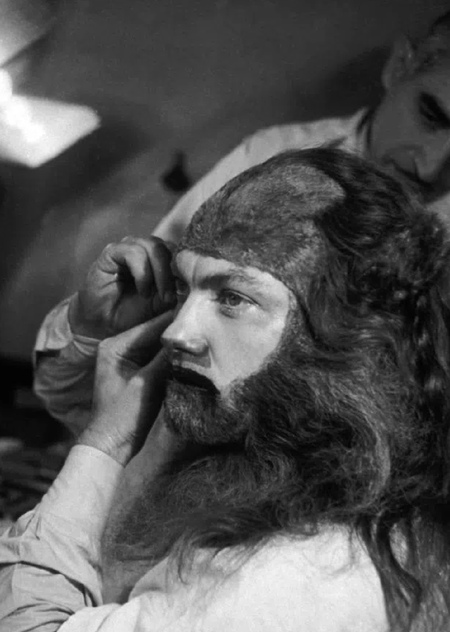
The film Beauty and the Beast is an excellent example of how the feeling of a fairy tale or a dream can be created not through special effects, but through cinematography, lighting, set design, and costumes. When shooting the Belle family’s home, a style reminiscent of the visual principles of Jan Vermeer was chosen. This style is characterized by: soft, natural light, calm compositions, and a sense of domestic comfort. For the Beast, Gustave Doré's illustrations were used as a visual reference. His castle is filled with strong contrasts, deep shadows, and unusual architectural details rarely seen in real life. Kocko also deliberated extensively over the Beast’s appearance. He initially wanted to give him a deer mask until he was convinced that such an image was completely unsuitable for a ferocious and raging beast. Ultimately, the Beast’s mask was designed so that the actor could convey his emotions through facial expressions and the eyes.
Instead of complex digital processing, Koktow employed optical tricks, reverse shooting, slow motion, smoke, mirrors, and various hidden mechanisms. For example, in one scene, I noticed that Belle seemed to be gliding down the corridor rather than walking. Upon closer inspection, I realized she wasn’t moving with her feet at all. Later, after learning various details about the film’s production, I discovered that to achieve this effect, the actress was placed on a small wheeled platform hidden beneath her actual dress and moved using a rope. Other techniques, such as making candles light themselves, involved blowing them out first and then playing back the footage recorded in reverse.
The narrative’s fairytale quality is also achieved through castle elements that in this film are not merely part of the setting but are living objects. For example, candelabras shaped like human hands, live statues observing the action, doors, and mirrors. Smoke and fog also play a role—they help make the space less defined, conceal the boundaries of the set, and lend a sense of transparency to the characters' movement.
It seems to me that the most magical part of the film isn’t the flying hands or the monster that speaks human language and lives in a castle woven entirely from magic—it’s the moment when only a loving gaze from a woman transforms that monster into a man. For me, the tale of the beauty and the beast has always felt more like horror than romance, which is why I experienced mixed feelings about Jean Cocteau’s film. There are many beautiful shots, many magical moments, and the actors are very pleasant; the amount of work put into it is genuinely impressive. Yet, the story itself evokes a sense of aversion in me. I find it difficult to watch the moments when Belle and the Beast are together because the feelings between them don’t seem real to me. Therefore, I conclude that they are as much of an illusion as all the fairy-tale elements of the picture—a focus invented by the director, much like when the heroine swims across the room, but you already know there’s a wheeled platform beneath her.
1950s–1980s.
During this time, many fantasy films began to move away from the conventional, idealized fairy-tale model, offering a more complex, ambiguous, and sometimes unsettling depiction of the magical world. This is not a separate official cinematic genre nor is it a strictly defined directorial movement. Rather, it is a tendency: directors started using fairy-tale narratives not just to create beautiful stories about miracles and happy endings, but also to discuss fears, human nature, power, identity, and social contradictions.
«At Volkov’s Company» 1984