Navigation
1. Concept 2. Shamail: definition, origin, and place in Islamic culture 3. Composition and symbolism of the Shamail: the word as the principal image 4. Key masters and works 5. Conclusion 6. References
Concept
The selection of this topic is driven by an interest in a unique phenomenon within Islamic art that has long remained little known outside of Tatar culture. Shamail represents a rare synthesis of calligraphy, ornamentation, and sacred painting, where, while strictly adhering to the prohibition against depicting living beings, a complete visual language was achieved. I was interested in how Tatar masters at the turn of the 19th and 20th centuries managed to transform sacred word into a visual image that combines aesthetic beauty, religious admonition, and protective function. Unlike Iranian or Ottoman traditions, Tatar Shamail fundamentally rejected portraiture, making calligraphy the main protagonist. This conscious aniconism—its causes and artistic consequences—became the central motif for choosing the topic.
The relevance of this visual study is determined by several factors. First, Shamayil remains under-researched in Russian art history. It is most often treated as part of the ethnographic life of the Tatars, rather than as a complete artistic phenomenon. This study seeks to fill this gap by examining Shamayil as a complex visual text, where every compositional element carries semantic weight. Second, there is a burgeoning interest in Shamayil in contemporary Tatarstan—a gallery of Tatar Shamayil has opened in the Kul Sharif Mosque, and competitions and exhibitions are being held. Understanding the classical examples is necessary for the meaningful continuation of this tradition. Third, Shamayil offers an intriguing material for interdisciplinary research at the intersection of art history, religious studies, and cultural anthropology, allowing us to trace how sacred language acquires visual substance.
The goal of this work is to identify the specifics of Shamail as a unique form of Tatar Islamic art, where the calligraphic word becomes the primary visual and semantic center.
To achieve this goal, the following objectives will be addressed: defining the shamail and tracing the origin of this art form; characterizing the technical specifics of its execution, including painting on the reverse side of glass with foil backlighting and lithographic shamail; explaining the fundamental iconoclasm of Tatar shamail when compared to Iranian counterparts; analyzing the compositional structure and symbolism of the main elements; presenting key masters and their works; and demonstrating the contemporary state of the tradition and its revival.
The object of study is Tatar shamail from the 19th–21st centuries, executed in various techniques. The subject of the study is the system of visual and symbolic means through which shamail fulfills its sacred, educational, and aesthetic functions. The materials under consideration include the classic shamail of Nurgali Ibn Muhammad, Gusman Saliev, Muhammad Ghali Ibn Mingazetdin, works by Gabdelkhak Bikmuratov from the Soviet period, as well as contemporary pieces by Baki Urmanche, Najip Nakkash, and Rustem Shamsutov.
The research methodology incorporates formal stylistic analysis to describe compositional and color solutions; iconographic analysis to decipher the symbols of the Kaaba, Solomon’s Seal, the Ark, and the World Tree; a comparative method to juxtapose Tatar, Iranian, and Ottoman versions of the Shama’il; and a historical and cultural approach that considers the context of Jadidism. The study utilizes photographs of museum exhibits and archival images. The practical significance of this work lies in the fact that its materials can be employed in academic courses on the history of Tatar art, Islamic culture, and museology.
Shama’il: Definition, Origin, and Place in Islamic Culture
The word «Shamail» has deep roots in the Arabic language. It derives from the Arabic word «Shamā'il» (plural of «Shamila»), which means «innate qualities,» «virtues,» or «moral characteristics.» In classical Islamic literature, this term was used in the titles of works describing the virtues, appearance, and character of the Prophet Muhammad.
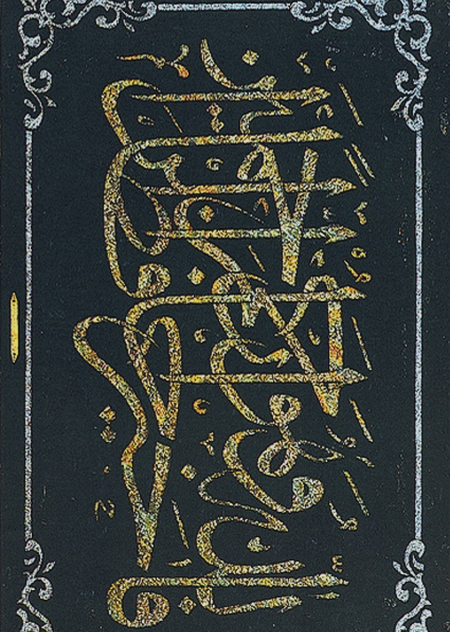
G. Saliev. «God is the best preserver and the most merciful of the merciful.» Early 20th century
Over time, upon entering the Persian cultural environment, the word acquired an additional meaning—“sacred image, ” «portrait, ” or „icon.“ It was in this capacity, as an image with sacred content, that the term became established in the art of Iran, Azerbaijan, and later among the Tatars of the Volga region.
Fragment of an antique shamail with Arabic calligraphy
Shamail is a form of Islamic visual art, comprising a painting with religious content and calligraphic inscriptions, rendered on glass, paper, canvas, or fabric. It is a wall hanging that combines three elements: sacred text (verses from the Quran, prayers, aphorisms), ornament, and symbolic depictions of holy sites.
Example of a classic Shamayil in the interior of a Tatar home
Key Characteristics of the Shamail:
Content: Qur’anic verses, names of Allah, Hadith, and moral texts in Arabic or Old Tatar.
Execution Technique: Painting on the back of glass with foil backing, printed lithographs, embroidery, and canvas painting.
Function: Home decoration, a reminder of faith, and an amulet against the evil eye and malevolent forces.
Placement: In an honored position in the home, above doorways, and in mosques.
It was from Turkey, due to the popularity of Turkish goods, that this art form entered the territory of the Middle Volga region in the second half of the 19th century. The Tatars, who had long-standing trade and cultural ties with the Ottoman Empire, adopted the technique but infused it with their own content, conforming to the norms of Sunni Islam.
Mukhametjan Khalil, Corner of Khodzhaseid. «Noah’s Second Ship.» 1904.
The key distinction of Tatar shamail from its Iranian and Ottoman counterparts is the strict adherence to a prohibition against depicting living beings. Tatars practice the Sunni branch of Islam, which is particularly stringent on this matter.
Tatar Shamayil
In times when not all Muslims could read the Quran in its original Arabic, the Shamail served as a visual guide and a reminder of the fundamental tenets of the faith. The Arabic text, supplemented with images of holy sites (the Kaaba, the mosques of Mecca and Medina), helped visualize the holiest places of Islam.
Composition and Symbolism of the Shamail: The Word as the Primary Image
The majority of shamail compositions lean toward a centrally-symmetrical arrangement, which is often complicated by a tripartite vertical division. This structural rigor is not coincidental: the composition of the shamail, much like the mythological systems of the world’s primary centers of civilization, was defined by traditional cosmological concepts, presenting a geometric schema of the universe’s structure with an hierarchical placement of Islamic shrines within it.
A distinctive hierarchical ladder is discernible in the compositional structure of the shamail. At the uppermost step is Allah, the creator of the world, situated at the center of all existence. The vegetal or geometric ornamentation placed around the perimeter of the shamail compositionally complemented the main, central motif.
Tatarsky Shamail
Shama’il possesses a strictly hierarchical structure that can be divided into three semantic levels.
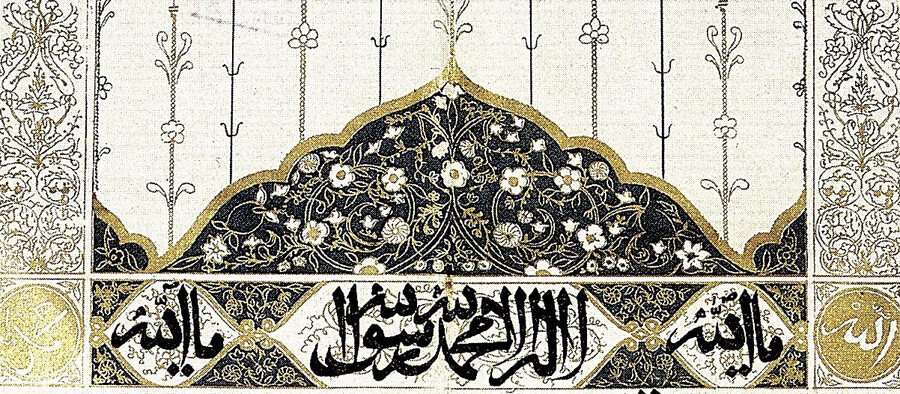
The upper level is occupied by the main formulas that generalize the Islamic worldview. These are sacred texts in Arabic—verses from the Quran, the basmala («In the name of God, the Most Gracious, the Most Merciful»), the shahada («There is no god but God, and Muhammad is His messenger»), and other key religious formulas. These sacred formulas were often placed separately, acquiring a dominant compositional function.
Unknown author. «And know that there is no deity except Allah and Muhammad is the messenger of Allah.» 1910
The lower register of printed shamayils contains explanatory text in Old Tatar, revealing the main content. Often, this text combined features from Turkic folklore and Quranic legends. These explanations not only clarified the meaning of the image but also provided «instructions» for the practical application of certain sacred words and utterances.
Tatar Shamail
Imagery of the Kaaba—the holiest shrine in Islam—occupies a central position in many shamail. The shamail often depicted the Al-Haram Mosque in Mecca and the Prophet’s Mosque in Medina surrounding the Kaaba, as well as other Islamic holy sites—mosques in Istanbul, Damascus, Cairo, and ancient Bulgar. These architectural views served as a visual reminder of pilgrimage destinations.