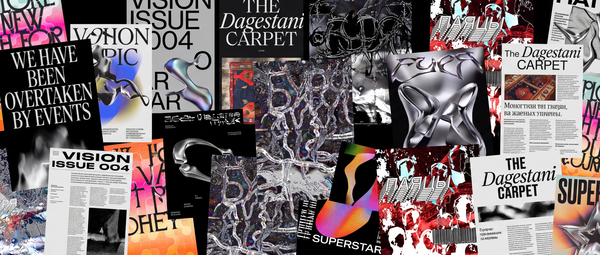
┃ MAGAZINE DESIGN: GRID, TYPOGRAPHY, AND COLUMN SYSTEM
┃ WHAT IS THIS COURSE ABOUT?
How can you combine a long article, an interview, and short notes into a single publication? How can you help the reader quickly find what they need and make a lengthy text easy to read?
In this course, you will design an issue of a magazine: from structure and modular grid to layout, covers, and navigation.
You will study the principles of newspaper and magazine layout, learn how to organize large volumes of information, and work with various reading scenarios: quick skimming, searching for specific material, and sequential reading of an article.
We will pay special attention to typography and the design system that maintains coherence when text and images are changed. We will test the solutions through proofs and reviews with readers.
┃ WHO IS THIS COURSE FOR?
• Students in design majors who wish to master editorial design.• Beginning designers who need to learn how to work with multi-page layout and large volumes of text.• Designers who already create individual layouts and want to learn how to develop a cohesive publication design system.
┃ FORMAT AND DURATION
Duration: 6 weeks
Total Workload: 48 academic hours, including 24 contact hours and 24 hours of independent study
Format: Online, two sessions per week, each lasting two academic hours
Sessions include publication analysis, layout exercises, discussion of interim solutions, and feedback. Independent work involves mockup development, proof printing, and readability checks.
┃ WHAT DO I NEED TO STUDY?
Fundamental knowledge of composition and typography. Introductory skills in using a multi-page layout program: creating pages, arranging text and images.
You will need a computer with layout software installed and the ability to print sample spreads in actual size.
The project utilizes a set of texts and images prepared by the instructor. You may use your own materials if they meet the volume and objectives of the course.
The course is self-paced. Prior coursework on zine creation is not required.
┃ WHAT WILL ATTENDEES LEARN?
↗ Defining the publication’s audience and considering their objectives when developing the structure and design↗ Building a modular grid for materials of varying size and nature↗ Setting typographic hierarchy: headlines, introductory paragraphs, body text, quotes, and captions↗ Selecting layout parameters based on readability: font size, line length, leading, and paragraph formatting↗ Typesetting articles, interviews, and short notes within a unified system↗ Developing the cover, table of contents, and section navigation↗ Adapting the layout when the text volume or image formats change↗ Testing reading comfort on a print prototype and preparing the issue for press
┃ PROJECTS
01 / Reader Profile and Publication StructureSelect the magazine’s theme and define its target audience. Based on the completed set of materials, create a page-by-page plan: distribute sections, articles, interviews, and short notes.Explain how the reader will navigate the issue and locate the necessary information.02 / Grid and ReadabilityDevelop two grid options for a single piece. Compare column width, margins, and line density.Prepare several typographic layouts with different parameters. Print fragments at actual size and choose the most suitable solution, justifying it based on readability and format adherence.03 / Three Material TypesDesign a long-form article, an interview, and a collection of short notes.Set up text styles and general layout rules. Maintain the publication’s coherence while accounting for the specific reading demands of each material.04 / System Adaptation and IterationAdapt one spread to new conditions: increased text volume or the substitution of a horizontal photograph with a vertical one.Demonstrate which elements remain constant and which can be changed without disrupting the hierarchy or readability.05 / Cover Design and NavigationDevelop a cover featuring the title and teasers, table of contents, section labels, running headers, and page numbers.Assemble the complete issue and verify the consistency of the overall design.06 / Print Prototype and Reader TestingPrint and assemble the prototype. Ask several representatives from the target audience to locate content, identify the start of an article, and read a text excerpt.Document any difficulties, implement revisions, and prepare the final file for printing.
┃ THEMATIC PLAN
01 / Reader and Publication Structure
Classroom, reading scripts, and sectioning. Analysis of newspaper and magazine layouts. Page-by-page issue plan02 / Grid and Typography
Columns, margins, column density, and reading order. Typeface, line length, leading, paragraphs, and hyphenation. Proofing03 / Different Material Types
Articles, interviews, and short notes. Headlines, introductory paragraphs, quotes, captions, and images. Text styles04 / Design System
Constant and variable elements. Adapting to new content. Cover, table of contents, and navigation05 / Issue Assembly and Review
Turn rhythm, consistency of sections, and full layout. Print prototype and reader assignments06 / Refinement and Prepress
Corrections based on review results. Control of text, images, and files. Formatting rules and project presentation
┃ COURSE RESULTS
Pilot Issue: 24-Page Magazine, Including Cover
The publication includes editorial content, a major feature article, an interview, and a collection of short notes. The theme and format are determined at the start of the course.
The final submission must include:• The layout mock-up and print-ready file• One assembled printed prototype• Brief design guidelines: grid system, typographic styles, navigation, and image handling• Feedback results from readers and a description of the revisions madeThe developed system must allow for the preparation of new content and be usable for producing the next issue.
┃ HOW IS THE RESULT EVALUATED?
• Correspondence of the chosen space’s structure and design• Clarity of hierarchy and navigation• Readability of text in print format• Consistency in applying grid and typographic styles• System’s ability to handle varying volumes of text and image formats• Justification of revisions following reader testing• Quality of the printed prototype and technical file preparation
┃ COURSE SPECIFICS
The design review system is tested across three material types and variations in source content. Listeners learn to make decisions that function across the entire issue and can be applied in subsequent editions. Proofing and reader tasks are integrated into the design process. Observations help identify navigation, typography, and reading flow issues, allowing the layout to be refined before final submission.