Russian Style in the Painting of M. A. Vrubel: Transforming the National Image into an Artistic Myth
Concept
I chose the theme of the Russian style in Mikhail Vrubel’s painting because his work presents a fascinating example of an artist engaging with national heritage at the turn of the 19th and 20th centuries. Vrubel is often associated with Russian fairy tales, epics, ancient legends, and images of folk culture. However, his paintings are not literal illustrations of folklore. In them, familiar themes become part of an independent, complex world: the bogatyr (hero) is no longer simply a character from an epic, the tsarevna (princess) is not just a character from Pushkin, and the natural landscape transforms into a space where mythological beings can inhabit.
I want to understand what visual techniques Vrubel uses to create this feeling and why his painting can be considered one of the original manifestations of the Russian style of the turn of the 19th and 20th centuries.
The research will focus not on the entirety of the artist’s oeuvre, but on a specific selection of paintings and preparatory materials related to national-romantic and mythological imagery. The core works selected will include «Bogatyr» (1898–1899), «Tsarevna-Lebed» (1900), «Lilac» (1900), «Pan» (1899), and «Thirty-Three Bogatyrs» (1901). Additionally, the preparatory sketch for the panel «Mikula Selyaninovich» (1896) will be examined—this is not a standalone finished painting but a preliminary version of a decorative panel, making it essential for understanding how Vrubel approached epic material and translated it into monumental-decorative composition. The works are selected not only based on the presence of Russian subject matter but also on how clearly they reveal the distinctive features of Vrubel’s artistic language: the organization of large color masses, crystalline modeling of form, ornamental qualities, rhythm, the integration of figure with the natural environment, and the transition from a recognizable image to the fantastic. The study’s structure will not follow a chronological narrative of the biography, but rather trace a progression from the origins of the artistic method to the analysis of individual images, and subsequently, to a comparison of the discovered techniques. First, the cultural context of the late 19th century will be outlined: the interest in ancient Russian heritage, epics, and fairy tales, the development of the national strain of Modernism, the role of the Abramtsevo Circle, and the theatrical-musical culture. Then, Vrubel’s early artistic experiments in Kyiv, his work with monumental painting, and his familiarity with Byzantine tradition—as a source for his unique understanding of plane, color, and decorative surface—will be discussed.
The main section will focus on the following works: first, the image of the epic hero and the bogatyr world; next, the fairy-tale heroine and the motif of transformation; and finally, personified nature and a mythological figure. Pan will be examined not as a character from Russian folklore, but as an important comparative example: an ancient narrative set in the Russian natural environment allows us to test the universality of Vrubel’s method and how he transformed various mythological sources. The presentation will conclude with a comparison of the paintings based on composition, color palette, plasticity, ornamentation, and the character of the human-nature relationship.
Key research question: How does Mikhail Vrubel transform motifs from Russian epics, fairy tales, and national folklore into an independent pictorial language that goes beyond illustrating literary narratives?
The hypothesis posits that Vrubel’s Russian style is determined not by an external set of national attributes, but by his artistic mode of thought. He reinterprets folkloric and literary imagery through Symbolist iconography, drawing upon the experience of Byzantine and monumental painting, as well as the decorative principles of Art Nouveau. Consequently, the national subject in his work ceases to be a mere reconstruction of the past and becomes a myth—one in which figure, landscape, color, and ornamentation form a singular space. Textual sources will be selected based on their research and museum credibility. The foundation will consist of catalogs and materials from the State Tretyakov Gallery and the Russian Museum, where the title, dating, medium, creation history, and museum interpretation of each work can be verified. These will be supplemented by scholarly articles on Vrubel’s artistic methodology, Russian Modernism, Symbolism, ornamentation, and its relationship to folklore. Information from various sources will be cross-referenced: museum descriptions will be used for factual documentation, while academic publications will frame the central problems and compare interpretations. The visual evidence will serve as the primary means of testing the hypothesis: each artwork will be accompanied not only by general reproductions but also by close-up fragments, allowing for the examination of formal construction, color relationships, motif repetition, and the intricacies of the painted surface.
A Return to National Heritage: Russian Style in 19th-Century Artistic Culture
To understand why Vrubel turned to Russian epics, fairy tales, and mythological figures, it is necessary to examine the cultural context in which his work was formed. Throughout the 18th and a significant part of the 19th century, Western European orientations predominated in Russian court and academic art culture. Artists studied according to European models, drew upon ancient mythology, historical and biblical subjects, and utilized the principles of classicism and academic painting. Nevertheless, Russia’s own artistic traditions did not disappear: icon painting, folk crafts, wooden architecture, ornamental, and applied arts continued to exist. However, for a long time, these forms did not hold a central place within the system of academic art education. In the 19th century, the situation gradually changed. Amid an interest in national history, literature, and folklore, artists began to seek an independent Russian artistic language. Old Russian architecture, icon painting, folk costume, epics, and fairy tales became not only subjects of study but also sources for new artistic solutions.
This is particularly noticeable in the second half of the 19th century. Viktor Vasnetsov, Ivan Bilibin, Elena Polenov, and other artists approached national heritage in different ways. For some, historical accuracy and narrative were more important; for others, ornamentation, decorative form, and stylization took precedence.
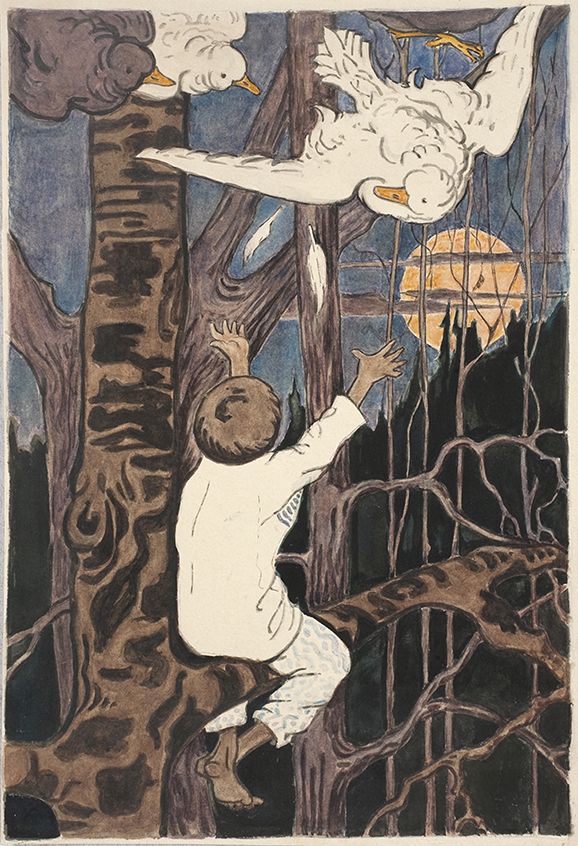
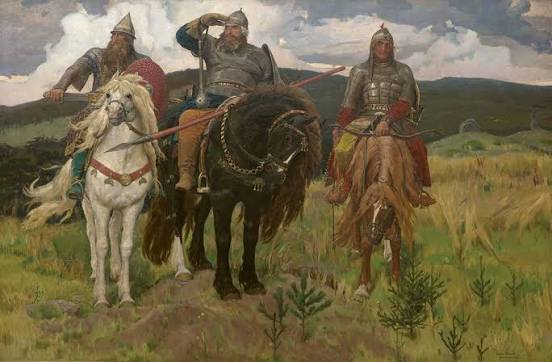
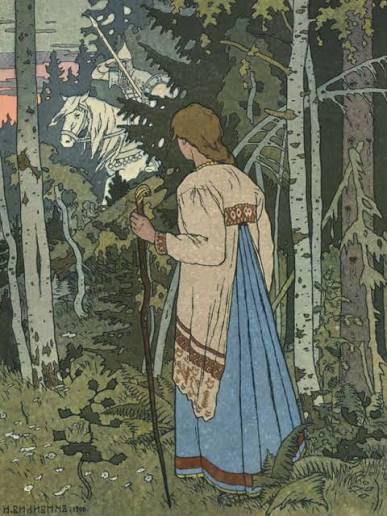
Against this backdrop, Vrubel’s creativity holds a distinct place. His interest in Russian culture is not limited to depicting national costumes, architecture, or fairy-tale characters. The artist seeks a way to convey the sense of an ancient mythological world where humanity, nature, and fantastical beings exist as parts of a single whole. Therefore, Vrubel’s Russian style can be viewed not just as a reference to specific subjects, but as a unique principle of image construction.
Orthodox and Byzantine Painting as the Foundation of Artistic Language
One of the most vital stages in the formation of Vrubel’s painting style was his time in Kyiv during the 1880s. Invited by the art historian Adrian Prakhov, the artist participated in the restoration and creation of frescoes in the 12th-century Kyrylov Church, and later worked on sketches for the Vladimir Cathedral.
At the Kyrylov Church, Vrubel encountered an artistic system that differed significantly from academic painting. The ancient monumental tradition was built upon the expressiveness of silhouette, the conventionality of space, the rhythm of lines, and the special role of color. The figure here did not necessarily adhere to the laws of realistic perspective—its spiritual and symbolic meaning was far more important.
In the fresco, «The Descent of the Holy Spirit upon the Apostles» (1884), the artist’s drive toward monumental composition is especially evident. The figures of the apostles are unified by a shared rhythm, and their poses, gestures, and the folds of their garments create a complex system of repetition. Despite the individuality of the characters, the composition is perceived as a unified whole.
No less telling are the icons for the Kirillov Church iconostasis, particularly «Mother of God with Child» (1884–1885). Vrubel preserves the recognizable iconographic scheme but imbues the image with unusual psychological expressiveness. The large eyes, the tension in the gaze, and the delicate modeling of the face make the character simultaneously sacred and profoundly human.
In these works, one can already notice the traits that would later appear in the artist’s fairy-tale painting: the expressiveness of the eyes, the generalization of the silhouette, the decorative quality of the color relationships, and the striving to connect a real human image with something inaccessible to ordinary sight.
Italian Temples and the Influence of Mosaic
During 1884–1885, Vrubel was in Italy, where he studied Byzantine and medieval monuments in Venice and Ravenna. He was interested in mosaics, stained glass, and the monumental interior decoration of churches. A distinctive characteristic of mosaic is that the image is constructed from individual elements. Here, color exists not only as a characteristic of an object but as an independent material surface. Individual fragments reflect light differently, creating a shimmering effect. A similar principle of form organization can be found in Vrubel’s paintings. Instead of smooth volume modeling, he often uses small, angular brushstrokes that resemble crystal facets or mosaic fragments. The color planes collide with each other, creating a complex surface for the image.
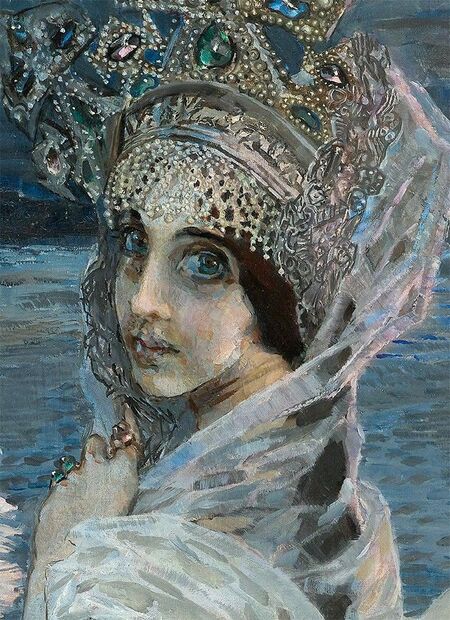
However, it would be inaccurate to consider his style a direct copy of Byzantine mosaics. Vrubel reinterprets what he observes, combining it with the academic school of drawing, an interest in natural forms, and his own understanding of color. This is particularly evident when comparing his early religious works with later paintings such as «Tsarevna-Lebed» and «Lilac.» The sense of a precious, shimmering surface is retained, but religious figures are replaced by fairy-tale heroes and fantastic natural imagery. Thus, religious painting became for Vrubel not merely a phase of professional work, but also a source of principles that he subsequently transferred to secular art.
Abramtsev Art Circle: Searching for a New Russian Style
The next important phase is connected to the Abramtsevo Art Circle, which was formed around the entrepreneur and patron Savva Mamontov. The Abramtsevo estate near Moscow became one of the centers of artistic life in the late 19th century. Victor and Apollonarius Васнецовы, Valentin Serov, Konstantin Korovin, Elena Polenov, and other artists visited and worked there. They were united by an interest in Russian history, folk art, architecture, and decorative and applied traditions. In Abramtsevo, artists did not just paint; they were also involved in interior design, creating furniture, ceramics, theatrical sets, and architectural projects. This was fundamentally important for the development of Russian Modernism: the national style was viewed not as a collection of individual ornaments, but as a way to create a cohesive artistic environment.
The Abramtsevo Ceramic Workshop held a special place, with Vrubel serving as its artistic director. The artist worked with majolica, creating decorative sculptures, tilework, and kiln designs. In ceramics, he was fascinated by complex glaze transitions, unusual plasticity, and the interplay of light on the surface. Although the primary subject of this research is painting, his experience working with ceramics is crucial for understanding his artistic method. The decorative surfaces, color transitions, and complex textures characteristic of majolica show a similarity to Vrubel’s pictorial style. In Abramtsevo, national tradition became a space for experimentation. The artists did not seek simply to replicate old forms; rather, they used them as material to create contemporary art.
From Folk Hero to Monumental Image: «Mikula Selyaninovich»
One of the works that traces Vrubel’s engagement with the national epic is the sketch for the panel painting «Mikula Selyaninovitch» (1896). The plot is based on the image of a legendary plowman endowed with extraordinary strength. Unlike the warrior-bogatyrs, Mikula embodies a strength connected to the earth, labor, and nature. For Vrubel, this image became the impetus for creating a monumental composition. The artist does not aim to retell the epic in detail or depict a specific moment of the narrative. What interests him is the hero’s character itself—his scale and his relationship with the surrounding world. The decorative organization of the image plays a crucial role. The figures, the landscape, and the objects form a unified rhythm. The composition is designed not only for examining details but also for perceiving the overall image holistically. This principle would be further developed in the painting «The Bogatyr,» where the hero practically merges with the surrounding nature.
«The Bogatyr»: Humanity as an Embodiment of Natural Power
The painting «Bogatyr» (1898–1899) presents one of the most expressive examples of Vrubel’s engagement with Russian epic. The canvas depicts a mighty rider on a massive horse, surrounded by a dense forest. The artist chooses not a moment of battle, but a state of tense tranquility. The hero is motionless, yet his figure conveys a sense of immense, latent power. The composition is structured so that the bogatyr and the horse occupy nearly the entire surface of the canvas. Their scale appears exaggerated in relation to the surrounding space. As a result, the character is perceived not as an ordinary person, but as a being of mythological magnitude.
The connection between the protagonist and nature is particularly significant. The dark outlines of the forest, the dense vegetation, and the massive forms of the horse and the warrior coalesce into a unified whole. The silhouettes seem to continue one another, making the picture space dense and almost impenetrable.
The color palette is built upon deep greens, browns, and ochre tones. Individual light details on the armor and tack create accents, yet they do not disrupt the overall chromatic unity.
Ornamentation is evident in the depiction of clothing, weaponry, horse tack, and vegetation. The small details form a recurring rhythm, which lends the painting a decorative integrity.
Comparing Vrubel’s «Bogatyrs» with Viktor Vasnetsov’s «Bogatyrs» (1881–1898) reveals a noticeable divergence in artistic approaches. Vasnetsov depicts three heroes within a historical epic landscape, dedicating significant attention to their character, weaponry, and individual traits. In Vrubel’s work, the bogatyr becomes a more generalized figure, almost inseparable from the surrounding nature. Thus, Russian epic transforms in Vrubel’s hands from a narrative of heroic deeds into an embodiment of primal force existing outside of specific historical time.
«Snegurochka»: A National Archetype Through Costume, Color, and Natural Environment
The figure of Snegurochka holds a special place in the work of Mikhail Vrubel, as it merges Russian fairy-tale tradition, the artist’s interest in decorative elements, and his involvement with theatrical productions. The work, «Snegurochka, ” executed in watercolor and gouache, is an illustration for the costume of Nikolai Rimsky-Korsakov’s opera of the same name, which was based on Alexander Ostrovsky’s play. Despite its small size and applied nature, the piece is perceived as a complete work of art.
At the center of the composition is a young woman dressed in light, wintry attire. Her figure occupies almost the entire height of the sheet, which focuses the viewer’s attention primarily on her silhouette and costume. Snegurochka stands against a backdrop of a snow-covered forest, with a squirrel positioned at her feet. This small detail is particularly important: it emphasizes the heroine’s connection to the natural world and helps present her not as an ordinary girl wearing a fairy-tale costume, but as a being for whom the forest is a natural habitat.
The costume is the primary expressive element of the work. A light fur coat with decorative detailing, a headdress, and ornamental accents form a unified silhouette. However, Vrubel does not aim to accurately reproduce historical Russian costume. Instead, he creates a fantastical image where traditional forms of winter clothing are transformed into a mythological garment. The decorative elements evoke snow patterns and underscore the heroine’s bond with winter nature.
The color palette is also of significant importance. The image is dominated by cool white, bluish, and silvery hues. Snegurochka’s light figure stands out against the backdrop of the darker winter forest, yet it is not completely set apart from it. The color relationships unify the costume, the snow, and the surrounding vegetation, creating a sense of the heroine belonging to a singular natural space.
The texture of the image also plays a crucial role. The artist combines more meticulously detailed areas of the costume and face with a more conventional rendering of the trees and snowy environment. This contrast emerges between the decorative precision of the central figure and the freer depiction of the natural setting. Moreover, the background is not a mere arbitrary addition—it helps reveal the character of the heroine and amplifies the fairy-tale mood.