Concept
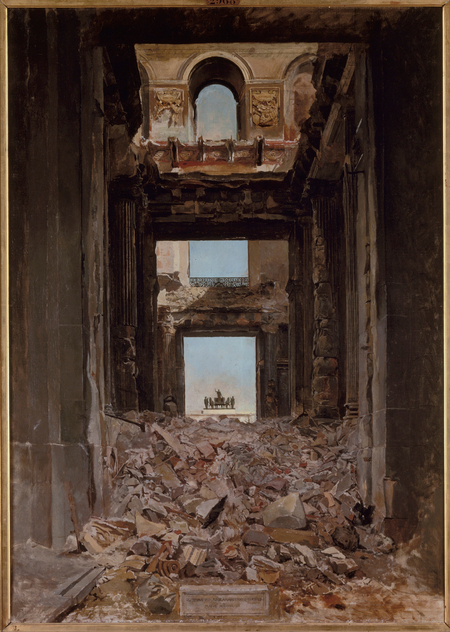
In the 17th century, the ruin looks backward. For Lorrain and Pannini, these are the remnants of ancient Rome, viewed from the outside as a foreign history. In the second half of the 18th century, Diderot writes that ruins evoke thoughts of one’s own mortality, and they even begin to be constructed in parks. The main shift, in my opinion, occurs with Robert. He witnessed the revolution toppling the Bastille and understood that a ruin could appear not over centuries, but in days. After this, he paints the Louvre in ruins, and in the 19th century, the Bank of England and all of London are similarly depicted. The ruin turns toward the future, and the viewer looks at their own city through the eyes of a descendant. In 1907, Georg Simmel described the ruin as «nature’s vengeance for the violence that the spirit inflicted upon it, shaping it in its own image.» For Simmel, the charm of the ruin arises where nature is slowly reclaiming what humanity has built. If the building was destroyed by people, that charm is absent. Seven years later, the First World War begins, and the ruins are precisely like that. Art reacts to this: instead of quiet contemplation, there appears testimony, irony, and a cry, as in Picasso’s «Guernica.» Ultimately, my work is a story of how the distance between the viewer and the ruin shrinks to zero.
Hypothesis
Over three centuries, the ruin «changes its time.» In the 17th century, it speaks of someone else’s past. Starting in the late 18th century, it becomes a look from the future back onto its own modernity. By the 1930s, the ruin belongs to the present: it no longer needs to be imagined; it appears overnight. The closer the ruin is to the viewer in time, the less beauty and quiet melancholy remains within it.
Section I. The Ruin as Memory
In the 17th and early 18th centuries, a ruin belongs to a distant and alien past, most often Ancient Rome. The destruction happened long ago, and the viewer observes it calmly, from a distance.
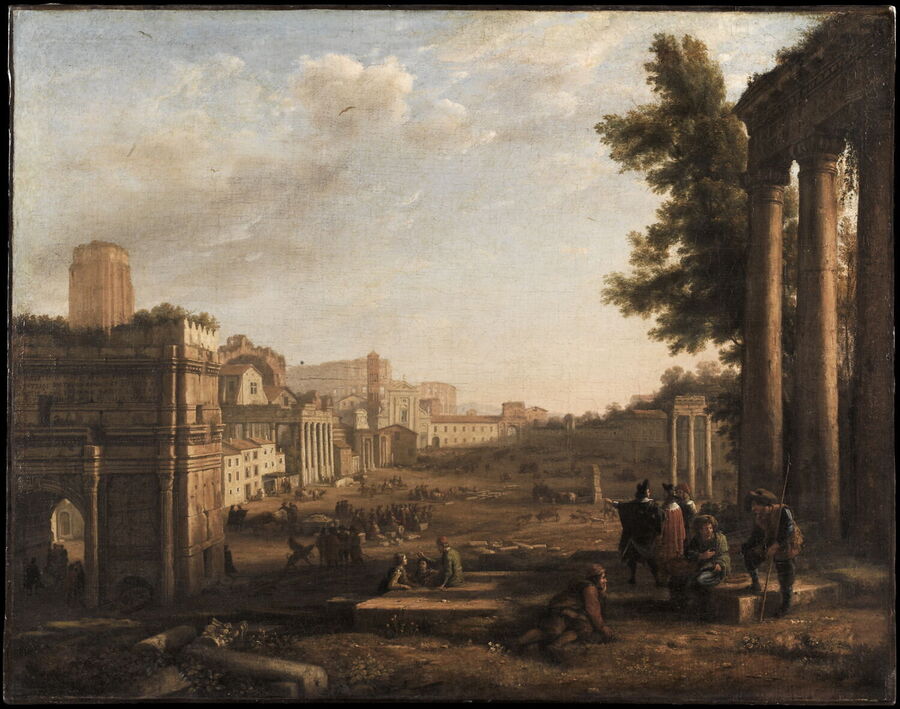
Claude Lorrain, «Campagna Romana in Rome, ” 1636, Louvre
«Campo Vaccino» translates to «cow field.» This was the name given to the Roman Forum in the 17th century because livestock was literally grazed there. The animals graze right on the Forum, while people in the foreground sit on the ruins of ancient columns, chatting and paying no attention to the monuments around them—the Arch of Septimius Severus on the left, the temple columns on the right, and the Colosseum in the distance. The figurines are very small compared to the architecture, and the warm light makes the ruins feel like part of the landscape, like trees or hills. For me, this is the purest form of a «ruin-memory»: the past has ended so long ago that it has transformed into nature.
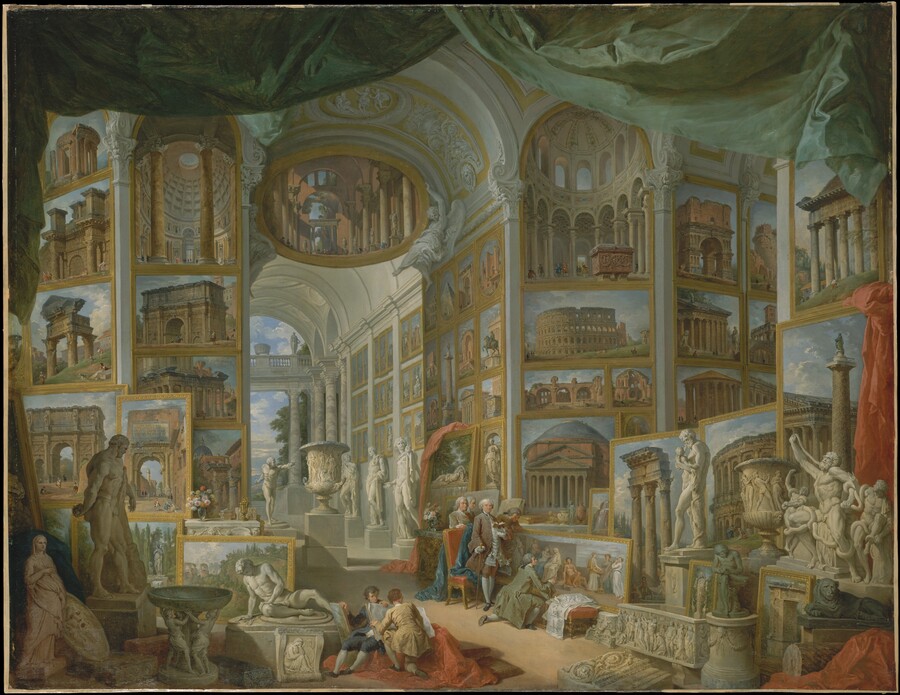
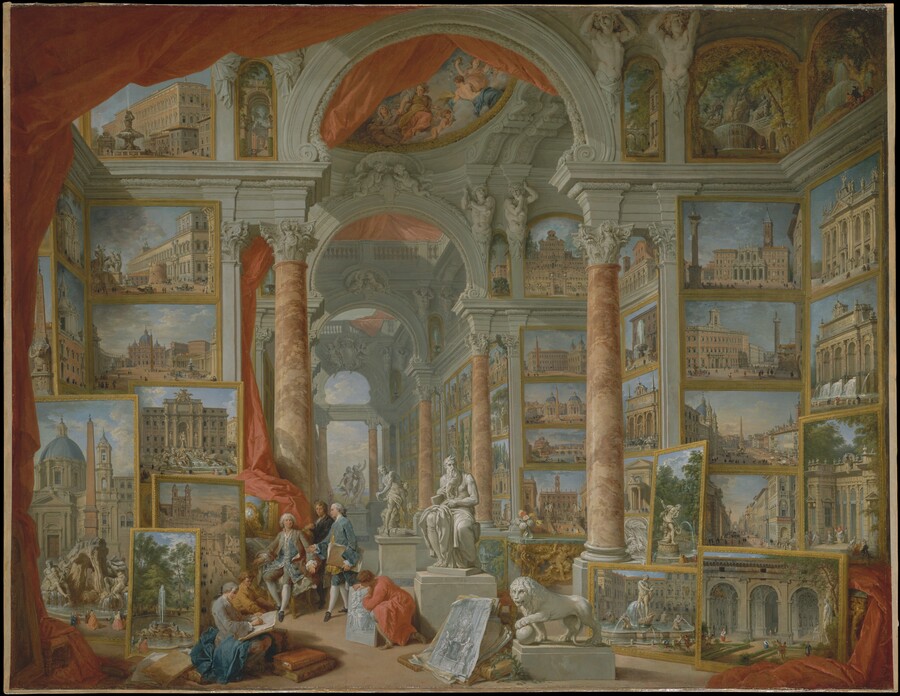
Giovanni Paolo Panini, «Ancient Rome» and «Modern Rome, ” 1757, Metropolitan Museum of Art, New York