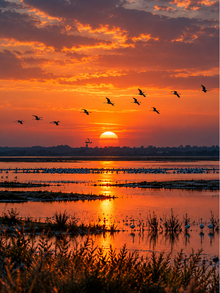
Berdyansk Spit is a narrow strip of land in the northern part of the Sea of Azov, located within the city limits of Berdyansk, Zaporizhzhia Oblast. The spit is approximately 18 kilometers long, with a width ranging from 40 meters to 2 kilometers, covering an area of about 7 square kilometers. The spit is part of the Priazov National Nature Park. Its formation is attributed to the Berda River, which flows into the sea east of the spit’s base. One of the oldest lighthouses of the Sea of Azov, the Lower Berdyansk Lighthouse (1838), is situated on the spit. In 2023, over 2,000 rose bushes were planted in the territory of the «Mayak» Creative Center.
Legend
They say every sea has its own soul. The Sea of Azov, the shallowest and warmest, has a feminine, capricious, and delicate soul. The ancient Greeks called it Maeotis, the mother of the Pontus. The Scythians, who roamed its shores, believed the sea was not water, but the tears of a giantess mourning her beloved. Perhaps this is why its water is so warm and gentle—it remembers the touch of human sorrow. Or maybe it’s because it is so shallow; the bottom is within easy reach. And everything that was hidden eventually comes to light. On the northern shore, where the Berda River empties into Azov, lies a narrow strip of land, weary from its long journey: the Berdyansk Spit. It is eighteen kilometers of sand and shell fragments, ranging from forty meters to two kilometers in width. It plunges into the sea like an arrow shot from a giant’s bow. The elders tell tales that this spit was created by a sorceress—powerful and temperamental. She loved a knight, but he did not return her affection. Enraged, she cast a golden key to her heart into the sea. The key flew past, fell into the water, and turned into an island. And following it, the sand spits were scattered. Such is the ancient legend.

However, there is another legend. The one that arose later, when the lighthouse was already standing on the spit, and the grass known locally as «tryn-trava» grew beneath the oaks. This tale is about the roses—now numbering over two thousand on the territory of the «Mayak» Creative Center—and about a love that proved stronger than time itself. In the days when Berdyansk was still called Novonogaisk, and later Berdy, two tribes lived on the spit. The Scythians, stern warriors who often buried gold in mounds. And the Meots, peaceful fishermen and farmers. A feud had existed between them for a long time—not even over land, but over the right to call this coast their own. The Scythians believed the spit belonged to them because their horses were the first to gallop across its sand. The Meots, however, claimed the local waters belonged to them because their nets were the first to fill with Azov fish. Among them were two people. A young woman from the Meot tribe, with eyes the color of seawater and locks scented with steppe herbs. And a young man from the Scythian tribe, whose hands were accustomed to the bow and the horse, and whose heart knew no fear. The young woman collected shells at the far end of the spit, where the lighthouse had not yet shone, and only the outline of the future tower could be discerned in the fog. The young man would ride there to be alone, away from the noisy bonfires and martial songs. They met by chance and immediately realized that the tribal feud had nothing to do with them. Their secret meetings took place under the oaks that grew opposite the entrance to the tent, where, centuries later, the «Don» tent would be erected.
The trees, crooked and gnarled, the elders called witches. They believed spirits dwelled in the branches, guarding lovers. And underneath them grew grass that no one trod upon or pulled. Because they knew that the «tryn-grass» granted strength and opportunity to those who treated it with reverence. Do not trample it, do not litter near it, do not tear it. And it would reveal what is hidden from others. The girl told the young man about the fish inhabiting the Sea of Azov, about the dolphins that occasionally swam here, and how her mother healed people using grass—and the mud from the lagoons. The young man told her about the gold of the Scythians, about the bowls and plaques that adorned horse harnesses and quiver straps, about the burial mounds where ancient kings rested. One day, he brought her a small gold plaque depicting a griffin. The girl hid it against her chest, closer to her heart. But hatred does not sleep. The Scythians discovered that their young man was meeting with a girl from a hostile tribe. Word reached the Meots, too. Both sides demanded blood. «Traitor!» some shouted. «Disgrace!» others echoed. The young man was ordered to forget her. The girl was ordered to marry the chieftain’s son. The lovers refused. And then the tribes decided: let the sea judge. If the young man could walk across the bottom from the spit to the island and return unharmed, the girl would be his. If he could not, they would both die. The Sea of Azov is the shallowest in the world. The depth varies from 0.9 to 14 meters. But walking across the bottom of even such a body of water is no stroll. The young man guessed that. He also understood something else: sea spirits do not favor those who disturb the tranquility. But he agreed. For her. At any cost. At dawn, when the sun had just appeared over the horizon, painting the surface the color of molten gold, he stepped into the sea.
The girl stood on the shore, clutching a golden griffin in her hand. She was not crying. She believed. And the witch-oaks whispered to her: wait, he will return. The young man walked along the muddy bottom. The water parted before him, yielding passage. Fish swam nearby, unafraid. Dolphins, that had entered these waters, circled around, as if guarding him. He walked for an hour, two, three. The seabed rose and fell, but the traveler did not lose his way. When he reached the island—the very one that was once the enchantress’s golden key—he fell to his knees and kissed the earth. And then he saw her. The rose. The only one on the entire island. White, with crimson veins, as if someone had brushed the petals with a hand dipped in blood. He carefully plucked it, like a child, and tucked it into his sleeve. And he turned back. The return journey was harder. The sea felt that someone had dared to challenge it. Waves swelled, the wind whistled. But he kept going. The traveler thought of her. Of her eyes, her hands, her laughter. And the elements retreated. They understood: before them was not just a warrior, but a man driven by love. When he finally reached the shore, the sun was already sinking toward the horizon. The girl rushed toward him. The lovers embraced. The witch-oaks rustled, and the wormwood beneath their feet blossomed in white and pink. For the first time ever. The young man took out the rose, and it glowed in the rays of the setting sun, like a tiny miracle. But their happiness was brief. The Scythians and Meoti, seeing that he had returned, became enraged. They decided: the sea had deceived them, and they demanded the death of both. The prisoners were seized, brought to the very end of the spit, where the Lower Berdyansk Lighthouse would later be built. And there, on the sand, among the shells, they were destined to die. The lovers looked at each other. And then the hero understood: death is not the end. He pleaded with the spirits of the oaks and the wormwood for one grace. Let their love not vanish, but remain on this earth forever. The spirits heard. In the moment when spears were about to pierce their hearts, the prisoners vanished. The roses wrapped around the sand, rooting themselves deep.
Centuries have passed. A lighthouse was built on the cape. Lower Berdyansk, one of the oldest on the Sea of Azov. Its octagonal tower, marked with a red stripe in the center, has guided ships for over sixty years. And nearby, on the grounds now called the «Mayak» Creative Center, over two thousand rose bushes were planted. No one knows exactly where this tradition came from. But the longtime residents say these are the roses that grew from the love of a young man and a young woman.