
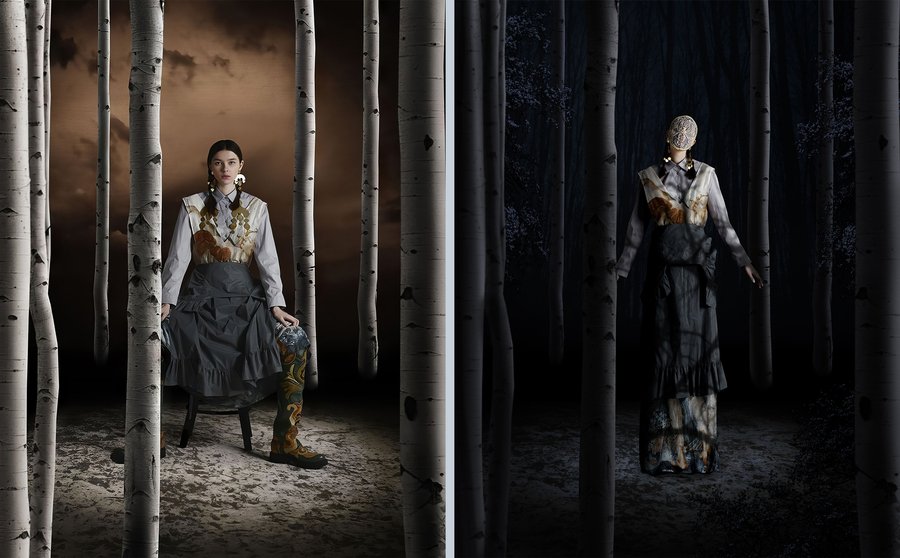
Digital Project «Tatar Fairy Tales.» Alisa Gulkanian x Your Yool Brand. 2021.
Amid globalization, as universalization permeates every sphere of human life, interest is growing in ethnic motifs within contemporary fashion—driven by concerns over the erosion of national and cultural uniqueness. For instance, Tatarstan is currently seeing a rise in young designers who draw inspiration from their national heritage when creating their work.
«Fashion is an important part of culture, which means that everything happening in fashion today will eventually become as much of a cultural heritage as the traditional national costumes of different peoples. There is no future without the past.» (Chernoguzova, 2022)
The Tatar costume embodies a unique cultural code that reflects the rich history and traditions of this people. Every seam and pattern seems to tell a story, connecting the past with the present.
Tatar fashion is not just a love for ethnic motifs; it is a way to express national identity through clothing, headwear, footwear, and jewelry. In today’s world, where boundaries blur and more people seek to preserve their uniqueness, ethnic style in dress becomes a means of self-expression and recognizing one’s individuality within a global context. Thus, contemporary small brands are actively contributing to the popularization of Tatar culture, reinterpreting and rethinking the traditional national costume and mythology as an essential part of cultural heritage that unites various artistic aspects.
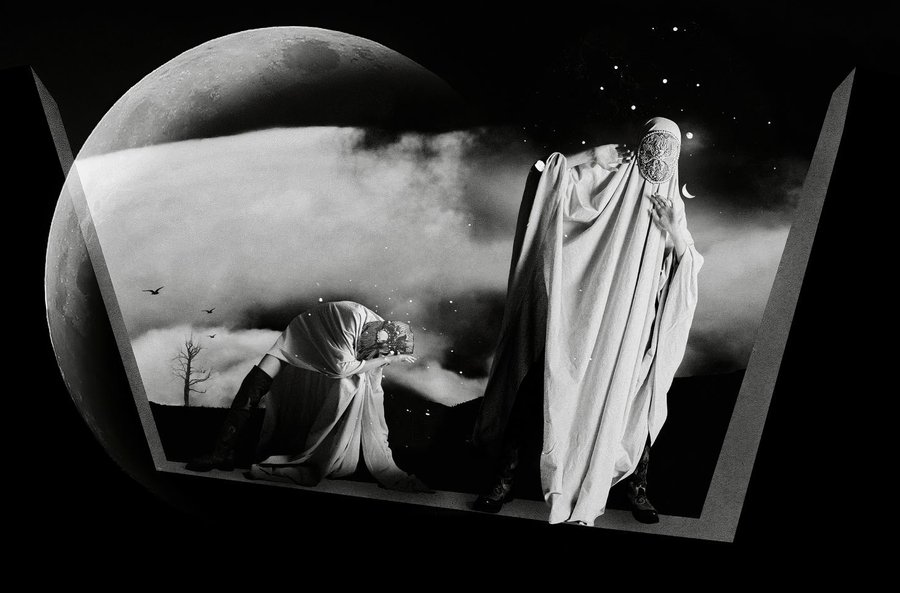
From the «Tatar Fairy Tales» series. Alisa Gulkanyan x Your Yool Brand. 2021.
My interest in this topic stems from my ethnic background within this group, as well as my direct residency in Kazan for several years and my observation, in both real and virtual life, of the representation of Tatar identity in fashion.
So, what does the contemporary Tatar dress look like in our reality? Has any national characteristic, typical of our people and reflected in their appearance, endured? The goal of this research is to examine the essential components of the Tatar costume, identify the latest trends in the visual language of Tatar culture, and familiarize readers with this aspect.
Your Yool Brand. 2022
The research will be based on an analysis of the core elements of Tatar costume that remain relevant in the 21st century, and an exploration of contemporary trends in the visual aesthetics of Tatar culture, with the aim of immersing the reader in this cultural context. The principle for material selection is based on identifying the dominant narratives, motifs, and imagery that appear in most works. The organization is structured as follows: — Clothing as an Element of Traditional Culture: ✻ ornamentation; ✻ Ichizhna-Kalyapush craft; ✻ jewelry: chulpy, khasite, alka. — Transformation of the Cultural Code: ✻ Tatar tribal aesthetic; ✻ reinterpretation of myths; ✻ digitalization.
In this analysis, I relied on historical and cultural studies sources, as well as my own observations.
Clothing as an Element of Traditional Culture
(1) The Faizullin Family. 1903; (2) Tatars. Early 20th Century
Clothing is a crucial element of human culture. The formation of the Tatar costume dates back to ancient times, but the specific attire that has reached us today developed slightly later—around the 19th century—based on the fusion of traditions from Islamic clothing, elements of folk dress, and general Russian fashion.
Portrait of Tatar Girls. 1910.
Traditional national costumes are rarely seen in daily life nowadays; they are often observed at religious and festive events. Before we delve into how Tatar identity is represented in contemporary society, it is necessary to outline the general characteristics of the specific details of the Tatar costume that later became widespread.
Ornamentation
(1) and (3) Snippet of gold embroidery on a women’s kalfak. 19th century (2) Snippet of embroidery on a boot. Early 20th century. (4) Snippet of gold embroidery. 19th century
Tatar ornamentation, as a primary medium of decorative and applied arts, reflects the rich history of the people’s formation and development, their culture, and their art. Three main motifs stand out in the ornamentation: floral-vegetal, geometric, and zoomorphic. The last is the rarest, due to the Islamic prohibition on depicting humans and animals. The most common and recognizable is the floral-vegetal pattern.
Ichige-Kalapush craft
In the 19th century, one of the main craft industries was the ichno-kalapush production, which included the creation of decorated mosaic patterned leather footwear and gold-embroidered headwear (tubeteika, kalfak).
Tubeteika: (1) late 19th century; (2) and (3) mid-19th century
Initially, the тюбетейка was used predominantly for military purposes, but over time, it became an integral part of the national costume. The word derives from the Turkic «tyube,» meaning «peak» or «apex,» which reflects the significance of this headdress—it becomes a kind of «celestial vault,» like a mosque dome, under which a person is born, lives, and dies.
(1) and (2) women’s kalfak. Velvet. Gold embroidery. 19th century
Originally, the kalpak served not only an aesthetic function but also a symbolic one—protection from evil spirits. Its decoration utilized gold embroidery, rhinestones, and sequins, transforming this headwear into a true work of art.
(1) Ichigi. Early 20th century. (2) Women’s shoes (bashmak). Velvet, metallic embroidery. (3) Women’s shoes (bashmak). Leather mosaic. Early 20th century. (4) Ichigi. Leather mosaic. Late 19th century.
The foundation of traditional Tatar footwear lies in the long-standing tradition of artistic processing of leather material using mosaic techniques. The shoes are created from numerous patterned, colorful pieces of leather that are joined with a decorative seam, lending them a distinct character and making them utterly unique.
Jewelry: chulpy, hasite, alka
(1) Alka (earrings). Silver, gold plating, filigree, granulation, turquoise. 19th century. (2) Necklace. Filigree, turquoise. 19th century. (3) Chulpy. Silver, gold plating, filigree, amethysts, turquoise. 19th century.
Adornments were an essential complement to the traditional Tatar costume, indicating status and age. The ritual and magical function was also important: as the wearer moved, the ornaments would make a chime, which was believed to ward off evil spirits.
(1) Tatarka in khastet, late 19th century. (2) Chulpy. Silver, gilding, turquoise, amethyst, filigree, coins. late 19th century.
Khasite is a traditional chest band in the Tatar costume, decorated with plaques, pendants, and coins. Initially, it symbolized the ceremony of the bride moving into her husband’s home, but over time, it has become merely a decorative element of festive attire.
Chulpys—hair ornaments—are narrow ribbons woven into the girls' braids and adorned with tinkling pendants made from coins, gemstones, or wirework crafted from various plaques.
Transformation of the Cultural Code