CATEGORIES
I. Concept
II. Scheme
III. Motif
IV. Print Run
V. Conclusion
CONCEPT
The image of the unseen as a problem of representationIn the miniature from the Parisian manuscript «Book of Wonders, ” two white unicorns graze next to an elephant—they are slender-legged, resembling purebred horses. Marco Polo, whose text the miniature illustrates, also calls his beasts unicorns but describes them as stout and ugly. They were rhinoceroses he had seen in Sumatra.
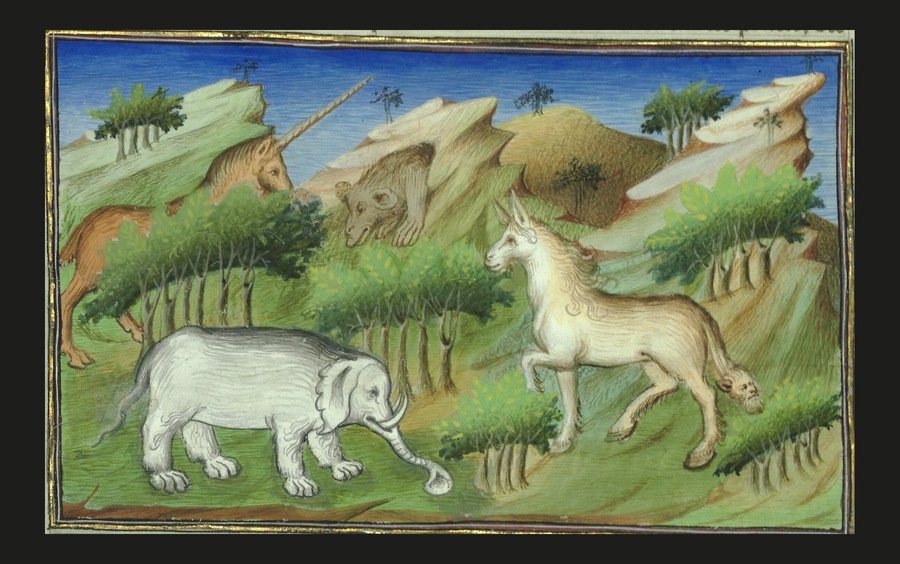
«The Travels of Marco Polo.» Elephant and Unicorns. Parisian miniaturists from the circle of Master Busico. Circa 1410–1412.
The miniaturist believed the traveler halfway. He kept the word «unicorn» but skipped the description and instead drew the beast he had long known from books. The page presents not the creature itself, but the book knowledge about it. Ernst Gombrich, in his book Art and Illusion, referred to such pre-formed images that an artist takes as a foundation and adjusts to fit their objective—schemata [Gombrich, 1960]; observation confronts these schemata here. The study examines three questions: what the image of the beast, which almost no one in Europe had seen, represented; why artists clung to the schema even when a live animal was presented to them; and what conferred the status of knowledge upon such a depiction.
Research Hypothesis: The depiction of an unseen beast was primarily a source of knowledge about it. The schema was preserved because it best served the image’s purpose, and the image’s status as knowledge was validated by the guarantee established through the print run.
The depiction of the unseen beast could not be matched to an original. Most viewers, and often the artist, had never seen the animal. The miniature in the bestiary interpreted the text, while the portrait of the elephant gifted to the nobleman glorified the owner. For these purposes, the recognizable schema suited better than new observation, and it was preserved even when a drawing from nature already existed nearby. Observation prevailed where it was necessary for the purpose to be fulfilled.
The measure of the monstrous creature’s authenticity was the appointment of its image.
It was impossible to verify the image, so it vouched for itself: citing authority or naming a witness and a date. The Hereford map references Solinus and Isidore; Breidenbach’s book refers to a journey to the Holy Land; the engraving from the late 16th century references a witness and a date. Louis Marin, in his book On the Power of the Image (Des pouvoirs de l’image), calls this the reflexive dimension of representation, where the image shows an object and simultaneously asserts its right to show it [Marin, 1993].
The work spans from bestiaries around 1200 to encyclopedias of the second half of the 16th century.
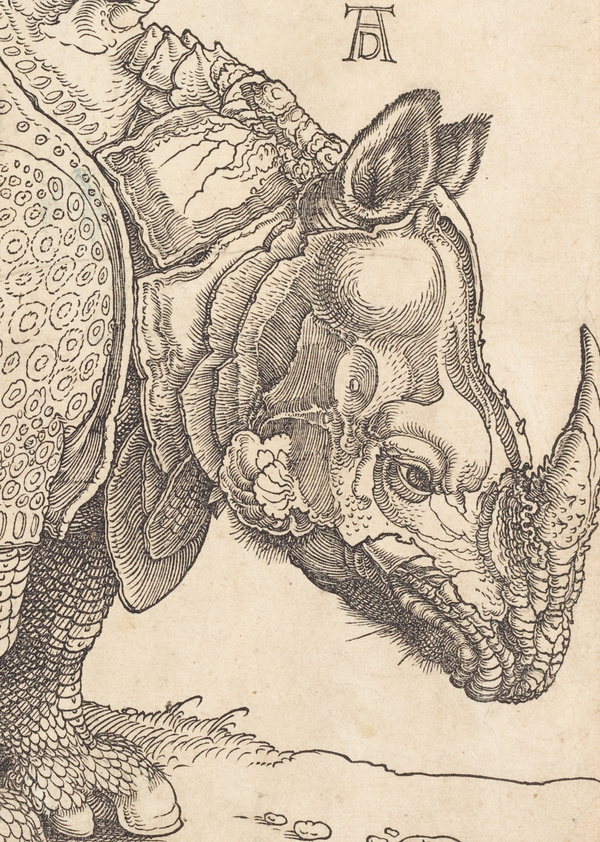
At the beginning of this period, elephants were drawn from texts, but fifty years later, Matthew Paris drew them from live animals: diagram and observation finally appear side-by-side. In Gesner’s encyclopedia from the 1550s, Dürer’s rhinoceros, the pilgrim’s unicorn, and the eyewitness giraffe stand as equals. At the beginning of this period, elephants were drawn from texts, but fifty years later, Matthew Paris drew them from live animals: diagram and observation finally appear side-by-side. In Gesner’s encyclopedia from the 1550s, Dürer’s rhinoceros, the pilgrim’s unicorn, and the eyewitness giraffe stand as equals.
The sections follow where the artist knew the animal: from a book or album («Diagram»), from life («Nature»), or from a print («Edition»). Four animals are tracked in detail: the elephant, rhinoceros, giraffe, and whale. Each one passes through several sources and sections. The artists could see the lion, cheetah, and parrot in life, and this demonstrates how the image changes when the live subject is available. The images are collected in pairs and rows so that the same animal appears in various contexts.
From written sources, we drew upon Pliny’s «Natural History,» Marco Polo’s accounts, and inscriptions on engravings. In terms of theory, besides Gombrich and Moran, Nelson Goodman’s book «Languages of Art» is significant: an image does not need an existing object, so a unicorn could stand next to a camel [Goodman, 1968]. Peter Parshall analyzes the «from life» formula as a statement of veracity in his article «Imago contrafacta» [Parshall, 2005].
III. DIAGRAM
Image based on description and exampleMost artists knew the exotic beast through someone else’s word or someone else’s drawing. The miniature depiction of the elephant in the Aberdinese Bestiary likely never saw one; instead, it read that Persians and Indians waged war while seated in wooden towers atop elephants, throwing darts from them as if from a battlement. The bestiary—a book on animals and their symbolic meanings—borrowed descriptions from Pliny and Isidore of Seville, and the illustration was meant to correspond to those accounts. From this image grew the elephant with a tower, which bestiaries copied for two and a half centuries.
Elephant with a tower. Unknown artist. Bestiarium, Harley 3244. c. 1236–1250 · Elephant in Cremona. Matthew Paris. «The Great Chronicle.» 13th century. · Elephant with a tower. Unknown artist. Bestiarium, Ms. Ludwig XV 4. After 1277
Hereford World Map. Approx. 1300.
Hereford world map. Unknown master. c. 1300. On the left—a rhinoceros; on the right—a unicorn, fragments.
On the Hereford Map, the rhinoceros and the unicorn stand almost next to each other, and each is labeled with its origin: the rhinoceros is from Solinus, and the unicorn is from Isidore of Seville. The authenticity of the creature here is ensured by referencing an authority, while the form merely alludes to the description. The bestiary read the creature not just as a beast, but as a symbol. The whale in it is an image of the devil with two habits: sailors mistake it for an island and drown with it, while small fish swim toward the sweet smell from its mouth. In Ashmole’s bestiary, sailors remain in the boat, and the fish swim into the mouth. The Getty bestiary master portrays the sailors directly on the whale’s back. The illustration selects one phrase from the text and repeats it along with the interpretation.
Seal Island. Bestiary of Æschmol. Unknown Master. England, circa 1210–1220 · Seal Island. Bestiary, Ms. Ludwig XV 3. Unknown Master. Flanders, circa 1270
In the bestiary, the illustration represents the word for the animal and is transcribed alongside it.
The second path by which the beast approached the artist was the sketchbook. The animals in it were drawn individually and without a background, allowing them to be transferred into any composition. According to Gombrich, any drawing, even from life, begins with a schematic representation [Gombrich, 1960]. Willard de Honnecourt labeled his lion as «drawn from life, ” but he replicated the head from the „Book of Flowers”—round, facing the viewer, with bulging eyes. The inscription attests to observation that the drawing itself does not convey [Parshall, 2005, p. 152]. The cheetah in De Grassi’s album may have been drawn from a live specimen, whereas Michelino’s has it running in the same pose, only facing the opposite direction. What is seen once becomes a model.
Lev. «The Flower Book» by Lambert St-Omer, fragment. c. 1120 Villars de Honnecourt. Lev. c. 1225–1235.
Cheetah. Giovannino di Grassi and workshop. 1370–1390 · Cheetah. Attributed to Michelino da Besozzo. Early 15th century.
From the book or album, the animal comes to the artist already in image, and even the inscription «from nature» does not negate the model.
III. NATURE
Observation and Image AssignmentAfter Raphael’s drawing. Gano’s Elephant. c. 1514–1516.
Occasionally, an exotic beast would appear before the artist. Elephants, lions, and giraffes were brought to courtyards as gifts and curiosities; crowds watched them and painted them directly from life. The elephant Hanno, gifted to Pope Leo X in 1514, saw all of Rome. But seeing the animal was not the same as depicting what had been seen. What happened to observation when it was transferred to paper: did it transform the image, and what service did it render?
Albrecht Dürer. Leo. 1494 / Albrecht Dürer. Two Lions. 1521.