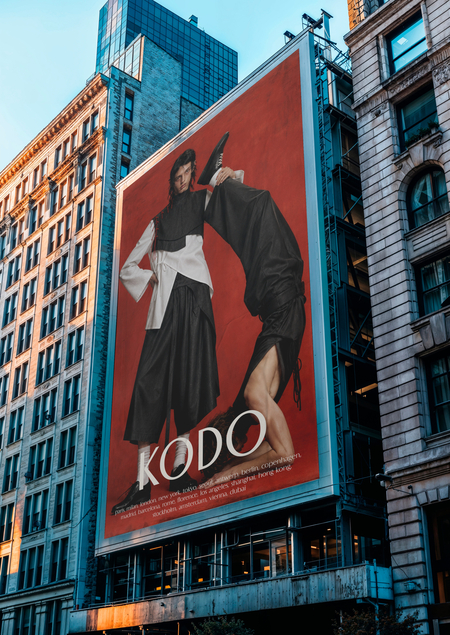


KODO—a modern clothing brand that reinterprets Japanese cultural heritage. Its core concept is the evolution of tradition: familiar forms, artisanal techniques, and aesthetic principles are given new life in everyday wardrobes. The brand draws upon the Japanese approach to clothing—attention to material, freedom of silhouette, layering, and expressive detailing. These principles form the foundation of pieces suitable for modern urban life.

In the context of globalization and rapid trends, cultural traditions are gradually losing touch with daily life. They are either preserved as relics of the past or used as decorative elements without revealing their inherent meaning. However, a tradition remains alive when people can interact with it in the present day. For this to happen, it requires new forms—forms that resonate with the contemporary person and align with their way of life.

KODO proposes integrating Japanese traditions into contemporary fashion by reimagining tailoring, proportions, textures, and details. For example, the characteristics of wrapping closures and loose silhouettes can form the basis of an urban jacket, while traditional fabric techniques can become a distinctive feature of everyday wear. Every reference to heritage must be thoughtful: it is crucial to study the origin of an element and understand the function or idea it conveys. In this way, clothing becomes a way to engage with and advance a culture.

Develop a recognizable brand with a cohesive concept that organically blends Japanese cultural heritage with the needs of modern wardrobes.
Main project goals:
- Develop a unique visual language through silhouettes, materials, and details.
- Adapt traditional elements for everyday wearability.
- Unfold the cultural context of the items through compelling narratives.
- Form a community of individuals who value meaningful design and individuality.

The main KODO archetype is The Creator. It is expressed in the desire to explore cultural heritage, experiment with form, and create pieces with a distinct character. KODO helps individuals perceive clothing as a tool for self-expression. The brand offers freedom in combinations and interpretations, allowing everyone to construct their own look. This Creator possesses a thoughtful, observant, and reserved nature. Their expressiveness is built upon the precision of choices—proportions, fabric texture, seam placement, and silhouette movement.
The voice of KODO is calm, confident, and attentive. The brand speaks meaningfully and accessibly, conveying an interest in culture through specific details and stories.
Intonation examples: «Tradition continues in motion.» «Free form. Thoughtful details.» «We reimagined the silhouette while preserving its logic.» «Every detail has a story. The piece continues in your life.»
The thread connecting generations.
This thread travels through time, linking the experience of the past with the ideas of the present. It can change direction, become part of a new pattern, and adopt different forms while maintaining continuity. For KODO, this metaphor reflects an approach to heritage: every piece of clothing becomes an extension of cultural history. This metaphor can be explored through seams, interweavings, tailoring lines, and the brand’s visual materials.
To continue the life of Japanese traditions through contemporary clothing, making cultural heritage part of daily life. KODO strives to create pieces that help individuals express themselves and cultivate an interest in their origins. Through design, the brand demonstrates how traditions can evolve alongside society.
Respect for Cultural Heritage
Studying traditions and symbols while preserving their context and origins.
Evolution of Traditions
Reimagining heritage by adapting it to contemporary life.
Craftsmanship and Attention to Detail
Designing the cut, materials, and details to blend aesthetics with comfort.
Individuality
Creating apparel that helps express character and accommodates diverse ways of wearing.
Intentional Design
Creating items that are well-founded, practical, and durable.
Diesel — brand character and denim work.
Acne Studios — signature design and visual identity.
AllSaints — cohesive everyday wardrobe.
EDWIN — Japanese heritage in contemporary fashion.
Y-3 — expressive silhouette and Japanese design ethos.
The working hypothesis for the primary audience is residents of large cities, aged 20–35, who are interested in fashion, design, art, and Japanese culture. They use clothing for self-expression, paying attention to silhouette, material, and brand history. They are drawn to independent labels with recognizable aesthetics and a clear concept. When choosing an item, the combination of expressiveness and comfort, quality of execution, and the ability to integrate the purchase into their existing wardrobe are important to them. An interest in Japanese culture may be the catalyst for discovering KODO, while the design and comfort are the reasons for staying with the brand. Age serves here as a guideline. The main unifying characteristic of the audience is the desire to choose clothing thoughtfully and to build a personal style.
«I am drawn to Japanese aesthetics, and I want to integrate them into my everyday style. I need clothing that conveys this connection while still allowing me to remain true to myself.»
TT Ricordi Allegria VF Edu
For the brand, a restrained, understated typeface was selected to emphasize the subtlety of Japanese aesthetics. Its delicate nature conveys a sense of harmony, calm, and attention to detail. The typography supports the brand’s visual identity by allowing space for expressive silhouettes and fabric textures, linking traditional elegance with modern minimalism.
The logo is a letterform representation of the name KODO, rendered in a slender, understated typeface. The simplicity of the lines lends it a sense of lightness and elegance, reflecting the brand’s concept rooted in Japanese aesthetics—its harmony, simplicity, and attention to detail. In Japanese, the name translates to «pulse» or «heartbeat.»
The meaning of the name: The pulse of the past within modernity The rhythm of culture that continues to live on The connection between generations through clothing The constant movement and evolution of tradition