
Navigation
- Concept
- Product Advertising
- Ad Constructor
- Ogilvy Headlines
- Absurdity
- Metaphor
- The Power of Word and Sign
- Extreme Consequences
- Shock
- Storytelling
- Conclusion
- Project
- Sources
Concept
In today’s rapidly changing world, where planning horizons shrink to mere hours, plans constantly shift, the relentless pursuit has become routine, and scrolling through social media brings not pleasure but anxiety—nearly every city dweller suffers from chronic stress. Therefore, I decided to create a project addressing a relevant issue: exhaustion, tension, negative emotions—all of it evaporates into the «Purgatory.»
«Purgatory”—a sauna where you can undergo a true ritual of rebooting not just the body, but also the soul and mind. Here, the heat and the aroma of medicinal herbs burn away toxins and emotional waste. Every visitor emerges as a different person—light, clean, free from the burden of the past.
The banya held sacred functions in Russian culture—it served as a place for cleansing both body and soul. Furthermore, one could ward off the influence of evil spirits in the banya. This is precisely why a modern concern finds reflection in ancient traditions—because a clear sense of one’s roots, customs, and values also helps keep the mind pure and prevents stress from taking hold.
The target audience for «Purgatory» consists of metropolitan residents aged 20 to 35 with above-average disposable income. These are individuals for whom self-realization in their career and a fulfilling personal life are paramount. They are perfectionists and high achievers, yet they often suffer from burnout due to their lifestyle, experiencing constant stress and negative emotions because they fail to schedule downtime amidst the endless race. It is in the bathhouse or in nature—not in the noisy city—that they can truly reboot their minds.
Brand Platform: Positioning: «Purgatory”—it’s not just a sauna, it’s a ritual for psychic reboot Character: wise, calm, dependable Communication Style: concise phrasing, capable of being provocative but never aggressive (it challenges the taboo of discussing emotional exhaustion) Values: mindfulness, honesty, reverence for tradition Emotional Benefits: the feeling of a „place of power, ” away from the urban hustle, honoring tradition Rational Benefits: a health-benefiting ritual Visual Style: the primary color is deep blue, with shades of light blue, symbolizing purity and sacredness; the accent color is red, denoting peak intensity and emotional fervor.
Advertising is a phenomenon without which we would not know about the products, goods, or specialists who could solve our problems. Since its primary goal is to change the behavior of most people in the interest of the advertiser (the client, the company), people have developed various concepts for constructing advertising messages over the years—the most important of which will be examined in this visual study. The work is structured as follows: a description of the advertising technique, a sketch description for my brand that is built upon this technique, and case study examples of this method used in real advertising campaigns. Finally, I will visualize what the «Purgatory» advertising campaign could look like.
Product Advertisement
Ad Campaign Description:
The simplest and most widespread advertising method of the 19th century, this approach focuses directly on product demonstration. Such a poster typically includes a title, logo, product image, tagline, or brief description. The main objective is to capture the attention of the target audience (addressing their pain points) and convey the key message in the shortest possible time.Sketch Description:
In my sketch, I depicted the interior of a bathhouse to immediately evoke the feeling of being there: dim light streams out from the window and dissolves into the steam from the sauna. The deep blue color, accented with red reflections, lends a sense of tranquility and «confession.» Following the rules of product advertising, I placed the logo and a description on the poster so that it would be immediately clear to the client what the purpose of their visit was.Examples from Advertising:
Here, we can see pre-revolutionary domestic advertisements for perfumes, cigarette filters, and toilet soap. Notably, although all of this is product advertising, its creators still emphasize the feeling of use, which makes it multi-layered in perception while not losing sight of the commodity.Perfume Advertisement — 19th Century

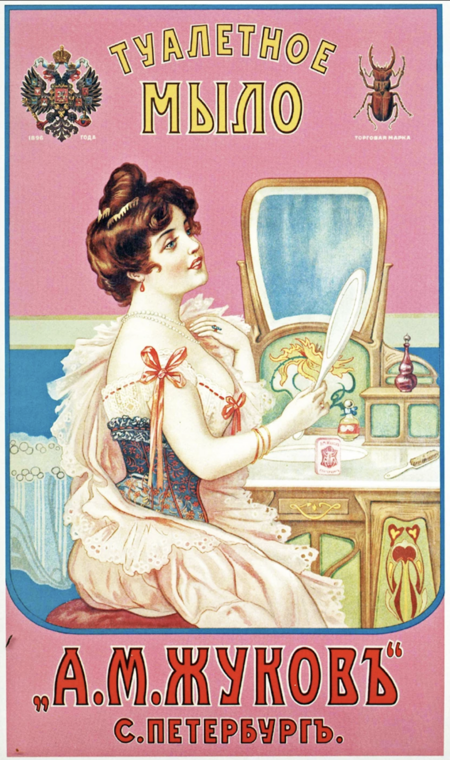
1 — Advertising poster for «Victor’s Senior» cigarette filters. 1890s; 2 — Advertising poster for «A.M. Zhukov. Toilet Soap.» 1904
Ad Builder
Application Overview:
This method is built upon the legacy of the creative partnership between Mayakovsky and Rodchenko. They were pioneers in applying Constructivist aesthetics to advertising, which manifested through bold, geometrically ordered foundations, emotionally charged messaging, and compositional dynamism. The authors themselves referred to their style as the «advertising constructor» and were highly focused on functionality and conciseness.

Mayakovsky — Rodchenko. Advertising Posters for «Rezinotrest.» 1923.

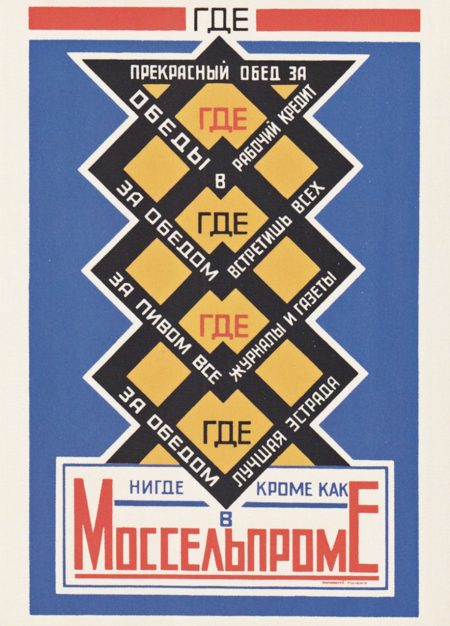
Mayakovsky — Rodchenko. Advertising Posters for Mosseprom. 1923
Sketch Description:
Here, I focused on the emotional sensation of a body slick with sweat, which gives the image a tactile quality and emotional charge. I highlighted the slogan in contrast with a deep burgundy blue, which references constructivism within the rectangle, just as the straightforward, legible typeface and the short, evocative slogan do.Examples from Advertising:
This is how Mayakovsky’s and Rodchenko’s advertising posters looked in real life: vibrant, noticeable from a distance, easily readable in any order, and immediately conveying a life-affirming emotion.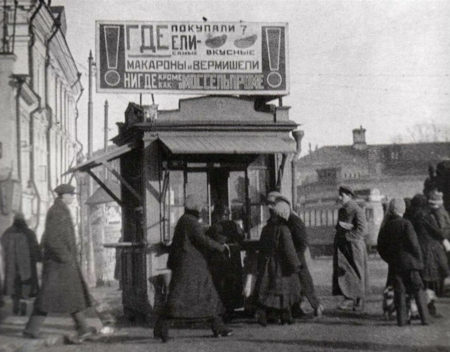

Mayakovsky — Rodchenko. Advertising posters for Mosseilprom. 1923.
Ogilvy Headings
Application Description:
The basis of this submission is David Ogilvy’s method—a great advertising copywriter—which relies on evocative slogans. Empathy for the consumer is also a critical component: the advertisement speaks to the client’s experience, specifying exactly how the product helps solve a problem. A testimonial from a real person who used the product inspires more trust than impersonal platitudes.Sketch Description:
In the advertisement «Purgatory,» I utilize a direct quote from a client whose experience at the bathhouse helped her and replaced ten sessions with a psychologist. The slogan is slightly provocative because it removes the taboo surrounding complex emotions. Furthermore, the credibility of the words is supported by the mention of the request the woman made, which raises hopeful expectations for her visit to the bathhouse.Examples from Advertising:
It would be appropriate here to present case studies by David Ogilvy himself: 1—an advertisement for Rolls-Royce. The concept was to emphasize the car’s elegance and smooth ride. The slogan was: «At 60 miles an hour, the loudest sound in a new Rolls-Royce comes from the clock on the dashboard.» 2—an advertisement for Dove, which uses a direct quote from a brand customer about how she is covered head to toe in Dove shampoo. This increases trust in the brand, and the photograph is also intriguing and draws attention.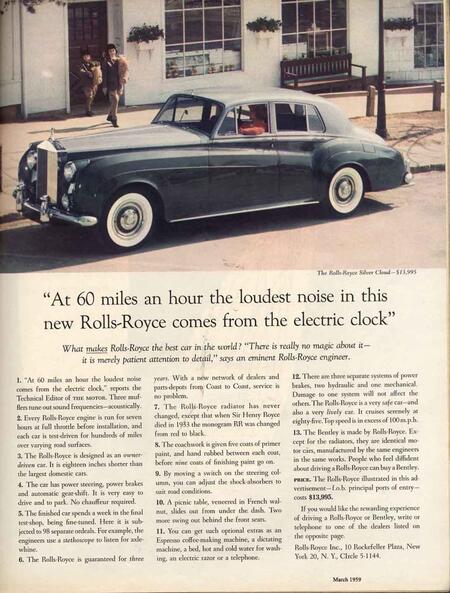
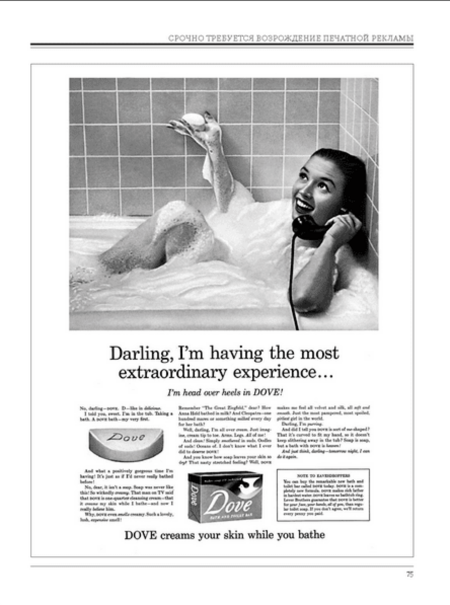
1 — Ogilvy Advertisement for Rolls-Royce (1959); 2 — Ogilvy Advertisement for Dove
Absurd