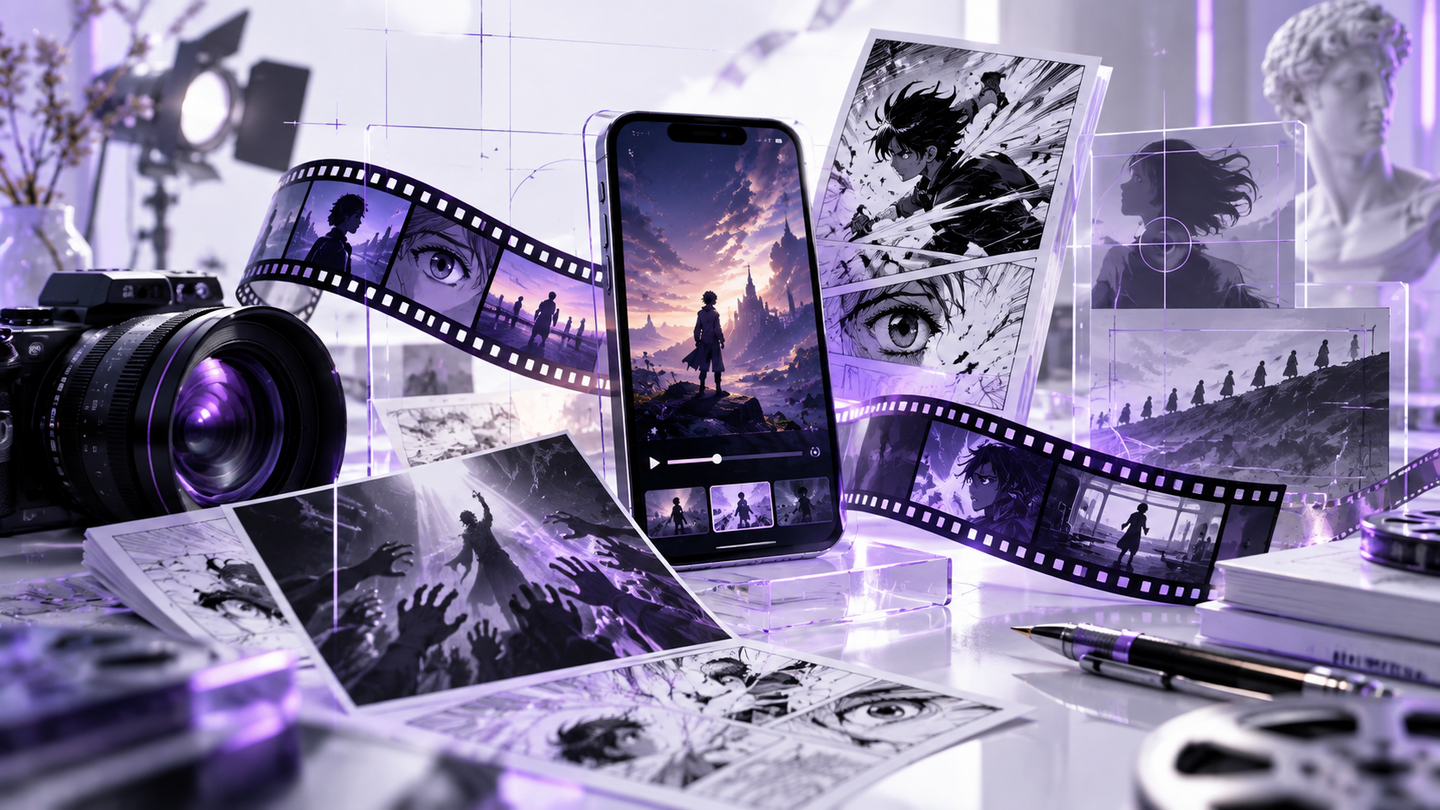
Concept of Cultural and Educational Media
Analytical media in Telegram with the prospect of developing its own database of works and an AI bot.
Themes: artistic techniques, dramaturgy, visual language, symbolism, and cultural connections across film, anime, manga, literature, and other arts.
The project’s goal is to help the audience not only become familiar with works but also understand how they function—why a specific scene creates an emotional impact, what artistic devices the author employs, where the imagery originates, and how it is reinterpreted in other works.
The media combines educational and entertainment functions. For engaged viewers, it offers analytical deep dives; for emerging creators, it provides practical analyses of artistic decisions; and for casual audiences, it delivers accessible explanations, unexpected facts, and recommendations.
Key Sections:
- «Why Does It Work?» — Analysis of expressive devices.
- «Cultural Code» — The history of symbols and artistic imagery.
- «Screenwriting Kitchen» — Dramaturgy and narrative mechanics.
- «One Plot—Many Media» — Connections between different art forms.
- «What’s Next?» — Recommendations based on themes, motifs, and atmosphere.
Technological Component: AI is used to assist with editorial research, material organization, and work discovery. In the future, a bot is planned that will allow users to find works based on a rough description of a scene, plot, or character, and to receive recommendations regarding mood and artistic characteristics.
The project’s editorial principle is to separate historical facts and authorial statements from research and personal interpretation.
Core Concept: From a single work—to an understanding of an artistic technique, its cultural context, and its connections to other works.
General Editorial Concept
Period: November 2026 — April 2027.
Format: A cross-platform, cultural-analytical media outlet examining artistic expression in film, anime, manga, and other art forms.
Primary platform for in-depth content: The project’s website.
Distribution and interaction channels: TikTok, Instagram, VKontakte, and Telegram.
The media explores how creators manage the audience’s attention, emotions, and perception. However, instead of a traditional educational format of «term—definition—example, ” we begin with the artwork itself.
For instance, a viewer sees a scene from „Dracula“ where nuns gravitate toward the vampire. The scene can impress even someone who disliked the movie. This contradiction is where the material begins: why does a single episode turn out to be so expressive?
We then investigate group composition, directional movement, and the protagonist’s placement relative to their surroundings. Only after that do we address potential symbolic meanings.
This approach is designed for various levels of engagement. One person might be satisfied with a short video featuring an interesting observation. Another might want to understand the reception mechanism. A third may move on to a large-scale study or attempt to apply the insights to their own creative work.
Platform Roles
Publications must vary in more than just length. Each platform is responsible for a specific part of the interaction with the artwork.
TikTok—First Impressions Dynamic vertical videos lasting 15–45 seconds. A striking scene, a short visual experiment, or an interesting fact. The main goal is to capture the attention of someone who knows nothing about the project yet.
Instagram—Visual Aesthetics Reels, carousels, frame comparisons, color palettes, and compositional schemes. The content must be engaging not only to read but also to look at and save.
VKontakte—Demonstration and Detailed Video Analysis VK Clips featuring original AI experiments, 2–5 minute videos, comparisons of multiple works, and discussions in the comments.
Telegram—The Artist’s Voice Narrative texts, short investigations, interesting observations, discussions, and direct appeals to readers. Here, the media transcends being merely a source of videos and takes on a character of its own.
Website—Archive and Research Environment Full articles, interactive diagrams, bibliographies, connections between artworks, a thematic catalog, and future AI search capabilities.
Six-Month Thematic Plan
November
Spectacle: Why Can’t We Look Away?
The initial materials must function without prior theoretical preparation. We begin with beautiful, strange, and dynamic scenes that make you want to rewatch them.
Monthly Goal
Audience EngagementTo introduce users to the project through emotionally resonant visual content. To show that behind an impressive image lie specific artistic choices.
Week | Main Theme | Platform Presentation
1 | «Dracula» (2025): How to make the entire composition subordinate to a single character? | TikTok — scene and hook; Instagram — compositional layout; Telegram — essay; VK — proprietary AI scene
2 | Action in Jujutsu Kaisen: How does the viewer perceive speed and direction of movement? | Short analysis of a fight scene, movement trajectory diagram, post on visual legibility
3 | Demon Slayer Fights: Why does the movement feel almost like painting? | Reels on graphic effects; comparison of action lines and silhouettes; video experiment
4 | Arcane Expressiveness: How does the design of movement and facial expressions reveal the character? | Video comparison of gestures, silhouette carousel, Telegram breakdown of character animation
December
Action Anatomy: How Drawing and Editing Create Movement? After an exciting first month, students gain the tools for independent analysis. Personal comics, storyboards, and AI animation are particularly crucial here. Week Main Topic Platform Submission 1 Sakamoto Days Manga: How to structure a fight scene on a page? Analysis of panel sequencing, gaze direction mapping, short animation 2 The Unseen Strike: Why can omitting action be more expressive than the action itself? Original mini-comic and two animation variations 3 Scale in Attack on Titan: How to make a threat feel massive? Working with perspective, figure ratio, and space 4 Six Frames versus One: How to stretch a split second? Experimentation with manga rhythm and demonstrating a single action across different sequences
January
Beauty and Anxiety: How is Atmosphere Constructed?
We transition from dynamic action to more subtle means of influence: lighting, color, sound, space, and anticipation.
Week Core Theme Platform Delivery
1 «Blade Runner 2049»: Why does the desert look like another world? Video on the color palette, carousel analyzing light, article on Roger Deakins' work
2 The beauty of a frame where almost nothing happens Comparison of several compositions; original experiment with a static scene
3 «Jaws»: Two notes enough to create a sense of threat Short video with a sound scheme, Telegram essay, material on the musical motif
4 How to convey danger while keeping it off-screen? An AI-generated scene, followed by an analysis of why the unseen can be unsettling
February
When the image begins to lie
The reader is now familiar with fundamental visual techniques. You can now complicate the content and move on to dramaturgy, editing, and identity.
Week Main Topic Platform Deliverables
1 «Perfect Blue»: how editing dismantles certainty in reality? VK Video with frame-by-frame script, short versions for Reels and TikTok
2 «Spirited Away»: why does the witch steal a name instead of money? Telegram essay, graphic analysis of the contract, long-form article on the website
3 Can you trust the narrator? «Rashomon» and four versions of one event Video detective piece, visual diagram of testimonies, analytical text
4 How to draw time: pauses, skips, and editing in manga Original panel sequence, interactive scene choice
March
Images also have a past
Art history, symbolism, and cultural connections do not appear as a standalone academic discipline but as a continuation of engaging with artworks.
Week Main Theme Presentation on Platforms
1 The Doppelgänger in Perfect Blue and Dostoevsky’s Short Stories Intermedia analysis, visual map of motifs
2 Nuns and Dracula: From striking composition to potential symbolism A return to the first month’s scene, a deeper interpretation
3 Mask, Face, and Personality: Why does costuming sometimes become transformation? A comparison of cinematic, manga, and historical images
4 How did Japanese prints influence Van Gogh? Visual comparison of works against museum sources
April
Cultural Detective: Discover, Understand, Continue The final month integrates the three core functions of media: analysis, recommendations, and interactive searching. Week | Main Topic | Platform Deliverables — | — | — 1 | What to watch after Perfect Blue if you liked the structure, not just the story? | Recommendation cards, comparative article 2 | Manga for fans of inventive action | Visual curation based on artistic techniques, not just genre 3 | «I only remember one scene»: How to find a forgotten work? | Telegram quiz, website search demonstration, AI bot prototype 4 | One scene—five artistic connections | Interactive map of six months' material and a user curation
Media Samples
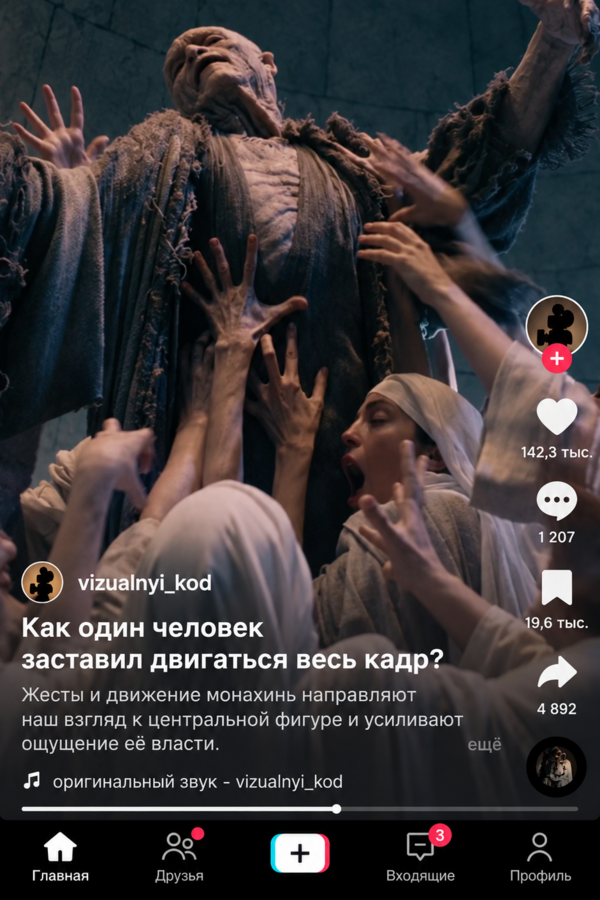
Example 1. TikTok — «How did one person make the entire frame move?» Category: «Why does this work?» Format: vertical video, 40 seconds. Work: «Dracula» (2025), Luc Besson.
The core of the piece is a scene where nuns are drawn toward Dracula under his influence, creating an impressive group composition.
«The new Besson ‘Dracula’ has a scene that looks more interesting than many other moments in the film.
Look: dozens of people are drawn toward one character. Their hands, heads, and bodies are directed in one direction. Even our gaze is involuntarily pulled along with this movement. Now, pay attention to Dracula himself. He barely needs to move. Those around him have already made him the center of the entire composition. This results in an interesting phenomenon: the character’s power is conveyed not by his own actions, but by the behavior of those around him. This is an excellent technique for film, animation, and comics. Sometimes, to show a hero’s power, it is enough to make the entire world turn toward him.»
Visual Support First, we show a short clip of the scene itself. Then, we repeat it in slow motion, pause the image, and draw lines from the nuns' figures to Dracula. Finally, we return to the original frame so the viewer can independently observe the technique being broken down.
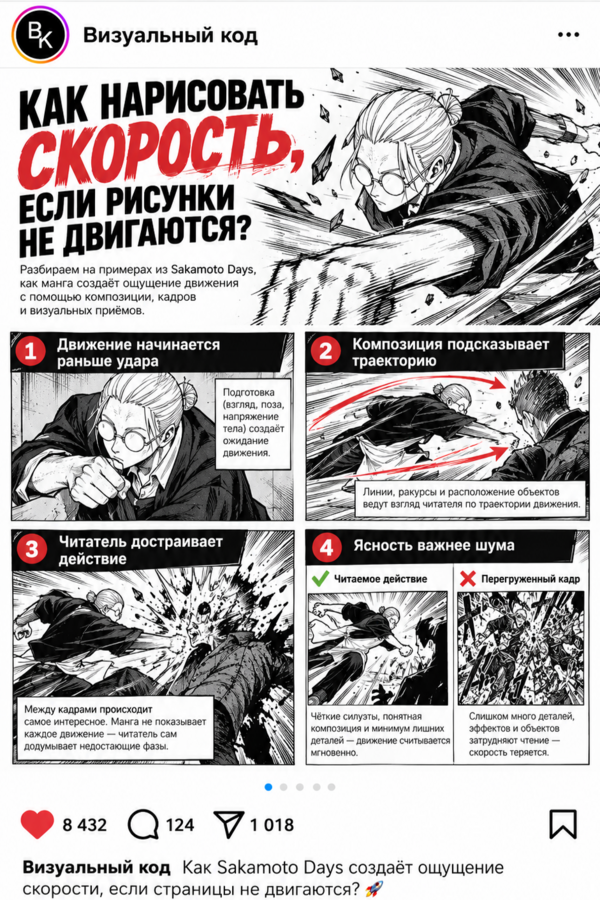
Sample 2. Instagram — «Manga where even static drawings move» Category: «How Does This Work?» Format: A six-card carousel. Artwork: Sakamoto Days, Yuto Suzuki.
This material focuses on depicting motion in manga. Instead of summarizing the plot, we show how the direction of lines, the arrangement of figures, and the panel sequencing help the reader perceive the action.
Card Text Card 1. How do you draw speed when your images aren’t moving?
Card 2. Motion starts before the strike Before a character lands a blow, the artist can depict their posture, line of sight, and body preparation. The reader begins anticipating the action.
Card 3. Composition guides the trajectory Figure angles, directional lines, and object placement direct the viewer’s eye. Even a static image can create a sense of movement from one point to another.
Card 4. The reader participates in the fight An entire action can occur between two panels. The artist shows the beginning and the result, and the reader fills in the missing phase themselves.
Card 5. More lines equal faster? Overloading an image with effects can make it harder to understand the characters’ positions. Sometimes, a clear silhouette and precise direction of movement work better than a dozen extra cross-hatching lines.
Card 6. Action is attention management The main secret to a dynamic scene isn’t the number of strikes. It’s important that the reader understands where to look, what is happening, and which movement is significant. Next time you read an action manga, try tracking not the character, but your own gaze. Who is actually controlling the movement?
Illustrations The first card shows a spread from Sakamoto Days. The second shows a fragment of motion preparation, and the third shows compositional line markings. The fourth displays two consecutive panels and the space between them. The fifth compares a simple versus an overloaded drawing. The sixth concludes the material with an overall image of an action scene.
Instagram belongs to Meta Platforms Inc., whose activities are recognized as extremist and are banned in the territory of the Russian Federation.
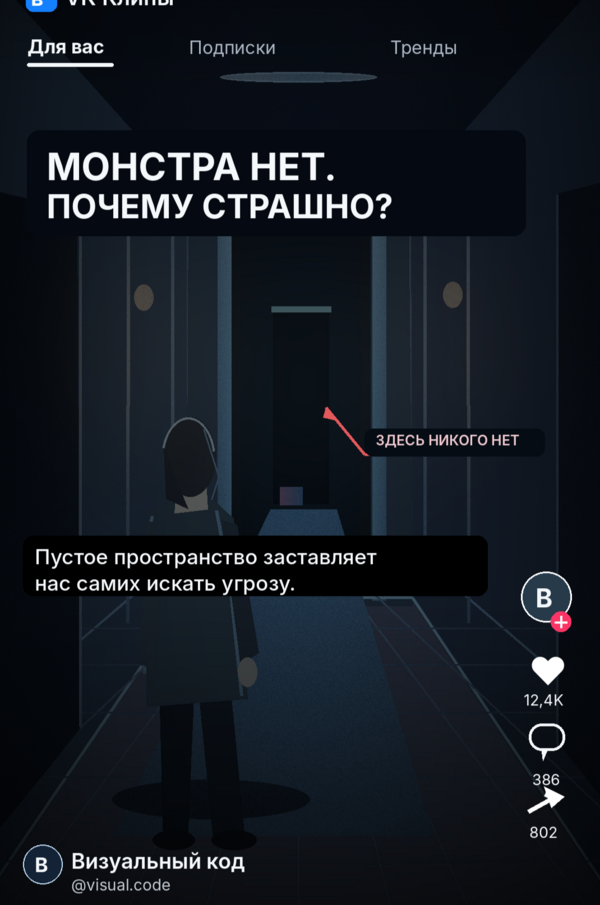
Example 3. VK Clips — «There is no monster. So why is it scary?»
Section: «Why Does This Work?»
Format: vertical AI video, 45 seconds.This example does not use an existing film. We create our own short scene to demonstrate how a director can evoke anxiety without showing the source of danger.
Script
At night, a young woman stands in a long corridor. At the end of the corridor is an open door. Darkness lies beyond it.Initially, nothing happens. Then, the protagonist turns, having heard a sound behind her.The camera remains focused on the empty corridor.And here is the main trick: sometimes the viewer is capable of imagining a far scarier monster than one they might be shown.»Shot Examples
Shot 1. Wide shot of a long, empty corridor. Cold light, symmetrical composition.Shot 2. Medium shot of the protagonist. She hears a sound and turns her head.Shot 3. The camera shows the space behind her. The corridor is still empty.Shot 4. A slow push-in toward the dark doorway. The video cuts off before any potential threat appears.
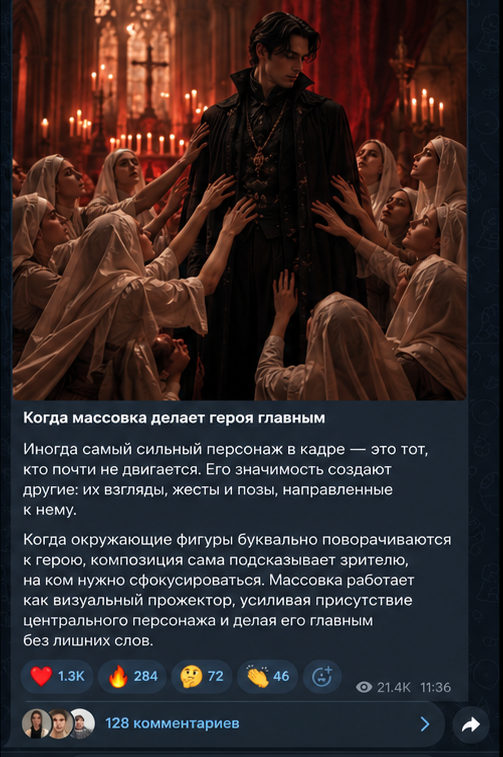
Sample 4. Telegram — «When the crowd makes the hero the main event» Category: «Why It Works?» Format: Authorial post with images. Work: «Dracula» (2025).
Here, we revisit a scene from the first sample, but this time we are not limited to a single visual observation. Publication Text Sometimes the most powerful person in the frame is the only one who doesn’t have to move. In Luc Besson’s «Dracula, ” there is a scene that one wants to rewatch even if the film itself didn’t leave a strong impression. Dracula is surrounded by nuns. Under the influence of his scent, the women lose their composure and begin to reach for him. At first glance, the scene is arresting due to its strangeness. Immediately, several people are literally striving to touch the same vampire. But let’s try to momentarily forget what is happening and look at the image as a composition. We are presented with a multitude of human figures. Each moves in its own way, but the general direction for all of them is the same.
Toward Dracula. Hands form lines, bodies draw closer, and silhouettes intertwine. At some point, individual characters begin to be perceived as a single, moving mass. And here is what is interesting: Dracula himself becomes the almost stationary center of this system. We are accustomed to showing a character’s power through their actions. They must deliver a menacing speech, overcome an opponent, or at least make an impressive entrance. Preferably with a flowing cloak—otherwise, the vampire career, apparently, doesn’t pan out. But here, the director does almost the opposite. It is not Dracula who demonstrates his power. It is the people around him who demonstrate it by changing their behavior under his influence. This concept can also be applied to a comic.
Illustrations The publication is accompanied by three images: a wide shot of the scene, the same frame with directional markings, and a two-panel original comic strip showing how the change in the crowd’s behavior alters the perception of the central character.
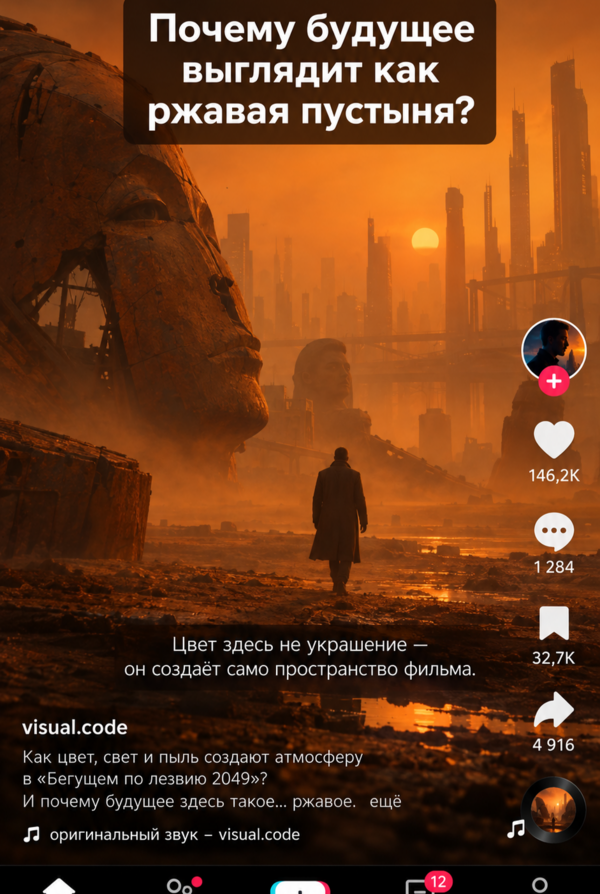
Sample 5. TikTok — «Why Does the Future Look Like a Rusty Desert?» Category: «Why It Works?» Format: Vertical video, 40 seconds. Artwork: «Blade Runner 2049» (2017).
The main focus is not the symbolism of the orange color, but the technical and artistic solutions that make the environment look so unusual.
«Who decided to paint the future in the color of expensive rust? Here is Las Vegas from 'Blade Runner 2049.' Instead of the familiar neon metropolis—there is a vast desert bathed in orange light. At first glance, it seems like someone just cranked up the color grading to its maximum. But cinematographer Roger Deakins used specialized filters and colored lighting right during filming. And this changes more than just the color of the image. Figures turn into silhouettes, distant objects dissolve into a uniform atmosphere, and the familiar world begins to feel alien. It turns out that the color here doesn’t function as mere decoration for the frame. It helps create the space of the film itself. Sometimes, the atmosphere begins long before a character utters a single word.»
Visual Support We start with a wide shot of the desert. Then, we show a person against monumental architecture, highlighting the contrast between the silhouette and the environment.
After that, we demonstrate a diagram showing the light sources and filters, explaining that the image was formed not only during the color grading stage. In the finale, we return to a beautiful wide shot without commentary, allowing the viewer to look at it with a newfound understanding.
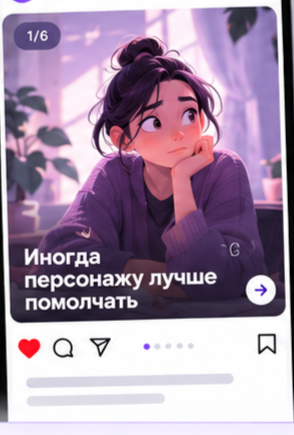
Example 6. Instagram — «The character hasn’t said anything yet. Why do we already understand how he feels?»
Topic: «Why Does This Work?»
Format: A six-card carousel.
Work: Arcane (2021–2024).This material focuses on the expressiveness of animation: gestures, body posture, facial expressions, and how these elements help tell a story without dialogue.Card 1. Sometimes it’s best for a character to remain silentCard 2. The body speaks tooCard 3. Not every movement is equally importantCard 4. A pause is also an actionCard 5. Design amplifies characterCard 6. Try removing the dialogueA well-written character exists beyond their lines. They exist in every deliberate movement.*Instagram is a Meta service, whose operations are banned in Russia
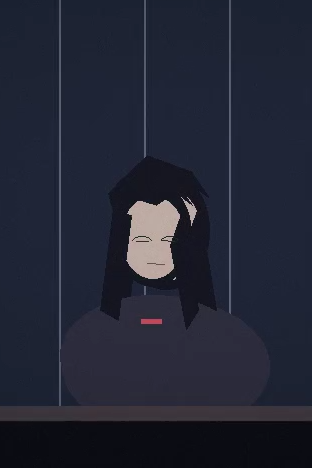
Sample 7. VK Video — «The Film That Makes You Doubt Your Own Eyes»
Category: «Screenwriting Kitchen»
Format: video essay, approximately 2–3 minutes.
Work: Perfect Blue (1997), Satoshi Kon.In this material, we delve into a deeper investigation. We examine how editing is capable not only of linking scenes but also of forcing the viewer to question what they are seeing.
Voiceover Script
The Film That Makes You Doubt Your Own EyesIn his animated film Perfect Blue, the main character Mima decides to retire from her singing career and become an actress.On the surface, it seems like a very ordinary story about a career change.However, the fans do not want to let go of her former image. A diary appears online, apparently kept in her name. Meanwhile, Mima gradually loses confidence in what is happening.And here Kon begins to play with one of cinema’s most crucial tools—editing.In a typical story, the transition between scenes helps us understand that the time, location, or situation has changed.In Perfect Blue, such transitions sometimes operate entirely differently.We witness an event, and then discover that it might have been part of the filming, a dream, or the character’s subjective perception.The film doesn’t always immediately clarify where one level of reality ends and another begins.And the most interesting part is that the viewer ends up in Mima’s own position.She cannot completely trust her own perception.Neither can we.For this, the director does not always need to use complex animation or fantastical transformations.Sometimes, simply changing the sequence of images or unexpectedly presenting a familiar situation in a different context is enough.As a result, editing becomes more than just a way to tell a story.It transforms into a part of the character’s psychological state.And this is where Perfect Blue achieves something particularly valuable in artistic work.The film is not limited to telling a story about losing faith in reality.
Visual Accompanying Material
Introduction: a short original animation—the character wakes up, only to find that the awakening was also part of a dream.Introduction to the Work: shots featuring Mima, her stage persona, and her acting career.Main Analysis: selected fragments from the film where editing connects different narrative levels.
Example 8. Telegram — «How to stretch a second across an entire manga page?»
Category: «Screenwriting Kitchen»
Format: Text post with a mini-comic by the author.
Post Text
In one second, there is approximately the same amount of time it takes to say the word «second.»Not the most surprising discovery, I agree. But for a comic artist, this statement operates quite differently. Let’s imagine a simple situation. Two samurai face each other. One is about to draw his sword. In reality, everything happens instantaneously. The hand twitches, the blade leaves the scabbard, and the opponent tries to react.Now, let’s try to draw this scene.Panel one — the hero’s eyes.Panel two — his hand on the sword hilt.Panel three — the opponent’s face.Panel four — the fabric of the clothing, slightly fluttering in the wind.Panel five — the eyes again.Panel six — the blade leaves the scabbard.We just used six panels for an action that lasted, perhaps, less than a second. Here is what is interesting: the scene doesn’t necessarily have to feel slow. On the contrary, it can become tenser. Because the artist has made the reader pay attention to every minute detail preceding the strike. Instead of one short action, we have an entire sequence of anticipation. Scott McCloud, in the book Understanding Comics, explores in detail how comics represent time through the space of the page and the sequence of panels.In film, the duration of a shot dictates the editing. In manga, the reader turns the pages and lingers on the images themselves, although the artist can direct this process through composition.It turns out that time in a comic is a rather pliable thing. It can be compressed, stretched, torn apart, or even completely omitted. But there is one unwelcome piece of news for the beginning author. Simply drawing twenty panels instead of two is not enough. If each new drawing adds nothing, the scene doesn’t become tenser. It transforms into a samurai who is suspiciously taking too long to draw his sword. Each panel must do its job: convey new information, shift focus, or heighten anticipation.