Navigation
Concept
Chapter 1. Conveying Weight and Character Motion Dynamics
Chapter 2. Grotesque Deformation as a Means of Creating Comic Effect
Chapter 3. Plastic Deformation as a Means of Expressing Emotion
Conclusion
Sources
Concept
A drawn character lacks a body that retains shape between frames, regardless of the artist. Every movement is composed of a sequence of individual images. A head might stretch after a sudden jerk, or a torso might compress under the force of a blow. The viewer connects these discrete phases into a continuous action and perceives the drawn body as possessing its own weight. The degree of shape alteration depends on the impression the sequence is intended to convey.In this study, stretch and squash refer to the temporary deformation of a character’s proportions, linked to movement or reaction. In professional terminology, this technique is known as squash and stretch (an animation principle based on stretching and compressing a character’s form for emotional expressiveness). A. A. Shlyadinsky defines it through the mutual compensation of dimensions across different axes, which preserves the impression of overall volume [7]. This definition serves as a guide when analyzing early films. Lengthening a neck for a gag, bending a limb in the rubber hose style (a characteristic early animation movement style where characters’ limbs are depicted as flexible without distinct joints), and compressing the torso before a jump are outwardly similar, though structured differently.
In early American animation, the body could conform to the logic of the drawing. Later, Disney artists began to render characters' reactions to external stimuli in greater detail. Changes to the image did not occur in a single direction. Eccentric techniques continued to exist alongside more restrained acting animation. On the material from short films, it is particularly evident how one studio combined different methods of movement. A comparison of Disney and Fleischer Studios will help establish the distinction between deformation that explains a physical action and deformation that violates its logic.
The body of work consists of nine American animated films from the period of 1929 to 1941. The choice of material stems from the fact that these films successfully juxtapose hand-drawn images that are similar in technique but serve different dramatic functions. General information on European animation is incorporated to delineate the scope of the research.
The research method is based on comparing sequences of frames. In the analysis of each scene, the evolution of a character’s silhouette is tracked—from its initial state to maximum deformation and subsequent restoration of proportions. Furthermore, consideration is given to the circumstances under which the shape changes and how long that change is maintained.
Chapter one is dedicated to the sensation of weight and inertia. Chapter two examines the comedic quality of the scene that arises from a disruption of conventional anatomy. Chapter three explores how body form changes during an emotional reaction and how necessary a strong deformation is for conveying that emotion.
Research Question:How does the temporal deformation of the body influence the perception of a character’s physical properties, and in what ways does altering their form reveal the emotional tenor of scenes in American animated films prior to 1945?The hypothesis is that, the expressive value of stretching and compression is determined by the ratio of the deformed form to the character’s standard appearance and the circumstances of the action. When conveying weight, the alteration of proportions intensifies the sensation of force. In a comedic scene, exceeding a permissible degree becomes part of the joke. In an emotional episode, the effectiveness of the technique depends on how closely the deformation relates to the specific character’s temperament.
Character Weight and Motion Dynamics
Bert Gillette. «Playful Pluto, ” 1934 (cartoon poster)
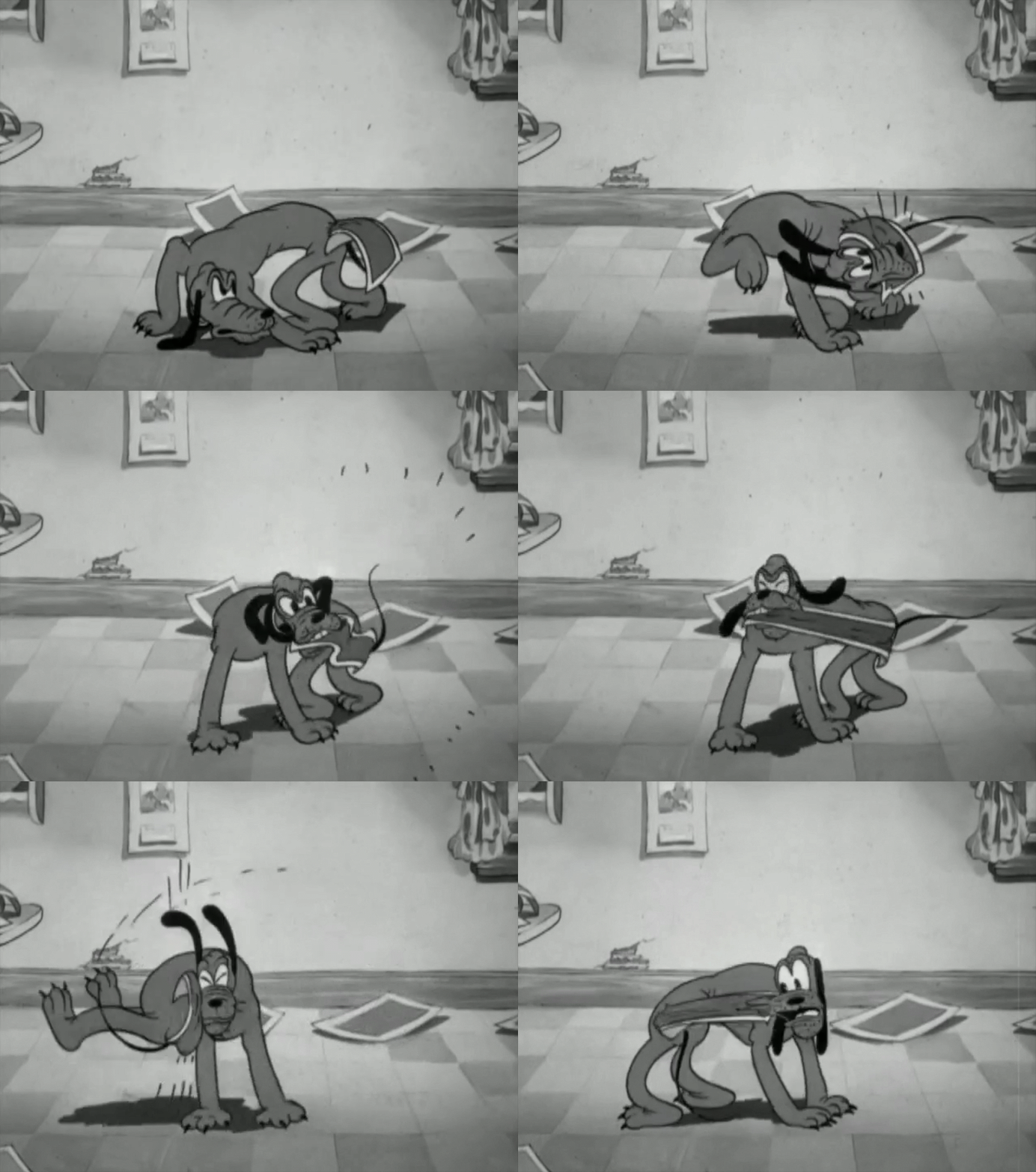
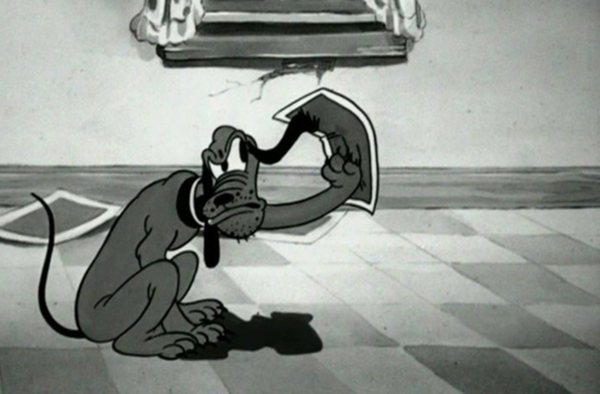
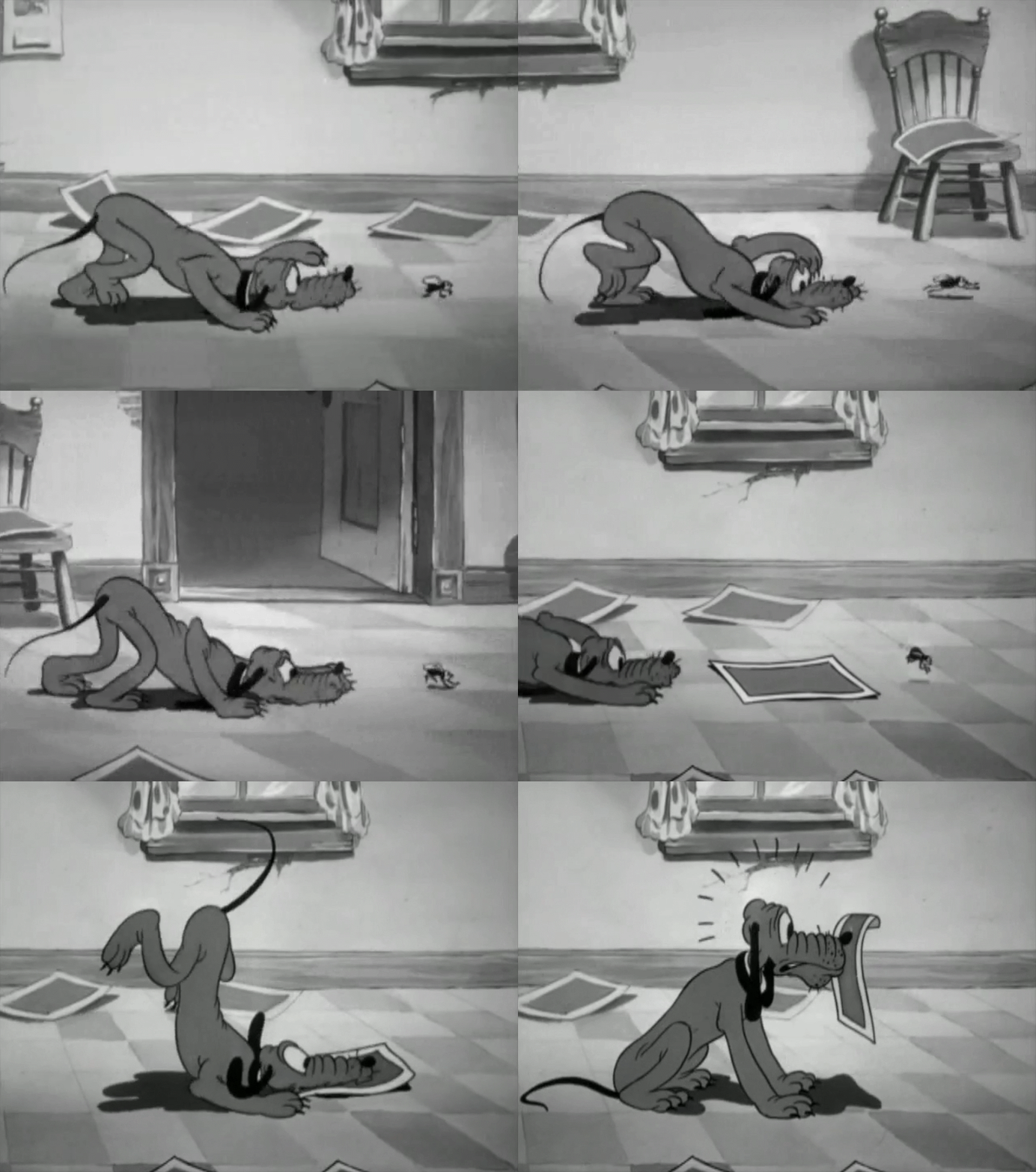
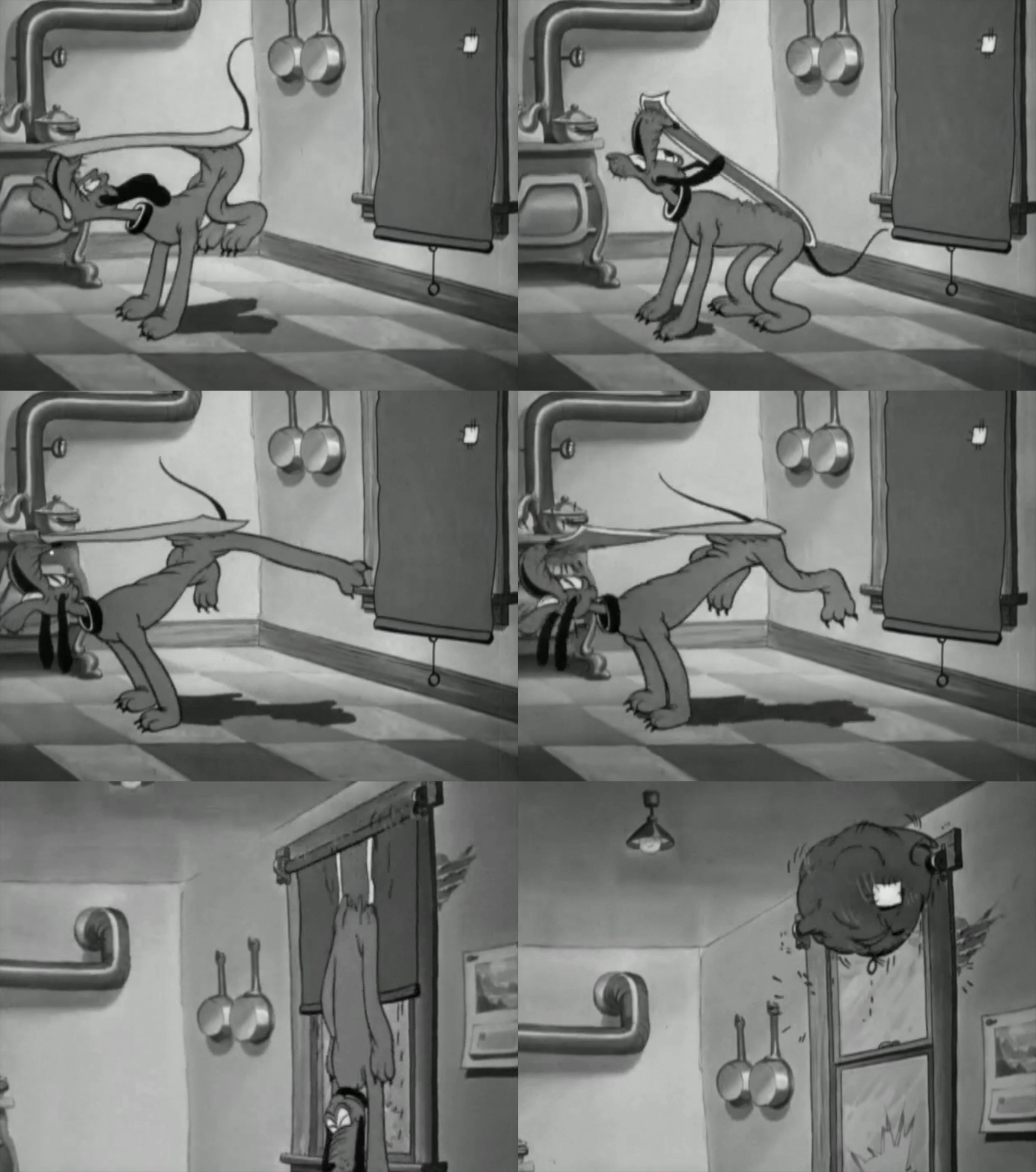
In «Playful Pluto, ” Pluto gets caught in a trap made of sticky paper. One of the film’s most recognizable episodes is built around the character slowly realizing the cause of his predicament. The paper clings to his paw and muzzle, and his attempts to free himself only worsen the problem. Pluto tries to tear away the adhered object. Even by observing the sequence of poses, the difference between free movement and movement constrained by something is evident.
Bert Gillette, «Playful Pluto,» 1934 (stills from the cartoon)
Bert Gillette, «Playful Pluto, ” 1934 (historical pose sheet)
It is interesting to compare two moments within the same scene. Before touching the sticky surface, Pluto tilts his head without any noticeable change in its length. As he attempts to pull away, his muzzle contracts, and his body resists the direction of the tug. The change in shape helps convey the effort. Variants showing a pinched snout can be found on the surviving studio sheets for the episode’s poses. The historical development of the sequence confirms that the artists meticulously sought expressive forms of movement. Norm Ferguson animated this episode (Bert Gillette is credited as the film director).
Bert Gillette, «Playful Pluto, ” 1934 (animation stills)
Bert Gillette, «Playful Pluto,» 1934 (stills from the cartoon)
Wilfred Jackson, «The Tortoise and the Hare, ” 1935 (animated film poster)
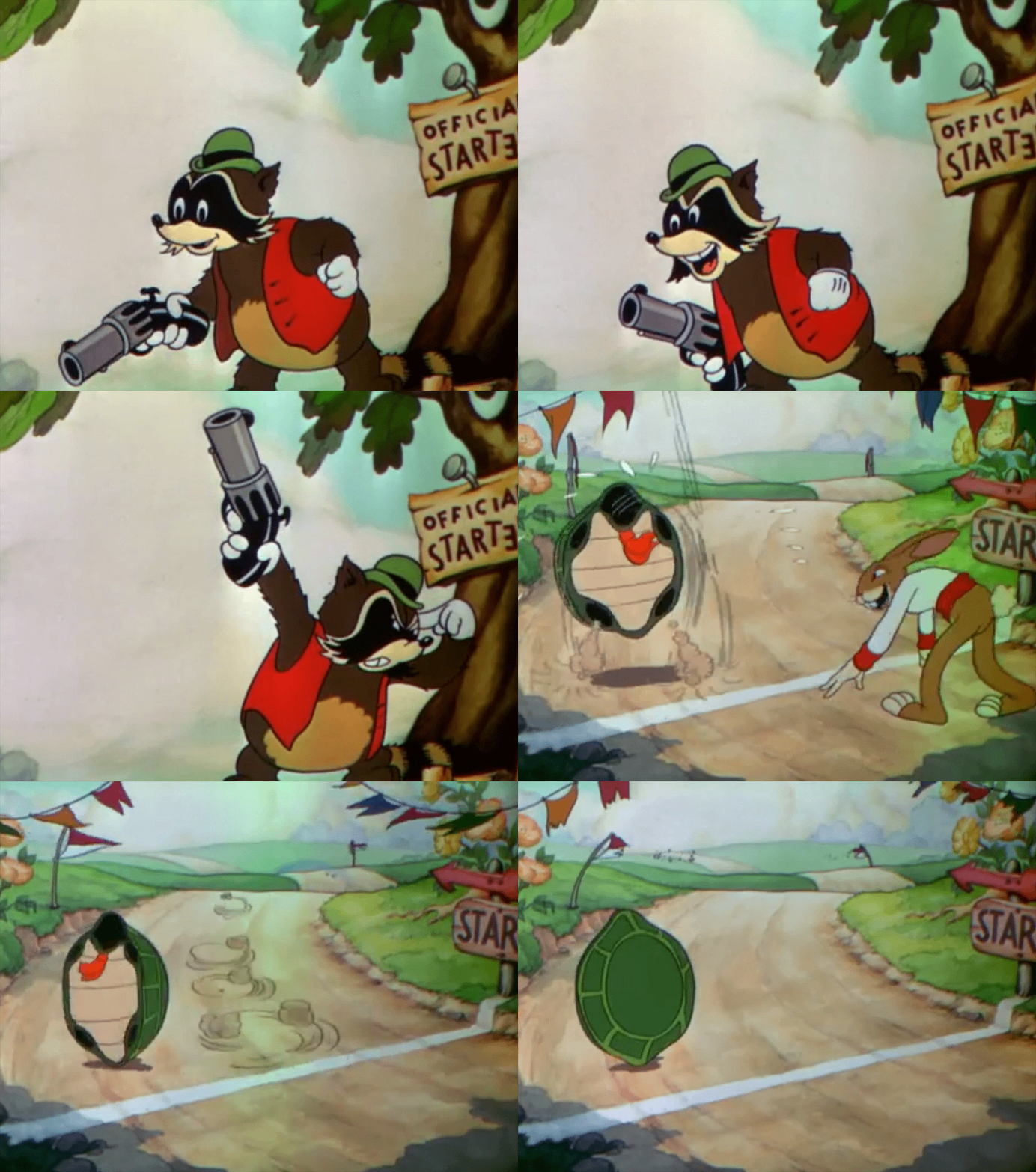
In the cartoon «The Tortoise and the Hare, ” the difference in the weight and physical characteristics of the characters is conveyed through the way their bodies change. Toby the tortoise appears heavy due to its massive shell, which restricts the mobility of its body.
Wilfred Jackson, «The Tortoise and the Hare,» 1935 (scenes from the cartoon)
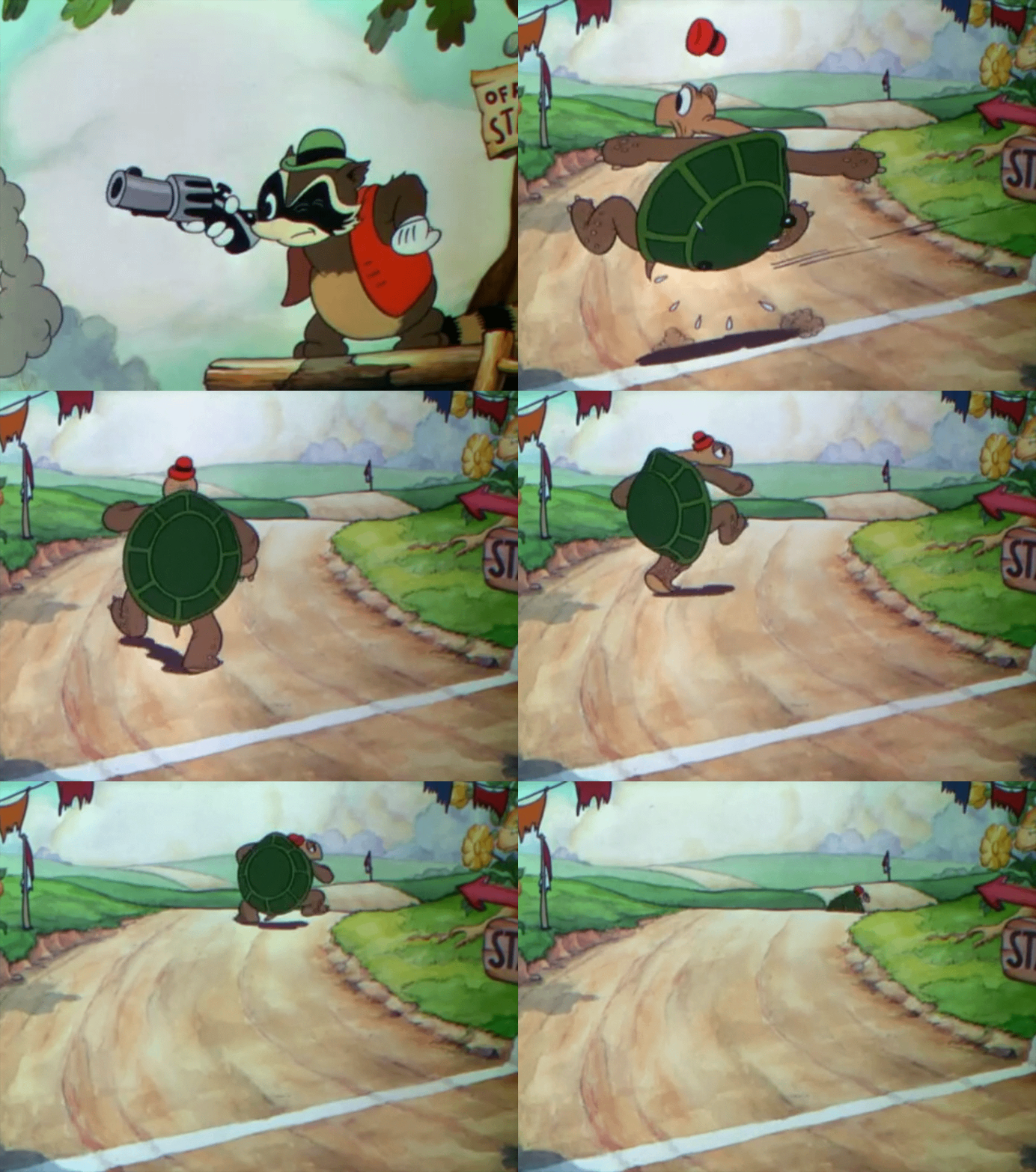
After the starting signal, she becomes frightened and tucks her head into her shell, mimicking the turtle’s natural defensive reaction. Max the rabbit crouches sharply before starting the race, tensing his body before pushing off, then stretches forward and swiftly bursts into motion. Both characters use a contraction, but for Toby it is tied to fear, whereas for Max, it is preparation for rapid movement.
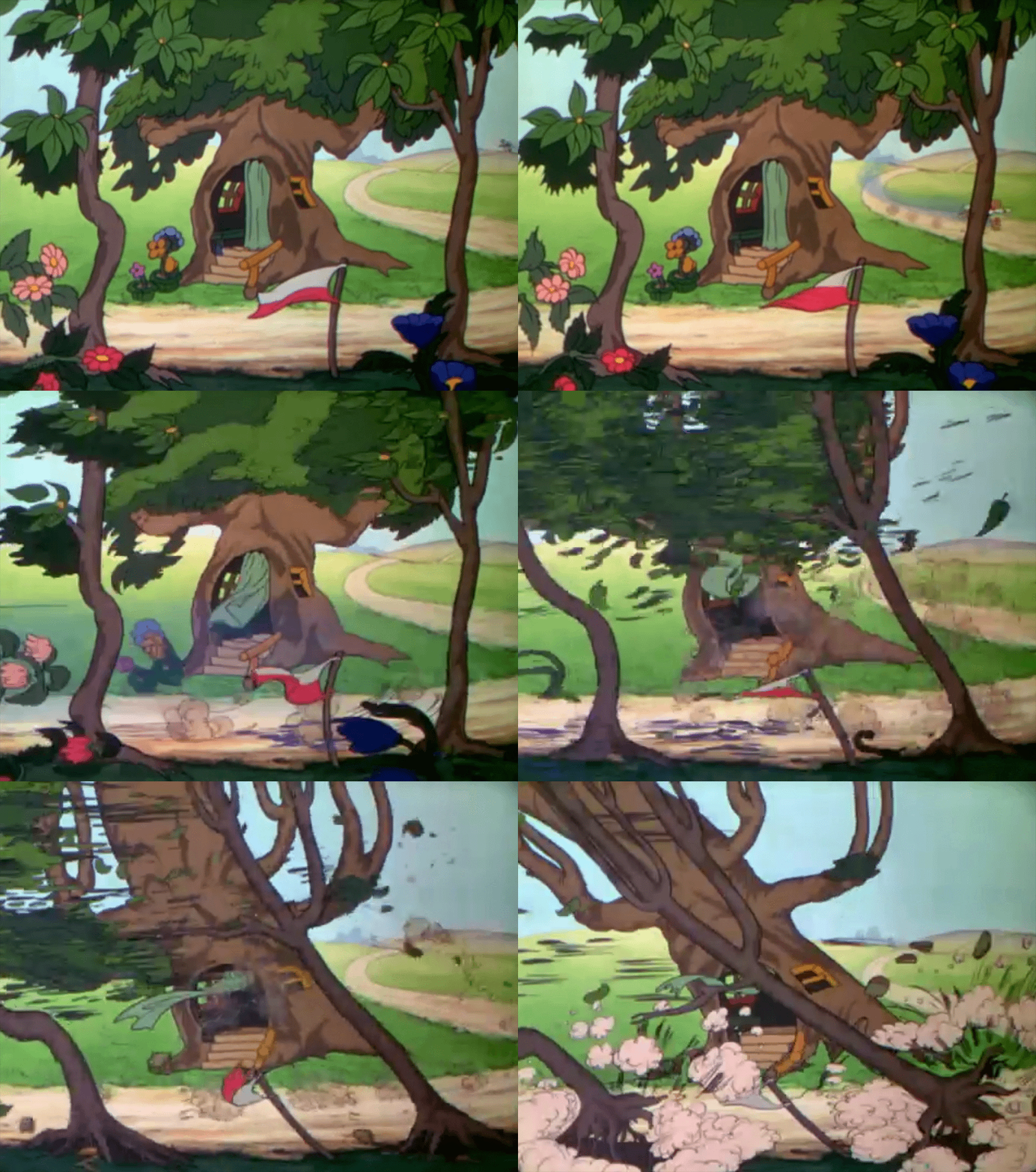
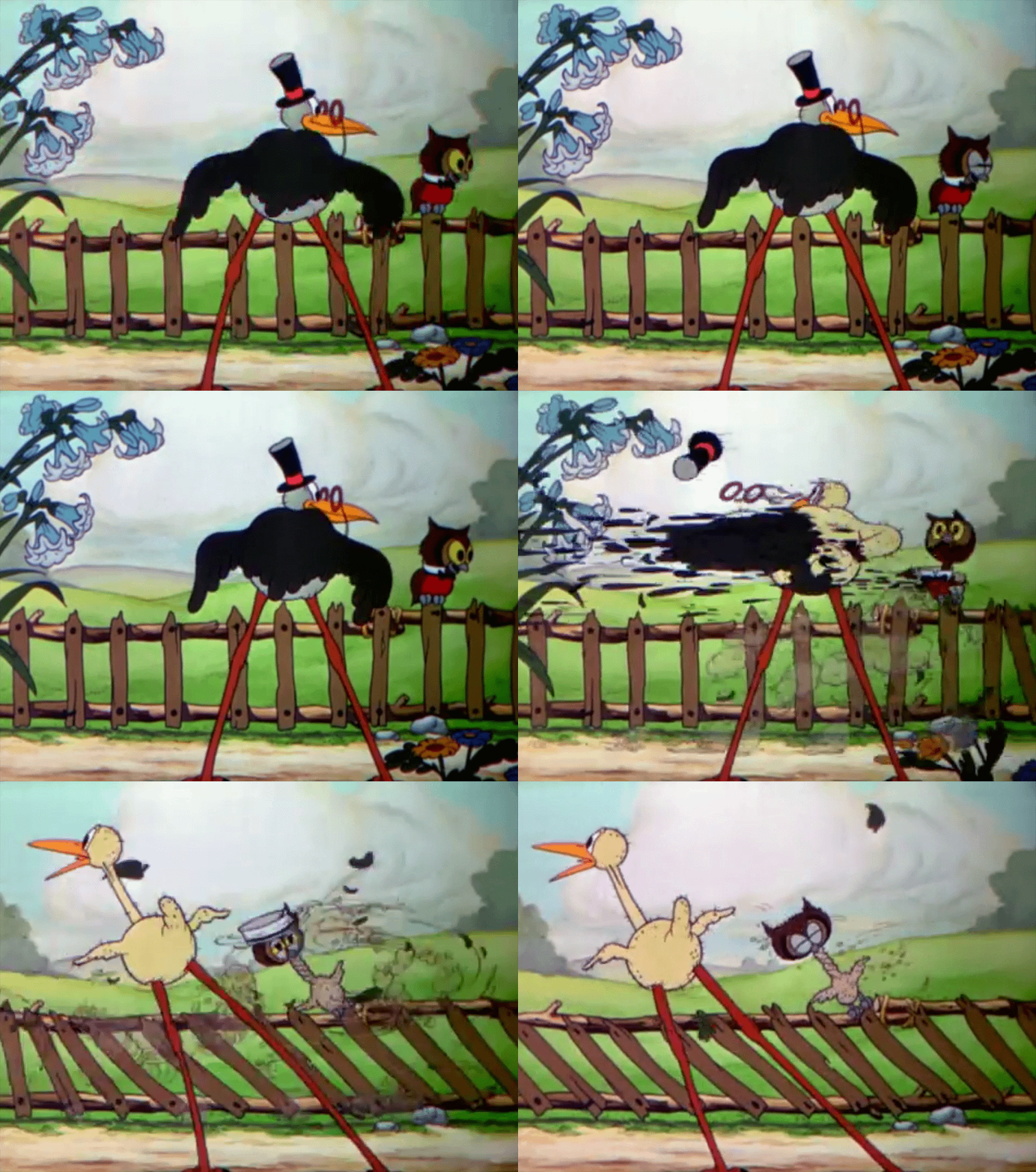
Wilfred Jackson, «The Tortoise and the Hare, ” 1935 (animation stills)
Wilfred Jackson, «The Tortoise and the Hare, ” 1935 (animated film stills)
The differences persist even during the race itself. When Toby moves with short strides, barely altering his body proportions, his heavy shell remains stable. Slight wobbles in the body create a sense of weight that the tortoise must carry with every step. Max’s movements are much sharper—you can see his body bunch up before pushing off, and conversely, stretch out while running. The frequent changes in proportions make the rabbit appear visually lighter and more agile. These two characters demonstrate how the degree of stretching and compression influences the perception of their physical properties. The sluggishness of the tortoise and the swiftness of the rabbit become apparent from the nature of their movement alone (even before considering the difference in speed).
Jack King, «The Hockey Champ, ” 1939 (cartoon poster)
In the animated short «The Hockey Champ,» movement forms the basis of the action, as the plot revolves around winter sports. Initially, Donald showcases his figure skating mastery. He glides effortlessly across the ice and performs complex acrobatic elements, giving his form an ethereal quality. During spins, Donald tightens into a group, and his silhouette becomes more compact. As the spin accelerates, the contours of his body blur so much that individual details of his form become indistinguishable.
Jack King, «The Hockey Champ, ” 1939 (animation stills)
The compression here is linked to a change in posture. The contour blur further emphasizes the speed. After completing the stunt, Donald straightens up, returning to his familiar proportions. The alternation between these states conveys the lightness of the character’s body, as it is literally made of feathers.
Jack King, «The Hockey Champ, ” 1939 (cartoon stills)
In the second half of the cartoon, Donald begins playing hockey with three nephews, and the character’s movement distinctly changes. During falls, his body compresses under the impact, while during sharp thrusts, it stretches in the direction of movement. This deformation is especially pronounced during episodes of rapid movement across the ice. Donald’s torso lengthens, and his limbs stretch out. This motion is reminiscent of the way Max the Hare runs in a previous cartoon. Both characters compress their bodies before accelerating, preparing for a powerful thrust, and then suddenly stretch forward.
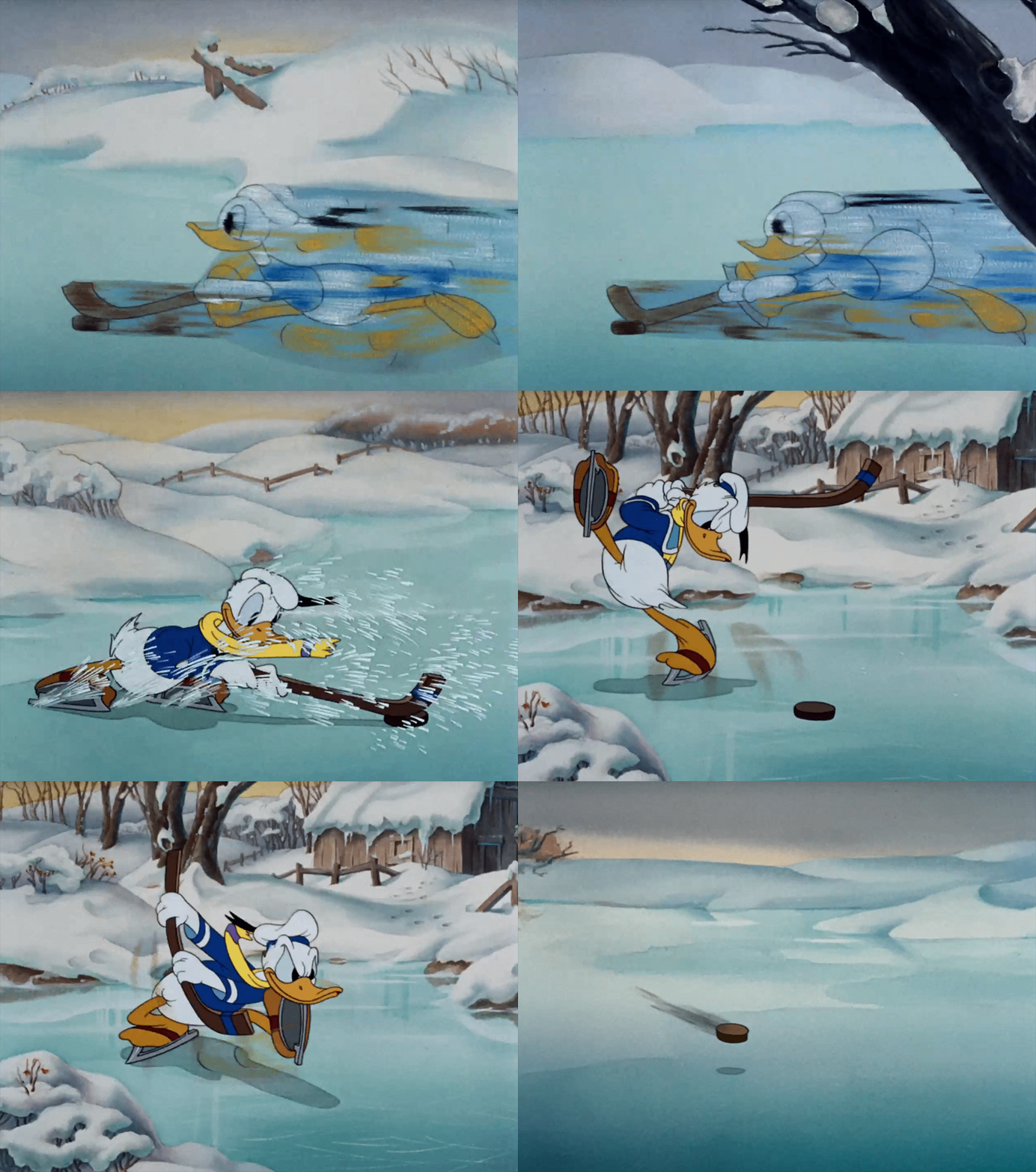
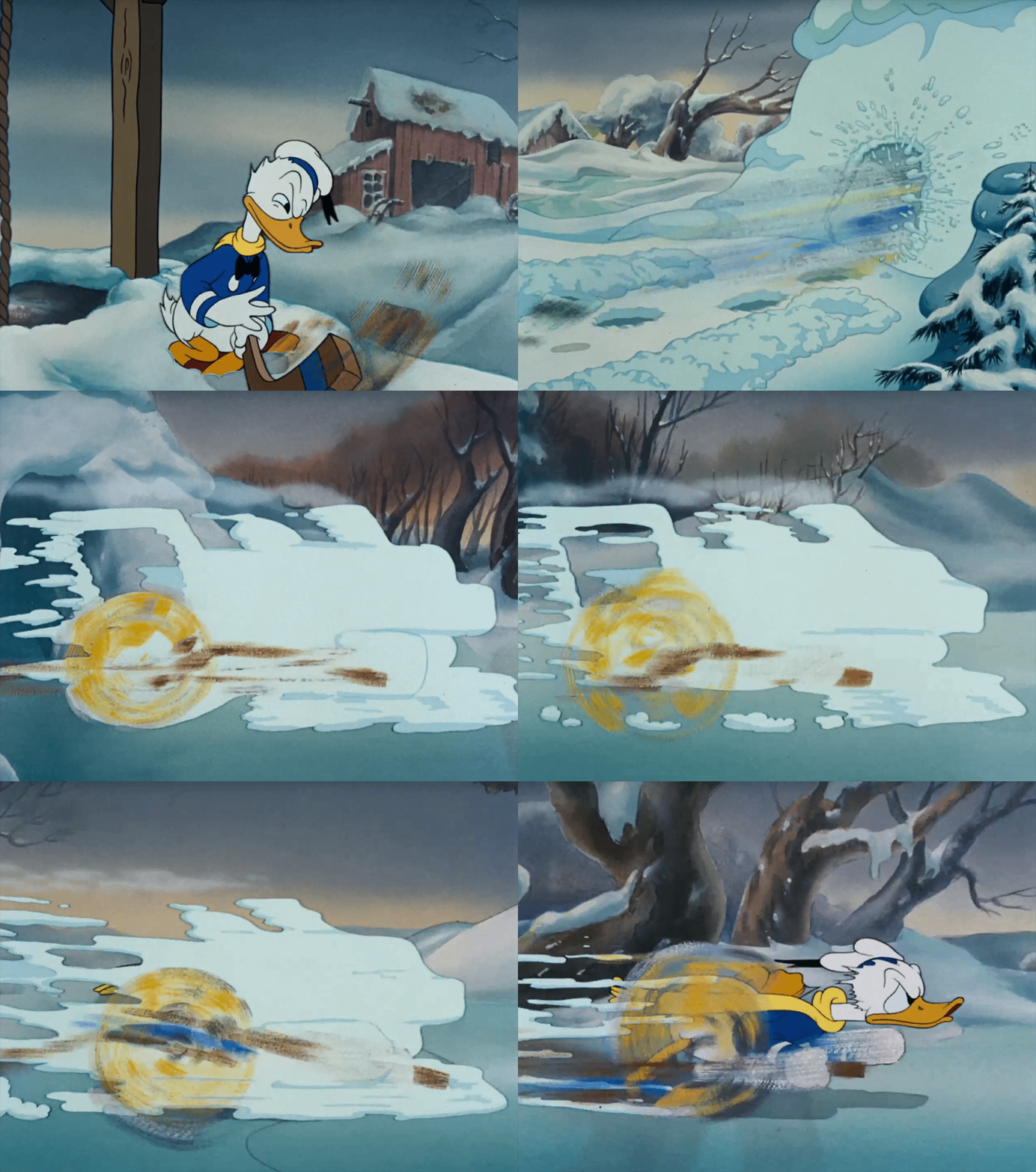
Jack King, «The Hockey Champ,» 1939 (cartoon frames)