Essay
Imagine walking across the steppe, only to see a massive hill rising before you—seven stories high. The steppe is a plain with minimal topographical variation, so where did this natural wonder come from?
The answer is simple: it’s not a natural wonder at all; it is an ancient burial mound, a kurgan called «Oguz.»
Oguz is one of the largest Scythian royal kurgans, constructed around 330–310 BCE, when the Scythians dominated the Northern Black Sea region. This was the era of the Scythians’ only widely known ruler—King Ateas. He is the one who fought Philip II of Macedon and ultimately died in battle near the age of 90.
Oguz is located 4–5 km east of the village of Nizhniye Serogozy in the Kherson region. Its construction required enormous effort. A gigantic kurgan was piled over the burial chamber, and a complex system of underground funerary structures was built deep beneath the earth.
In the center, archaeologists discovered a deep burial pit and an unusual stone crypt. Its design has no exact parallel among known Scythian burials. Judging by the architecture and artifacts, Bosporan masters may have been involved in creating the tomb. However, there is a nuance: the crypt’s architecture is so unique that no direct counterparts have been found in the Bosporan region. Therefore, several influences might be involved at once: Scythian tradition, Greek influence, and motifs related to Thrace. For a steppe power of the 4th century BCE, this is not surprising—the Scythians actively interacted with neighboring peoples, traded with Greek cities, and adopted artistic techniques.
The first excavations of the kurgan were conducted by N. I. Veselovsky between 1891 and 1894. However, he did not achieve significant success. The tomb had been almost completely looted. Niches were dug into the western, northern, and eastern walls of the pit where, likely, ancient robbers found valuables and took them with them. Veselovsky concluded his work there, as the considerable effort put into the excavations yielded minimal results.
Over time, rains eroded Veselovsky’s excavations, and local peasants discovered a large number of jewels within the ancient robber’s passage—specifically in the southern part of the kurgan that Veselovsky had studied. Unable to resist the wealth before them, they took everything they could find.
Archaeologists managed to purchase some of the findings from the peasants, but many valuable items had already entered private collections. When they were eventually returned to the museum, it turned out that some of them came from neighboring burial mounds, not from Oguz!
It was discovered that some gold items that fell into the hands of traders had been «enhanced» before sale—loops were soldered onto them, and they were transformed into pendants. Earrings, in some cases, were pieced together from completely different parts simply to fetch a higher price.
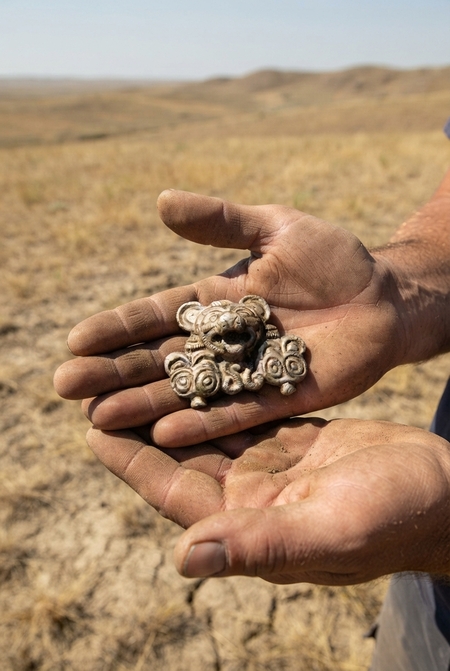
Nevertheless, gold, weapons, horse harnesses, and silver cheekpieces were found in Oguz. One of the cheekpieces features a figure making a hand gesture whose meaning researchers have never been able to determine.
The wealth of the burial mound suggests that a person of high rank was interred here. Therefore, there is a theory that the heir of King Ateas was buried here—that same Scythian ruler from the 4th century BCE who united a significant portion of the Scythian lands. This theory is appealing, but it cannot be confirmed, especially since Ateas himself died in battle far from these areas. The tomb was looted, and no written records mentioning him survived. All we know about the person in the burial is through the objects that survived them.
The gold jewelry, weapons, harness fittings, and those mysterious silver cheekpieces—all of this is housed in the Museum of Historical Jewels of Ukraine. You can stand in front of the display case and see for yourself the items held by a person whose name we will never know.
Who was that person for whom such a tomb was constructed in the steppe? How many stories disappeared along with the objects that did not survive the robbers and peasants? We do not know, and perhaps never will.
We can only speculate about who was buried at the center of this mound. But we do know where you can look at what was managed to be saved from the clutches of robbers—at the State Hermitage Museum in St. Petersburg.
«Enticing Treasures»
Long ago, in a vast steppe thick with grass, near a huge hill, there was a small village where lived a peasant named Trofim. He never became a warrior or a merchant; instead, he remained a simple farmer, whose back bent daily in the fields. The steppe around him lay flat as a tablecloth, and only one peculiar hill, of an unprecedented height for the region, captured the gaze of the bored laborer.
Every day, Trofim climbed to the roosters, hitched his ox Bor’ka, and tilled the earth, churning up sticky, black soil. From dawn till dusk, his back remained unbent, and by evening, his hands ached so severely he could barely hold a spoon. And from this life, as flat as the steppe, something invisible gnawed at his chest. The hut was sagging, food was scarce until the next harvest, and Trofim’s children often went to sleep hungry. All that was left for Trofim was to stare at the peculiar hill in the middle of the steppe and scratch his head.
Then, one summer, strange people appeared with pickaxes, shovels, and some kind of brushes. It turned out to be the scientist Veselovsky with his group of equally enthusiastic young men, who studied the earth as if it were the pages of a book. For three years, they dug that—which turned out to be a burial mound. And in that mound, they found the tomb of an ancient tsar! They chipped at the stone, moved earth, smoothed it with brushes, their eyes alight with enthusiasm, and then simply packed up their camp and left, dejected. As people on the street said, the burial had been looted centuries ago, and the remaining tunnels were filled in with earth. It seemed these young men had wasted three years of their lives here.
One day, while gathering firewood near the old excavation, which the rain had already muddied considerably, Trofim noticed a small wolf pup struggling in a collapsed pit. It was clear that it had separated from the pack and become trapped. His neighbors walked by, preoccupied with their own thoughts, but Trofim, muttering an oath to himself, went down and pulled out the creature, wiped it with his shirt, and set it free. Bending down to retrieve a dropped knitted scarf, he spotted something yellow in the mud.
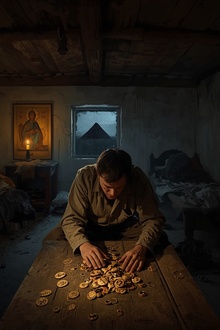
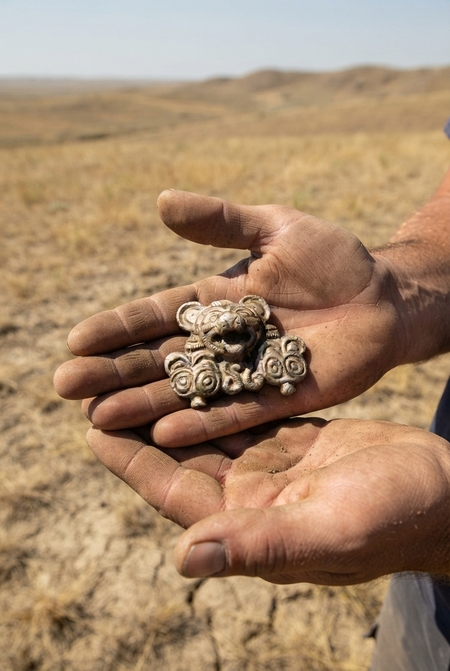
Trofim dropped the twigs, crouched down, and plunged his fingers into the soft earth. In an instant, a sturdy medallion with a beast’s snarl was in his hand. He turned it over in his hands for a long time but said not a word to anyone; he simply tucked it into his bosom and left. A couple of days later, one of the neighbors also discovered a find and dug up a gleaming patch. The men, with their sons, started making regular trips to those spots, even unearthing a robber’s tunnel that Veselovsky had missed. And there, beneath mounds of dirt, ancient trinkets frequently peeked out. Trofim also went out on such hunts. He was the first to arrive and the last to leave, stuffing anything shiny he found into his pockets and under his coat, bringing home a new bounty every evening—sometimes a broken buckle, sometimes a rusted chain. His wife examined the debris, shook her head, but collected it, wrapped it in the cleanest rag, and stored it in a small chest under the bed.
For the first time, Trofim saw real wealth in his hands. He clenched the medallion into a fist, looked at the dilapidated hut, at the empty stalls by the stove, and slipped the find into his bosom. He would sell everything he found in town, and with the proceeds, he would buy a cow, patch the roof, feed the children, and delight his beloved. The mere thought made the corners of his mouth curl upward.
Well, that’s what the other residents of their village thought too… Strife began among the men: each tried to hoard more for himself, and it was clear that no one wanted to share. Medallions and ornaments clinked under skirts and shirts; people constantly watched each other and threatened one another. And the children, following their parents, stopped playing together.
One evening, Trofim returned home and saw his youngest son sitting alone on the porch. Previously, Trofim would see groups of boys running through the streets when returning from work, but now everyone kept to their own huts. Trofim wanted to ask what happened, but he remained silent. That day, he polished his medallion three times, yet still couldn’t understand why it caused such a trembling in his strong hands.
In the morning, he packed his satchel, stuffed the finds inside, and headed into town. He walked briskly, not looking back, and only paused near the outskirts to catch his breath and adjust his strap. In one shop, the merchant merely snorted, «This is cheap imitation, not gold. I can only value the craftsmanship!» The merchant poured a handful of copper onto the counter—not enough even for bread. Trofim left immediately. He knew what soft gold felt like under the tongue, and this copper was nowhere near that! In another shop, a portly old man nervously stuttered, «From an ancient grave? May I be cursed—get out of here, I don’t deal with things like that!» Trofim walked past all the stalls, but everywhere he was met with pennies or was told to scram.Trofim returned to the village that way—with an empty purse and a heavy heart. On the way, the faces of the merchants came before him: one snorted, another crossed himself, the third spat. Even if they were just copper trinkets, why did each merchant linger over them so long before naming a price?Several months later, scholars arrived in the village again. They went door to door, asking to see the finds, and praised them profusely, just like the clever merchants. But only then did they offer money—and good money by the standards of their small town! So, the line eventually reached Trofim.
The archaeologist examined his amulet for a long time, carefully wiping it clean of dirt. Then he called over a colleague, and they began speaking in low tones. Trofim had already opened his mouth to demand his artifact back. They were just about to sing a song about its cheapness and hand over a few coins. But one of the archaeologists suddenly raised his head:
«Do you understand that this could belong to the Scythian king Ateus himself or his descendant? Look at the precise pattern, the exquisite detailing!» The men in front of Trofim became increasingly animated by their admiration, and they only composed themselves when the house owner coughed.
«Thank you for preserving it and not melting it down!» The scholars counted out a respectable handful of coins for him—enough for a cow and for repairing a roof. Trofim put the money in his pouch, thanked them, and then one of the archaeologists said:«We are going to take this item to the city museum. If you wish, you can come with us; you can see firsthand how it will find its place, and we will put your name beside it.»He rubbed his chin, looked at his wife, then at his children, and finally waved his hand, «Alright, let’s go.» And he thought to himself: I’ll buy a cow in the city while we’re at it.
Trofim returned to his grazing with the cow, repaired the roof, fed the kids until they were full, and pleased his wife with the renovations. The money from the scholars was just enough for everything he planned, with a little left over. But the most surprising thing happened afterward: that year, the rye grew so densely that the stalks bent to the ground, and the wheat filled out with grain twice as large as usual. By autumn, Trofim sold the excess bread in the city, counted the coins, scooped them into his pouch, and smiled into his bushy beard—it was enough for a second cow and boots for the whole family. The mound, which they nicknamed Oguz, stood in the middle of the steppe even quieter from that day on. After digging to their heart’s content, the scholars covered the mound back up, and they donated what they found to the museum, which his grown children visited one day. There, under glass, next to the golden plaque, they read the faded inscription: «Found by peasant Trofim.»