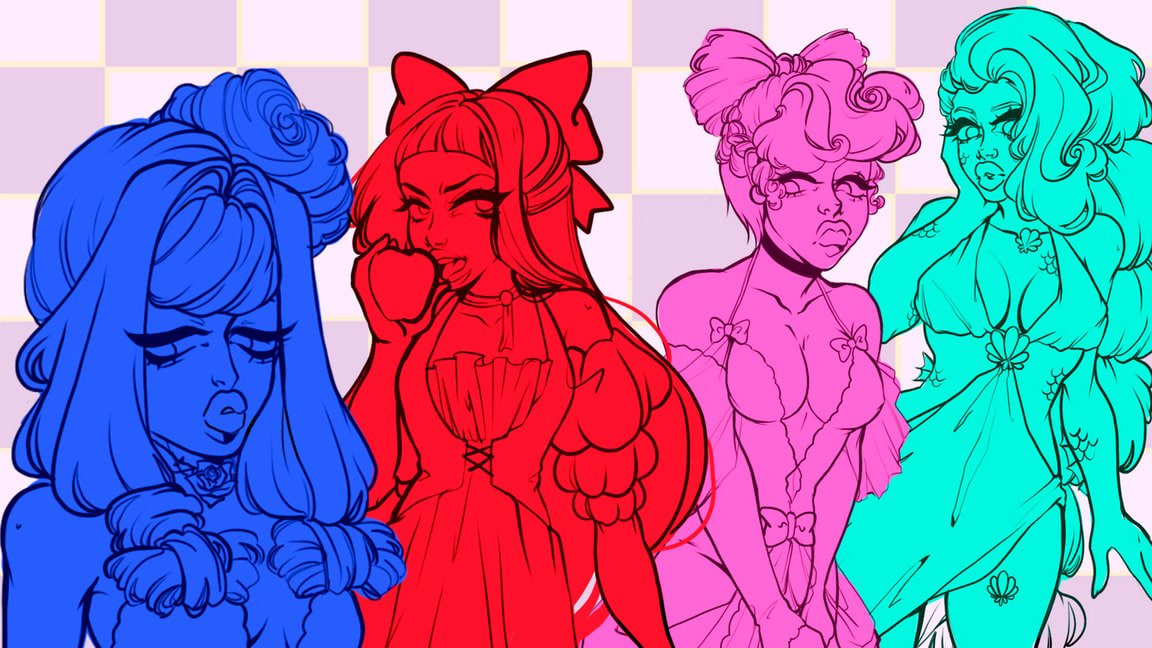
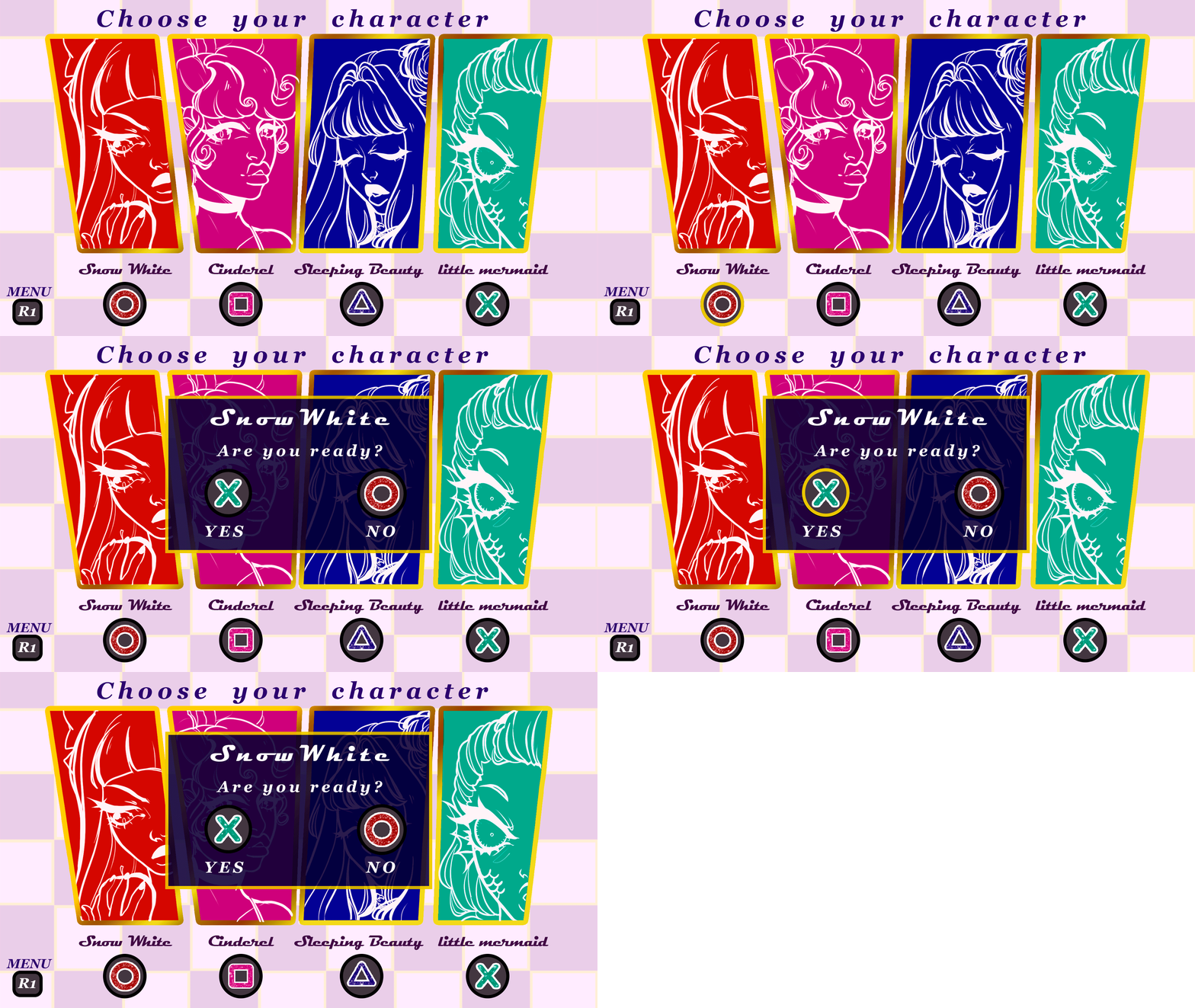
PrincessS — an animated comic based on the concept of a fighting game that I developed in my sophomore year.
PLOT
The plot revolves around four princesses who cannot decide which one will win the only prince. The situation escalates into a fight among the ladies, but in the end, their doubts begin to surface: do they truly love him, or is he merely a prize—a source of envy among the others?
ABOUT THE PROJECT
Target Audience
The primary audience consists of students and young professionals aged 18 to 30 who grew up on Disney fairy tales and cartoons. At this age, there is a strong sense of nostalgia for classic tales, and black humor and the deconstruction of genre with inverted plots are perceived as an adult take on a long-familiar story.
A secondary audience may include teens aged 14–17 and fans of anime, manga, various one-shots, and webcomics.
Technique
For this project, we chose a rigging system: the characters are drawn once, broken down into layers, and assembled like a puppet with a skeleton. The arms, legs, head, and weapons move as separate pieces. This technique was necessary to stay within a realistic budget and timeline. In the comic, the same five characters are repeated, and animating them without redrawing every frame is significantly cheaper than doing frame-by-frame animation. Simultaneously, the comic aesthetic is preserved: the outlines and faces remain consistent with the storyboard, rather than «drifting» from frame to frame. The rig also suits the plot perfectly because the fighting sequence is built on repetitive movements (a wind-up, a strike, a knockout), which can be constructed once and reused in all duels. The most impactful moments can be enhanced with separate illustrations, so the technique’s limitations remain invisible to the viewer.
Runtime
The three-minute runtime was chosen because it is enough time to tell the entire story—the setup, two rounds, the twist, and the finale—without dragging it out or cutting it short. This length is convenient for the viewer and for platforms where short clips are watched and shared, increasing the project’s chances of being seen to the end. The scope also aligns with the completed storyboard: 180 seconds for 40 pages allows for approximately 4.5 seconds per page, which is sufficient for the text to be read while the action doesn’t feel sluggish. Finally, three minutes establish a clear scope of work for the partner: it’s easy to estimate the required animation, sound design, and voiceover. And if the project is successful, the finale with the Fairy Godmother allows for a smooth transition into subsequent episodes using the same rig.
If necessary, I can condense these paragraphs for a slide or integrate them into the presentation text.
CHARACTERS
Snow White. Archetype: «Class Queen.» Dramatic and spoiled, accustomed to being the center of attention and getting what she wants. Her sweet exterior hides a volatile, vengeful nature: she cannot tolerate losing and thrives on dramatic entrances. She is the main contender in the battle of ambition, yet it is precisely her vanity that makes her vulnerable. She is the first to exit the tournament, but she will later demonstrate her worth in the collective solution.
Snow White
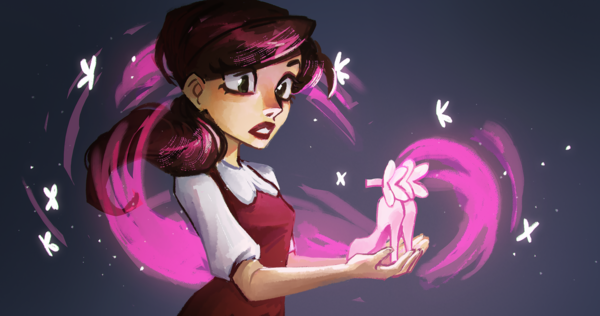
Cinderella. Archetype: «The hard worker who finally made it.» She has endured servitude and no longer intends to miss anything. Calculating, tough, and pragmatic, she maintains her composure and acts with cool efficiency. Behind the flirtatiousness lies a hunger for life and a desire to finally claim what is rightfully hers. She succeeds because she knows how to see things through to the end.
Cinderella
Mermaid. Archetype: «eccentric from another world.» Strange, naive, and unpredictable: the rules of sushi are incomprehensible to her, so she behaves as she pleases. Emotional, candid, and sometimes frightening. Her strength is that she doesn’t play by other people’s rules, which throws even experienced rivals off balance.
Mermaid
Sleeping Beauty. Archetype: «a sleepy sweetheart with a dark side.» She is lazy, relaxed, and perpetually drowsy, believing that none of this is worth the effort. But push her to the limit, and an unexpected fury awakens. Her rivals underestimate her—and they are wrong. Eternal fatigue and apathy make her the most ironic heroine in the story.
Sleeping Beauty
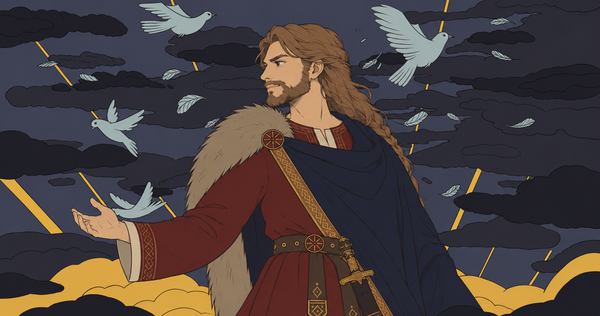
Prince Charming. Archetype: «the perfect prince nobody needs.» Kind, polite, and comically naive: he believes any quarrel can be solved with cookies. He fails to recognize his role in someone else’s conflict and doesn’t understand why he is divisive. Not a villain, but not a hero either—he is too gentle to defend himself. It is precisely for this reason that the princesses eventually realize he isn’t worth the fight.
Prince
How they work together.
Four princesses—initially rivals, then a team. Each represents her own way of fighting for herself: aggression, calculation, eccentricity, and stubborn laziness. And the prince serves as a contrasting figure: the most «proper» and the most helpless in this group.
COMICS WORLD