Concept
In the age of total dominance by computer graphics, we are slowly forgetting how genuine cinematic magic was created before the digital era. Soviet special effects masters from the 1920s to the 1980s performed miracles without computers or complex software, utilizing only optics, mechanics, painting, miniatures, and incredible human ingenuity. Their legacy is not just a technical history—it is a story about people who believed they could create the impossible.
INDEX
INTRODUCTION
1. THE BIRTH OF THE COSMIC DREAM
2. THE POST-WAR RENAISSANCE
3. THE GOLDEN AGE OF SOVIET FANTASY
4. THE ERA OF «THROUGH THORNS TO THE STARS»
5. CONCLUSION
INTRODUCTION

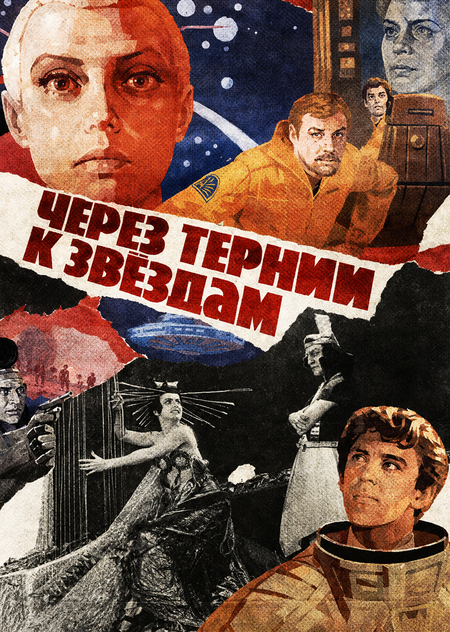
Through thorns to the stars, 1980
Space Flight, 1935
56 years of Soviet sci-fi cinema. From silent film to the threshold of the digital age. Every film is not just a story, but a technological breakthrough of its time. Special effects masters worked with limited equipment, but compensated with ingenuity and artistic vision.
BIRTH OF A COSMIC DREAM
«ELITE»: PROTAZANOV’S MARTIAN MIRAGES
Elite, 1924
Aelita, 1924
- Yakov Protazanov created the first Soviet science fiction film, «Aelita, ” based on a novel by Alexey Tolstoy. The Martian city was a triumph of Constructivism: geometric shapes, staircases without railings, multi-level platforms. Artist Isaac Rabinovich created not merely set design, but a visual utopia. The film became a sensation not only in the USSR but also abroad. It was the first instance where Soviet cinema demonstrated to the world its ability to create large-scale fantasy.
Elite, 1924
Tatlin’s Tower (Monument to the Third International), 1919
Mars in «Aelita» is not a planet, but a manifesto of a new art form. The constructivist architecture, inspired by the works of Vladimir Tatlin, Konstantin Melnikov, and El Lissitzky, envisioned a future where technology and art merge seamlessly. Alexandra Exter, a legendary avant-garde painter, created the Martian costumes adorned with geometric patterns. These are not merely clothes—they are part of the film’s visual system.
SILENT FILM TECHNOLOGIES
Pathe-Cook Cinematograph, 1912–1925
Double Exposure and Masking Technique Diagram
The equipment was primitive by modern standards: hand-cranked Debrie and Pathé cameras, simple optical printers, and hand-painted effects. But the masters compensated for the technical limitations with artistic ingenuity. Double exposure was the primary technique. Part of the frame was covered by a black mask, and the foreground (actors) was shot. Then, the film was rewound, the mask was swapped for the opposite one, and the background (set or painted image) was shot. The alignment had to be jeweler-precise—an error of a few millimeters was noticeable on the screen.
Space flight, rocket model, 1935.
Space flight, zero-gravity scene, 1935
Space travel, spacecraft interior, 1935
The First Steps of Soviet Science Fiction in Cinema.
In 1924, Yakov Protazanov shot «Aelit»
based on Alexei Tolstoy’s novel. It was the first Soviet science fiction film, and it immediately became a sensation.
The Mars in «Aelit» is a triumph of constructivism. Artist Isaac Rabinovich and Alexandra Exter created a geometric world featuring staircases without railings and multi-level platforms. There were no computers—only plywood, cardboard, paint, and light. The effect of weightlessness was achieved using ropes
and slow motion (16–18 frames per second instead of 24).
Eleven years later, Vasily Zhuravlev directed «Cosmic Flight» (1935)—the first film
with a scientific consultant. Konstantin Tsiolkovsky personally verified the trajectory calculations, the ship’s construction, and the spacesuits. The film proved prophetic: 26 years after it, Gagarin flew into space.
POSTWAR RENAISSANCE
Silvery Dust, 1953
After the war, Soviet cinema returns to science fiction with new vigor. Alexander Andrievsky shoots «Silver Dust”—a story about Soviet scientists creating the „elixir of life.“ The film reflects the post-war optimism and faith in science.
«Aloskop» Projector
Consul EC7172m Typewriter
The technical foundation has improved: more sophisticated optical printers have been introduced, film quality has increased, and budgets have grown. The laboratories and scientific equipment featured in the images are now grander and more detailed.