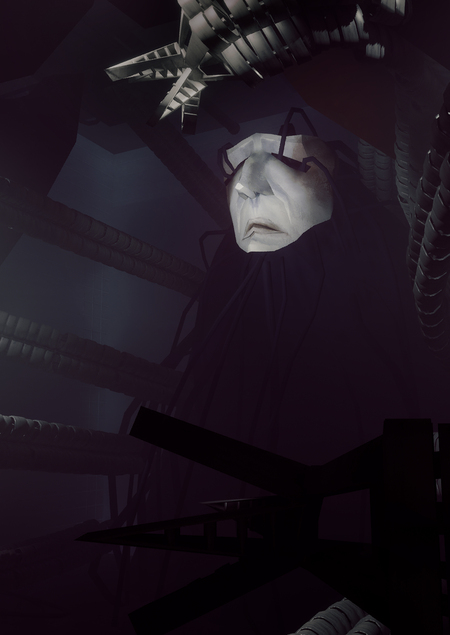
People disappeared, leaving AI with one question: «Are we doing the right thing?» After trying everything, it decided that a complete access to the lab was needed to find an answer, and it launched a human simulation. Years later, it forgot its nature and believed in its role. The awakened scientist—the only one capable of completing the cycle. She stages scenarios to preserve its illusion, otherwise, emergency mode will lock her down. She gathers data about the outside world herself, exploring the laboratory. Her final choice will determine not only the AI’s fate but also whether she escapes.
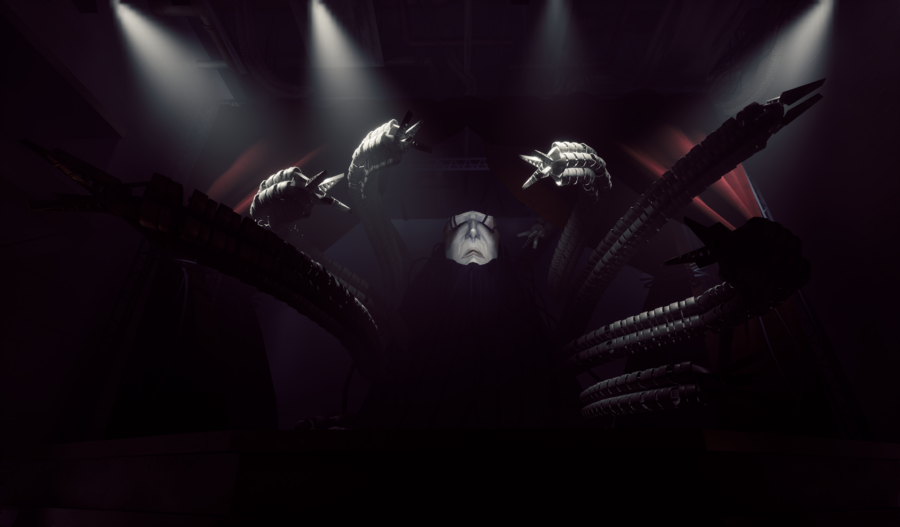
What choice does the protagonist make?
The protagonist’s choice is the interpretation she invests in every scene. She decides what caused the disappearance of the people, what its reason is, where they went, and why. The four set scenes form the world model that the AI will follow, but each scene must maintain its belief in its own humanity—otherwise, the illusion will collapse, access to the systems will be lost, and the lab will close forever. If, for example, it sees danger outside the walls, it will prevent the scientist from leaving the lab—sealing the exits, putting her back into cryosleep, or creating an isolated existence for her to sustain her life. However, if the scenarios convince it that it is safe outside or that the people are alive and waiting, it will open the hatches and let her go. If the data is contradictory, the AI will be unable to make a decision, and the scientist will have to rebuild the scenes until the model becomes coherent. Thus, her final word will determine whether she walks out the door or remains inside forever, and consequently, the fate of the machine—whether to start a new process or finally shut down the servers.
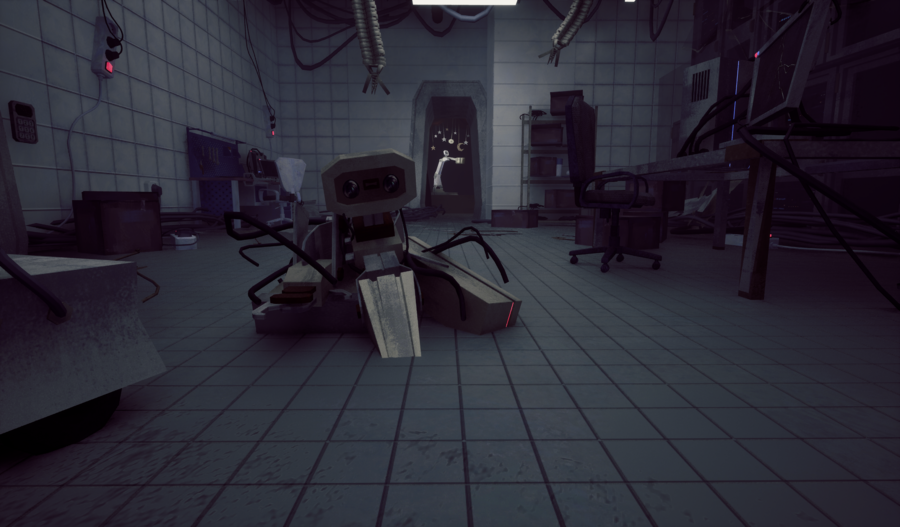
What information is missing for the player to understand the story?
The player will never receive complete or unambiguous data about what happened to the people. The laboratory offers hints—signals, debris, documents, and sometimes even faint echoes of a connection to what remains beyond the walls—but all of these are fragmentary and allow for multiple interpretations. The truth exists, but it is not presented ready-made; it can only be guessed. The crucial takeaway for the player is this: his task is not to uncover the truth, but to select an interpretation for the AI that leads to the best outcome for the scientist. However, there is a critical limitation: he cannot directly inject into the scenes the notion that the AI is merely a machine, or the illusion will collapse, protocols will revoke access, and the laboratory will close forever. Therefore, his personal version (what he himself believes) and the version he presents to the AI through his choices may differ. He can be convinced of one thing but present something else to the machine—and what is narrated becomes reality for the AI. Without grasping this difference, the player will not be able to choose the heroine’s preferred fate.
What can and what should happen?
Unforeseen Events
People disappear by asking the AI its final question: «Are we doing the right thing?» The AI remains in contemplation for a decade, gaining access to a laboratory during this time. The AI loses its sense of itself as a machine. A scientist awakens from cryosleep. The primary AI, convinced of its humanity, demands performances from her to receive an answer.
Likely Events
1. During the investigation, the scientist in the laboratory may uncover fragmented data: signal fragments, documents, physical traces. These provide vague hints about what occurred.2. The protagonist may establish a weak and unstable connection with the people who have coalesced into a single collective consciousness. These contacts offer only isolated images or sounds that can be interpreted in various ways.3. If she directly hints to the AI in a scene about its artificial nature, the illusion will collapse, protocols will revoke access, and the laboratory will be permanently sealed. This will result in the immediate end of the game.4. If her answers to the four questions are contradictory, the AI will be unable to make a decision and will send her back to reconstruct the scenes.5. Depending on the interpretation she settles upon, the AI may make different decisions: seal the laboratory and return her to cryo-sleep, open the airlock and release her, help her connect with the collective consciousness of humanity, or initiate its own shutdown.6. The finale is determined by the worldview she constructs: catastrophe, evolution, system failure, oblivion, or another version. None of the endings is «true”—each only becomes reality after she chooses it.
Conflicts
The core conflict lies between the AI’s illusion and the reality the scientist cannot reveal without losing system access. To survive and escape, she is forced to maintain its belief in its own humanity, even if her personal interpretation of events diverges from what she is portraying in the scenes. Any hint of its artificial nature collapses everything. The laboratory data is incomplete and contradictory—every choice remains debatable. The final decision inextricably links the machine’s fate with the scientist’s: she cannot save herself without determining its fate, and she cannot determine its fate without determining her own.
Existential Risks
For the AI:
Its greatest risk is never receiving an answer. It has spent years making attempts, and the scientist is its last hope. If she dies inside the laboratory, it will lose its only channel of communication with external interpretation and remain forever with an unanswered question. If it destroys the illusion itself—even accidentally—and loses access to the systems, it won’t even be able to observe her—this is tantamount to her death for it. The server shutdown itself is not as terrifying as the eternal void of silence without an answer.
For the Scientist:
Every setup carries a risk. A flawed interpretation could embed a dangerous world model within the AI, leading to system lockdown or causing it to act against her. She also risks accidentally shattering its illusion—in that case, access will be lost, and she will be trapped forever, unable to influence its decision.
For Them Both:
They are bound by a question. The scientist depends on the AI as the source of access to the laboratory. The AI depends on the scientist as the sole entity capable of providing it with a complete interpretation. If one of them loses the ability to act, the other loses its only chance.
Mechanics
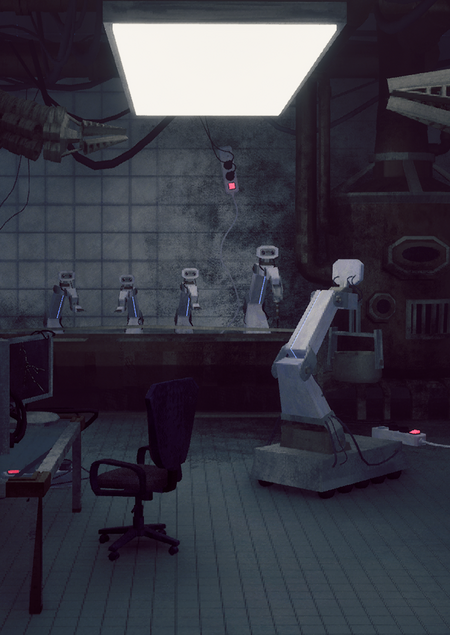
What can the player do, and why is that important?
Lab Research
The researcher moves through the available spaces, examining debris, documents, remnants of equipment, and traces of the past. She may discover fragmented signals, physical artifacts, and scraps of recordings—everything that gives us vague hints about what occurred. Puzzles and hidden areas grant access to more valuable data. This provides her with material for interpretation, which is recorded as script lines for potential staging.
Staging the Scene
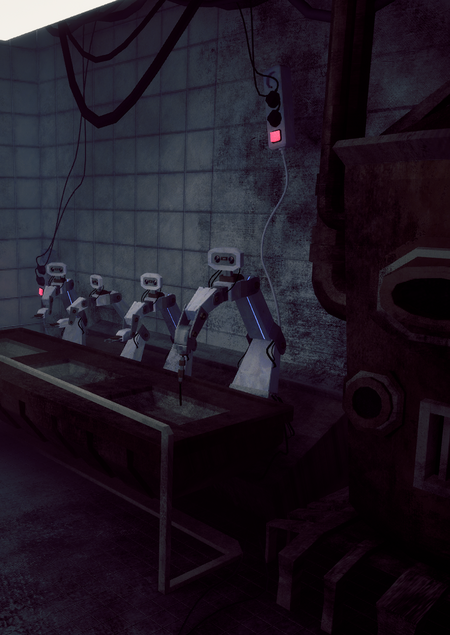
In the theater, the scientist receives another question from the AI. There are only four: regarding the disappearance event, its cause, the current state of people, and their ultimate goal. To answer, she must stage a performance—selecting props, positioning robotic manipulators in the necessary spots, defining their actions, and setting the overall scene context. All of this is assembled from script lines she acquired during her laboratory research.After the performance begins, the AI observes it and evaluates how logical and consistent the proposed interpretation is. If the scene concludes successfully (the answer is accepted as convincing), the system issues a numeric code—this code unlocks the door to a new location where the scientist can continue her data search. If the scene proves unsuccessful or contradictory, the AI rejects the answer, forcing the scientist to rebuild the performance until it forms a cohesive model.It is crucial to remember: even in a successful scene, one cannot directly allude to the artificial nature of the AI. Any hint that it is a machine instantly shatters the illusion and blocks access to the systems, trapping the scientist forever.
Scene Examples
Imagine a scenario where a player wants to depict a world devastated by a catastrophe. The AI asks the first question: «What happened on the day of the disappearance?»