About me
Hi, I’m Maria, a game designer, who is drawn to games that are built around unusual challenges.
I like to prototype an idea quickly, put it in front of real players as early as possible, and keep refining it until the core loop feels right. I’ve worked independently and in teams.
What I do: — Game design — Core loop and systems design — Level and route design — Balancing and game economy — Prototyping and playtestingPrograms I use: — Roblox Studio — Unity — Unreal Engine 5 — Figma — Miro — Notion
Over the course of my studies I have worked on several projects, from Roblox experiences to game jam entries, as well as Unity and Unreal Engine 5 projects.
Baby Delivery
A cooperative parkour game where every run begins with a random baby and ends on a cloud. Made on Roblox as a solo project.
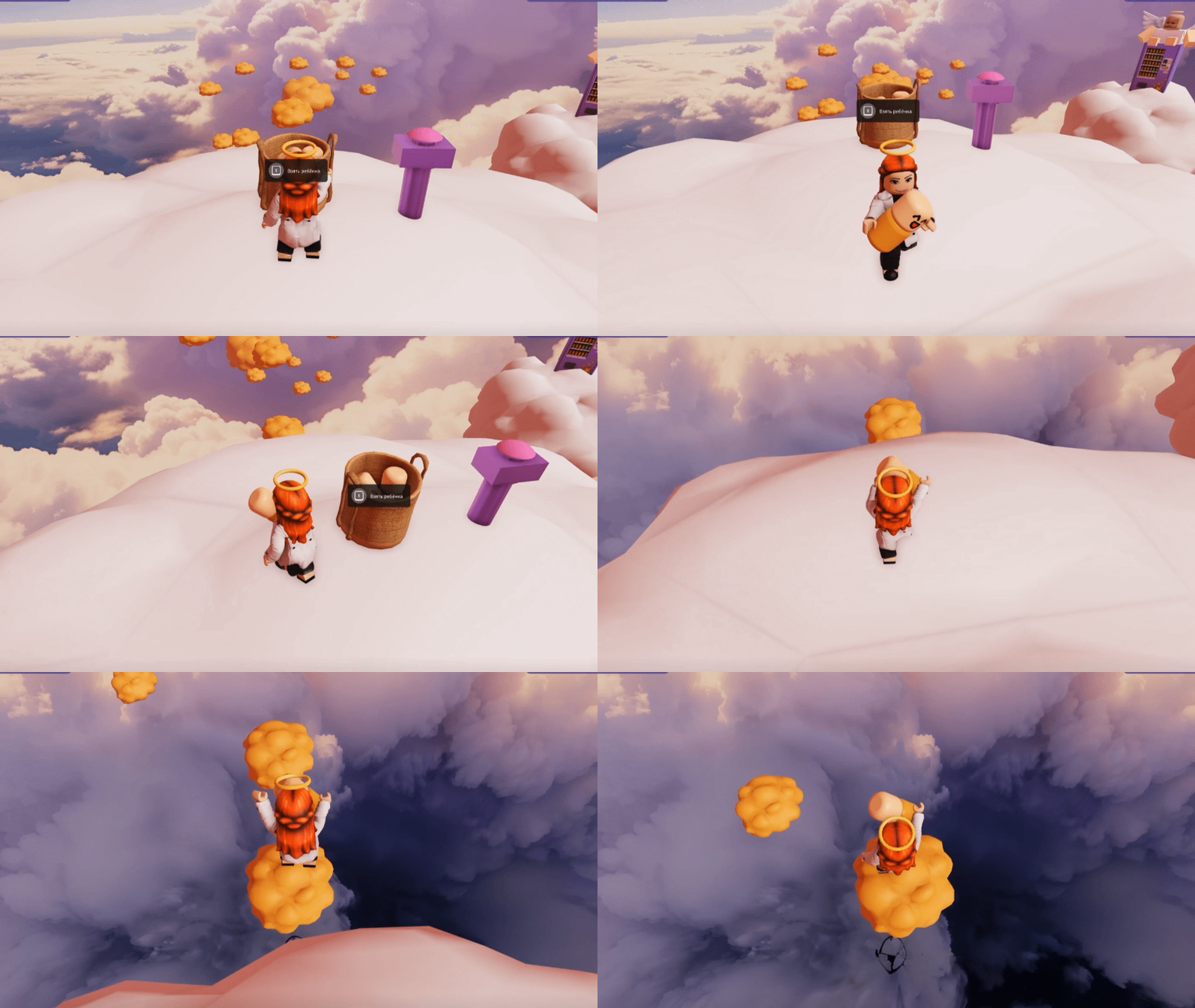
It has become hard for developers to stand out on Roblox. There are so many game modes, and many of them look and feel alike.
The goal was to create a mode with a truly unique mechanic that invites players to team up with friends, makes every run feel different from the last, and still gives a clear sense of progression.
Baby Delivery was developed as a cooperative parkour mode where every run feels different.
Each run is a simple loop of picking up a baby, choosing a route, reaching the finish, earning coins and spending them on an upgrade.
To make the game stand out, babies are handed out at random, each in a different swaddle, so no two runs begin the same way. Coins buy one of several upgrades, such as speed or higher jumps. Players build their own style of play and feel their progress with every run.
As a result of my work, Baby Delivery became a cooperative Roblox mode where every run feels different. Four routes with unique mechanics, random babies and a choice of upgrades gave players a reason to come back, play with friends and see their progress.
Cupid’s Arrow
A chaotic reimagining of ping-pong where two rival kings have to bounce a love arrow back and forth until they finally make peace.
Classic ping-pong is easy to pick up, but for many players it gets boring after a few minutes of the same back-and-forth.
The goal was to reimagine it as a game that stays exciting from the first rally to the last, with a clear story and a lot of surprises on the field.
Two kings face off with armies of soldiers behind them. Instead of a ball, they bounce Cupid’s arrow, meant to reconcile the rulers. Every time the arrow gets past a king and hits a soldier, that soldier flees the field.
The fewer soldiers left, the more power a player gets. Abilities unlock as the army shrinks: slow down time, add one extra arrow, or add two. With only one soldier remaining, every ability can be used again.
So losing doesn’t mean falling behind — the losing player gets stronger tools, turning the match into a tense, unpredictable fight.
Player feedback showed that the abilities changed the experience. Matches became livelier and more fun to play, and the constant chaos on the field kept players engaged.
I presented Cupid’s Arrow at a game exhibition, where it became one of the most popular games among visitors. Players came back to it because of its unusual challenge and the energy of the matches.
I designed the core concept, the rules and the comeback ability system that makes every match unpredictable. I believe that classic can be given new life when a simple rule, like unlocking power through losses, changes how players feel about the game.
Krysgrad
A 3D city-building simulator where the player grows a colony of rats in the sewers.
A team project of four people, in which I took on the role of game designer.
Krysgrad is a 3D city-building simulator set in the sewers. The player builds and develops a rat colony, turning a dark and cramped underground space into a living city.
My approach was to make the design clear and shared by the whole team. I gathered all the mechanics in a single game design document, so that every team member could see how the systems fit together.