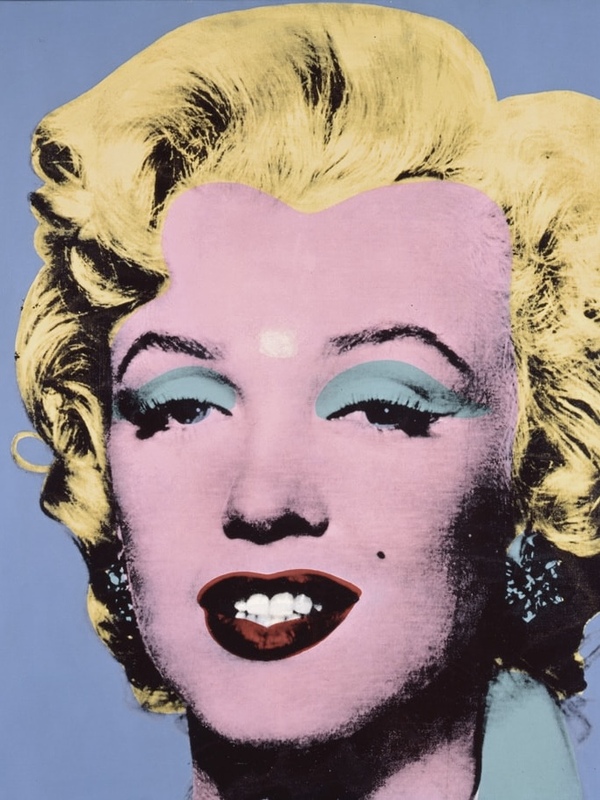
Pop Art and Social Art—two vibrant movements that have significantly influenced the development of contemporary art. While many call Social Art a Sovietized version of Pop Art, their sources of inspiration differ greatly. For example, Pop Art was a reaction to commercial imagery, and while there wasn’t the same saturation of advertising in the Soviet Union, there was a vast amount of ideological imagery. The «whimsical nature» of American culture did appear in the work of some artists, such as Leonid Sokov and Alexandr Kosolapov, but it was not mainstream.
Pop Art is a movement that originated in Great Britain but gained popularity in the United States. Works in this new style were a specific response to the seriousness of abstract art and other styles that emerged in the 20th century. They did not carry any deep philosophical meaning; rather, they simply reflected the influence of mass culture on consumer society.
«Rebelling against the asceticism of Abstract Expressionism, young artists turned to earthy things like Coca-Cola, ice cream, hamburgers, supermarkets, and the 'FOOD' signage.»
— Robert Indiana
One of the key characteristics of Pop Art is the use of vibrant colors and high-contrast color schemes. Artists in this movement sought to capture the viewer’s attention with unconventional color palettes, which makes their works memorable and distinct against the backdrop of other artistic masterpieces. Collaging and combining various elements from diverse sources is also a signature technique of Pop Art.
Central to Pop Art’s repertoire is an assortment of products and commodities—from slices of cake to broken toys. By reflecting on the rich abundance of packaging and the economic strategies behind its development, Pop artists focused on both the undeniable charm of product design and the darker aspects of consumption. Pop Art was recognized as an art of social equality because this movement aestheticized mass-produced goods—objects used by all people, regardless of their material wealth or social status.
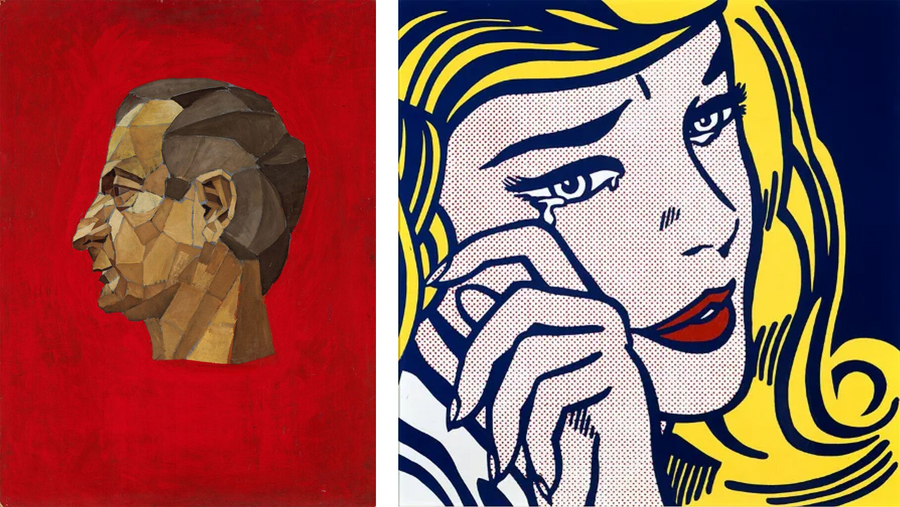
«Father’s Portrait, ” Vitaly Komar and Alexander Melamid, 1973 / „Crying Girl, ” Roy Lichtenstein, 1964
Social art, in turn, emerged as a response to Pop Art and focused on the influence of art on social and political issues. Increasingly relevant social themes became the central motifs in the works of social art artists.
Conceptualists of the same period disliked that the idea of social art was based on «irony, ” but both movements share a foundation in the deconstruction of claims to power—with the difference being that social art specifically addressed Soviet power. Social art satirizes all methods of the state communicating with the populace.
«Overall, we were trembling, drinking, and wondering what scoundrels we were to get involved in this mess for money. Then, at some point, we started such a drunken conversation: ‘What if there’s someone—a person who does this sincerely? If it’s a cry from their soul for them. And what do they draw? Probably their own relatives in the style of Soviet heroes.’»
—From the memoirs of Vitaly Komar, one of the founders of social art
The objectives of social art are often connected to protesting social norms and provoking thought. Artists strive to influence society, awakening people to relevant issues and the possibility of resolving them. Through satire and ridicule, social art exposes the absurdity of Soviet propaganda.
In this visual study, the similarities and differences between pop art and social art will be examined from an ideological and visual perspective. Although these two art movements existed nearly concurrently, they addressed different themes and, consequently, employed different tools to explore them.
Navigation
The sections explore various aspects of the similarities and differences between artistic movements.
- Similarities between Pop Art and Socially Engaged Art in the Use of Pop Culture and Mass Media
- Differences between Pop Art and Socially Engaged Art in Goals and Methods of Expressing Social and Political Ideas
- Comparative Analysis of Styles and Themes in Pop Art and Socially Engaged Art
Similarities between Pop Art and Social Art in the Use of Popular Culture and Mass Media
Pop Art, by translating the concept of popular culture into artistic space, reveals mass media images and symbols through the lens of irony. Pop artists dissected elements of mass culture into their constituent parts, demonstrating the principle of image deconstruction. They utilized pop culture and advertising motifs to create a new, bold artistic language that reflected the spirit of the sociocultural reality.
Social Art engaged with a culture familiar to the Soviet person—posters and propaganda. The reworking of ideology becomes analogous to the reworking of media images. Social artists choose humor as their primary tool; there are no off-limits topics for them—they joke equally about religion and political figures.
«Lenin, ” Alexander Kosolapov, 1989 / „Flags, ” Jasper Johns, 1973
The work «Lenin”—a component of the complex object „Two Flags (Perestroika).“ It is quite obvious to compare it to Jasper Johns’s „Flags.“ Kosolapov’s work examines the idea of uniting the languages of capitalist and socialist propaganda through design. The result of this fusion is a sense of equilibrium. While the substitution of Lenin’s portrait with a Mickey Mouse figurine might initially seem arbitrary, both Lenin and Mickey Mouse are extremely significant symbols within their respective cultural contexts.
Similar to the artists of British Pop Art, Johns drew inspiration from Dadaist concepts, particularly Marcel Duchamp’s idea of the readymade. However, Johns differed from Duchamp in that he used not „found objects, ” but „found images“ in his works, such as flags. This represented a new system of signs and symbols to which many Pop Art artists referred.
«Mickey and Minnie, Worker and Collective Farm Woman, ” Alexander Kosolapov, 2004 / „Display Case of Pastries, ” Clas Oldenburg, 1962
A significant commonality between Pop Art and Social Art is the active use of popular culture and mass media formats to shape artistic expression and engage the viewer. Both movements emphasize the influence of mass culture on contemporary consciousness, demonstrating how the environment surrounding us and the imagery from media can become material for artistic creation.
The blending of Mickey Mouse and Minnie Mouse imagery with the sculpture «Worker and Kolkhoz Woman, ” in my opinion, diminishes the pathos of the monumental artwork, reducing it to an element of popular culture. This subtle substitution of one symbol for another recalls the replacement of the real with a facsimile—a game found in a typical American store in Class Oldenburg.
«Do not make for yourself a graven image, ” Alice Zarzhevskaya (left), „My Blood, ” Alexander Kosolapov, at the exhibition „Beware, Religion!“, 2003 / „Marilyn Diptych, ” Andy Warhol, 1962
Here, it is interesting to note the reinterpretation of societal «idols.» Andy Warhol addresses the theme of celebrities and their cult—how that cult evolves after a person’s death. The works of Alice Zarzhevskaya and Alexander Kosolapov are more provocatively characterized by blending mass culture imagery with religious symbols. This contrast forces us to consider that everything in the modern world will eventually transform into an object possessing commercial power and functioning as a commodity.
Thus, both Pop Art and Social Art, each in its own style and with a unique approach, demonstrate the importance of utilizing popular culture and mass media in art as a means of reflecting contemporary socio-cultural and political realities.
Differences between Pop Art and Social Art in the Goals and Methods of Expressing Social and Political Ideas
«Campbell’s Soup Cans, ” Andy Warhol, 1962
Pop Art became not just a response, but also a reflection of the society in which it arose: «consumer society» emerges when social relations begin to be built upon the principle of individual consumption. The term itself sounds dismissive and negative, and according to many Pop artists, people lose themselves—through the chromatic diversity of the presented objects, the imagery conveys an apocalyptic meaning of the «privacy crisis”—that is, the individual’s loss of self in a world of things, their „fall out“ of history. A person confined to a world of goods and services, performing only habitual actions within the relaxing space of the home, continues to consume even in their small domestic world: streams of advertising messages and news reach them via television and radio—and Pop Art expresses this mediated presence of humanity in paintings (in the form of a sign or a commodity), criticizing this type of society.
«Oh God! Help me survive this deadly love, ” Dmitry Vrubel, Berlin Wall graffiti, 1989
As has been noted, social art engages with themes of politics and propaganda. It satirizes authority and critiques it. It interprets images for the purpose of ideological processing.
For many people today, this work has become a source of powerful visual impact, symbolizing the era of the collapse of Communist countries. Immediately after its creation, photographs of the work were published in numerous well-known German publications and subsequently spread worldwide. Over the years, this work has also become one of Berlin’s most recognizable symbols, and its image can be seen on a multitude of souvenirs.
«The Origins of Socialist Realism, ” Vitaly Komar, Alexander Melamid, 1982–1983.
Here, Stalin is not the recipient of angry letters, but a hero of a reconstructed ideological myth. A witty satirical commentary on the origins of an art movement that served the state—its absurdity debunks all the seriousness of Socialist Realism.
If Pop Art addresses everyday life and consumer society through the use of commercial symbols, Social Art aims to reveal political problems by challenging the viewer. Social Art calls for social change and the shedding of ideological stereotypes.
«Tacka-Tacka,» Roy Lichtenstein, 1962
Roy Lichtenstein aimed for his paintings to appear as the product of printing presses rather than human hands. His work reflects the influence of comic book and advertising styles: thick black lines, Ben-Day dots, and a limited color palette—hallmarks of these cultural phenomena. In this work, he references the comic book as a symbol of pop culture.
Pop art could not have emerged in a society lacking advertising; its ironic reflection on the methods and techniques used to draw the «average person» into consumption must be founded on something. The remarkable and unique connection between advertising and pop art lies in the fact that advertising was the first to create a direction within art, rather than merely applying its elements in design.
«Hero. Leader. God, ” Alexander Kosolapov, 2014
A string of several characters walking hand-in-hand. Following the logic of the titles and the arrangement of the figures, Lenin is the hero here, Mickey Mouse the leader, and Christ God. Their proximity seems to equate them with one another, inviting play with the title and a shuffling of roles: what if Mickey Mouse were God here? Or Lenin? The chosen material alludes to the appearance of toy reproductions and other cheap goods.
«Mao, ” Andy Warhol, 1972
The Chinese leader, interpreted and reprocessed through Pop Art, becomes a capitalist commodity, much like a can of Campbell’s soup or a soda.