Essay «Under Genic»
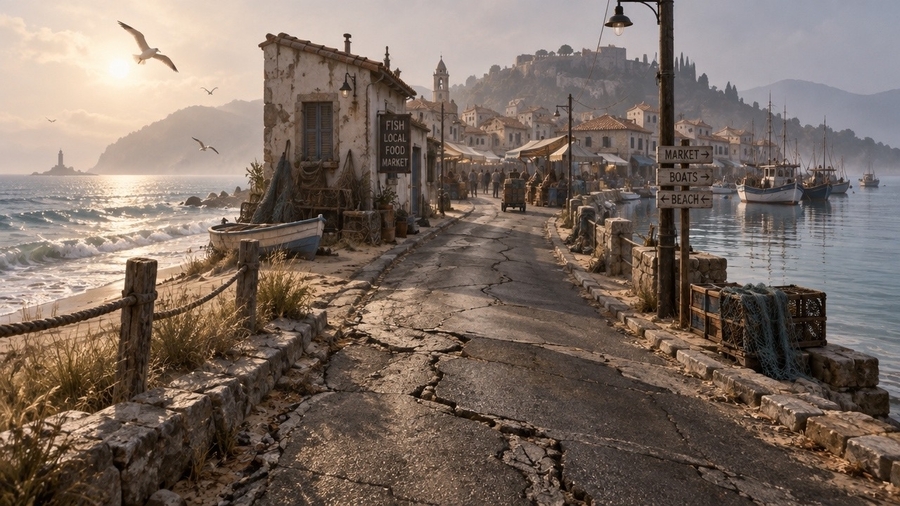
Genichesk smells of fish and hot sand. Mornings here begin with the rumble of carts in the market and the cry of seagulls over the Tyonky Strait. The city exists on a narrow strip between two bodies of water: Sivash to the left, Azov to the right. Beyond that—only the sky.
I walk down a street where the asphalt lies in waves. Not from the heat—but from time. In places, it has sunk, and it has been flooded again, layered over the old. You can see the strata at the edges: gray, dark, gray. Like a cross-section.
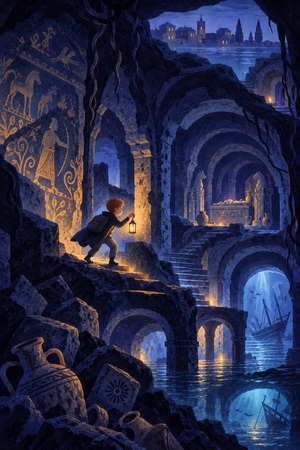
Beneath this cross-section is something else. Tunnels. Galleries. Halls with columns carved into the shell-mound. Forty kilometers have been explored; the rest lies in darkness. The lower levels are flooded. The upper levels are buried by construction. Sometimes the ground settles, and a hole appears in the center of the city. They cordon it off with tape, equipment arrives, and the hole is filled in. It’s quieter that way.
Herodotus was the first to write about this. In 440 BCE, he stood on these shores and listened to the locals. He was told that the Scythians had hidden a ransom from Darius in an underground city near Meotida. Since then, everyone has been searching for the treasure—with shovels, with instruments, with phones. They leave empty-handed.
There are several theories. The Greeks who founded colonies. The Scythians escaping the Persians. The Sarmatians whose arrows are found in these areas. Some even speak of a civilization predating the flood. The sites date back over two and a half thousand years; they yield ancient amphorae, medieval mosaics, and Sarmatian weaponry. The walls are lined with stone and brick stamped with markings—LK, IL, NK. Names belonging to someone, erased down to two letters.
People of high rank might have been buried in the tunnels. Perhaps a Scythian king lies here. But there is no written evidence, and the tombs were looted long before any scholars arrived. Archaeologists come in groups, carry flashlights, measure, and photograph. Then they leave. There is no money for the work. The plan to open the catacombs to tourists remains just that—a plan.
And deep within—there is silence. Thick, like water. Locals speak of voices, of strange lights between the columns. Of a legend: the tunnels lead to the sea, to sunken ships. Some believe it, some scoff. But they do not stand near the sinkholes at night.
No one knows where the labyrinth ends. Forty kilometers is just what has been traversed. Beyond that—water, collapse, sealed masonry. That is where Darius’s ransom lies. Or nothing. But one morning, the asphalt will ripple again, and the city will look down once more. Then it will be covered. And people will walk over it again. They will hurry, speak on their phones, push strollers, not looking underfoot. And beneath their feet—is what has not been found, and what has yet to be discovered.
The Legend of the «Fabric That Should Not Exist»
In 1953, a sewing workshop opened in Genichesk—two rooms, three machines, a long cutting table. The owner was Maria Tarasovna. She was forty-two and had arrived from Melitopol after the war. She rented a space from a fisherman’s widow and hung a sign with scissors on the door.Business was steady. Women brought in fabric pieces and collected finished dresses. Maria Tarasovna sewed quickly and cleanly, without unnecessary chatter. Clients left satisfied.That same autumn, a spot near the stove in the corner of the workshop gave way. First, a crack appeared in the floorboard, then the plank sagged, and finally, it split open. The owner brought a lantern and leaned over the void. Below was darkness. She called her neighbor.
«Lower a rope, ” she told him. „Tie a weight to it.“The neighbor brought a rope, tied a hammer to one end, and lowered it into the hole. The rope extended ten meters. The hammer struck a stone.
„We need to fill it in, ” the neighbor said.
„I will, ” Maria Tarasovna replied.
She did not fill it in.
At night, when the city was asleep, she took a lantern, a spool of rope, and descended into the crevice. The passage was narrow, lined with shell fragments. After three meters, it widened; after ten, it turned into a gallery. Maria Tarasovna walked, holding onto the wall. The wall was dry and warm, like a brick oven. The gallery turned, then turned again, then descended. The lantern illuminated only the next step.
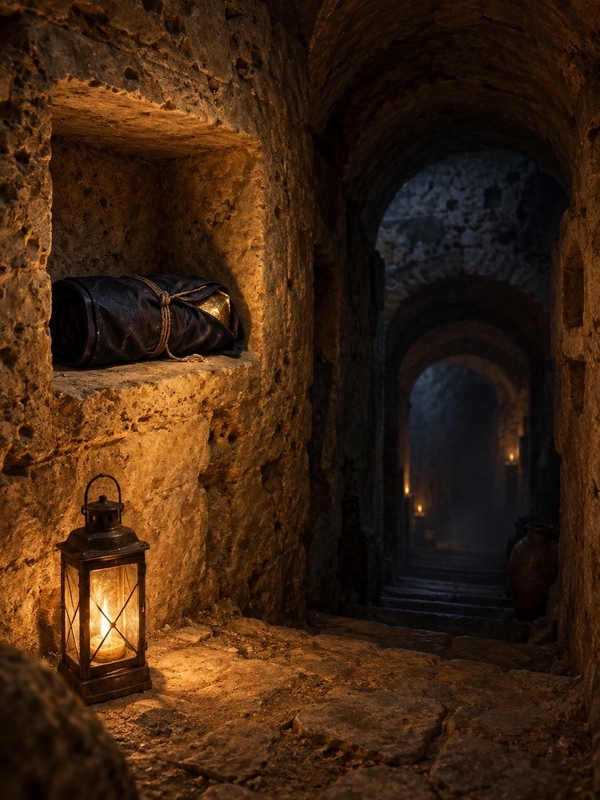
She reached a niche carved into the wall at chest height. In the niche lay a bundle—dark, dense fabric tied with a cord. Maria Tarasovna untied the cord and unfolded the cloth. Inside was another bundle, thin and silky. Within it lay a piece about three meters long, as wide as a regular bolt of cloth. The fabric was heavy, smooth, with a faint sheen. The woman held it in her hands, unable to understand what it was. It wasn’t linen, nor cotton, nor wool. Something else.
She lifted the piece upward, hid it in the wardrobe under a stack of sheets, and covered the crevice with planks and a chest full of scraps.
A week later, she took out the fabric and cut it. The dress was simple—straight, with a high neckline and long sleeves. She sewed it in one evening and wore it the next morning. The fabric draped on her figure as if it had been custom-made. It was cold in the workshop, but the woman didn’t feel the chill. She worked all day without a break and wasn’t tired by evening.
A month later, she sewed a second dress—for her daughter—and a third a year later—for her niece. The fabric was enough for all three. Not a piece or scrap remained.
Maria Tarasovna’s daughter, Nina, wore her dress for twenty years before passing it down to her own daughter. Her niece, Olga, wore hers for thirty years and put it away in a chest. The third dress remained with the woman. She wore it on holidays and died at ninety-two, in her sleep, with a steady heart.
No one in the family ever fell ill, no one died young, and no one was ever in an accident. This could be called luck, but the family knew: it was the dress. The fabric. Where it came from.
The years passed. The workshop closed, the fisherman’s widow passed away, and the building was transferred to the city. A small, local history museum was opened in it. The rooms remained the same, only the machines were replaced with display cases. In the corner, near the stove, where the floor had once collapsed, stood a chest. It was undisturbed.
In 2018, Katya, Nina’s granddaughter, worked at the museum. She brought her grandmother’s dress to the fund—for safekeeping. A restorer, a woman in glasses, examined the fabric and shook her head.
«I don’t know what this is, ” she said. „It needs expert analysis.“
A month later, the lab’s response arrived: the fiber was of unknown origin. It was neither plant-based, nor animal-based, nor synthetic. Its structure was multilayered, almost modern. The age was estimated at around two thousand years.
Katya sat in the storage area, staring at the dress. Two thousand years. Fabric that shouldn’t exist. Fabric that hadn’t decayed. Fabric that someone had hidden in a niche beneath this building.
She inspected the lining. The lining was simple, calico, stitched by Maria Tarasovna. But in one spot, right at the seam, a thread protruded—it wasn’t calico. It was thin, golden, and shiny.
Katya pulled on it. The thread came out easily, without snags or breaks. Katya pulled, and the thread extended—long, straight, as if it were being wound from a spool. She pulled the entire length out and wrapped it around her finger. The thread ended. The spool felt warm.
Katya returned to the dress and examined the spot where the thread had emerged. The seam was intact. The lining was whole. The fabric was whole. The thread hadn’t left a trace—as if it never had been there.
Katya knew: there were old passages beneath this building. Everyone in town knew it. But no one went down there. In the corner of the basement, behind the old display cases, stood the chest. The very one Maria Tarasovna had used to cover the collapse. Katya went down to the basement, pushed aside the chest, and lifted the boards. Below was blackness.
She returned upstairs and called her grandmother.
„Grandma, ” Katya said, „I found a thread in the dress. And the basement. Under the chest—a passage. What is it?“
Nina was silent for a long time, then replied:
„Don’t go there. Grandma never went there either. She knew that if she went, she wouldn’t come back.“
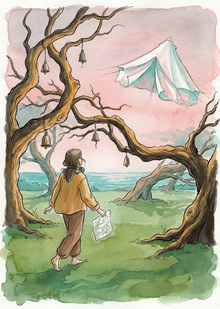
Katya hung up. She looked at the dress, at the spool of thread, at the dark void in the basement—and she did not go down. That evening, she closed the museum, put the dress in a closet, and went home. In the night, she dreamt of the passage—narrow, lined with shell fragments, a warm wall, a niche, a bundle. And a voice, neither male nor female, that said: „You have come. Now you will stay.“
In the morning, Katya went to the museum. The dress was in the closet. The thread was gone. The lining was intact, the seam even—not a trace remained. Katya examined everything but found nothing. She exhaled and sat on a chair. She looked at her hands. A fine, golden dust lay on her palms. She washed it off with water, but the dust would not come away. It was ingrained in her skin, as if it had always been beneath it.
Katya returned home and opened the closet. On the shelf lay her grandmother’s dress—the very first one. She took it out and held it to herself. The fabric was warm. Like a brick fireplace. Like a wall in a gallery. Like a hand that guides.
She put on the dress and looked in the mirror. In the reflection, behind her, a figure flashed for a second—a woman in the same dress, with the same face. Then it vanished.
Katya took off the dress, hung it back up, and closed the closet. The wind howled outside the window. Somewhere under the floor, deep in the darkness, lay a niche. And in the niche—a bundle. And in the bundle—fabric. Another length.
No one knew where it came from. Maria Tarasovna took hers in '53. The niche stood empty. But the bundle lay there. Warm, dense, tied with a string. As if it had been placed there yesterday. As if it had always been there. As if it were waiting for someone.