
A frank conversation with the artist about theater, art, life and accident.
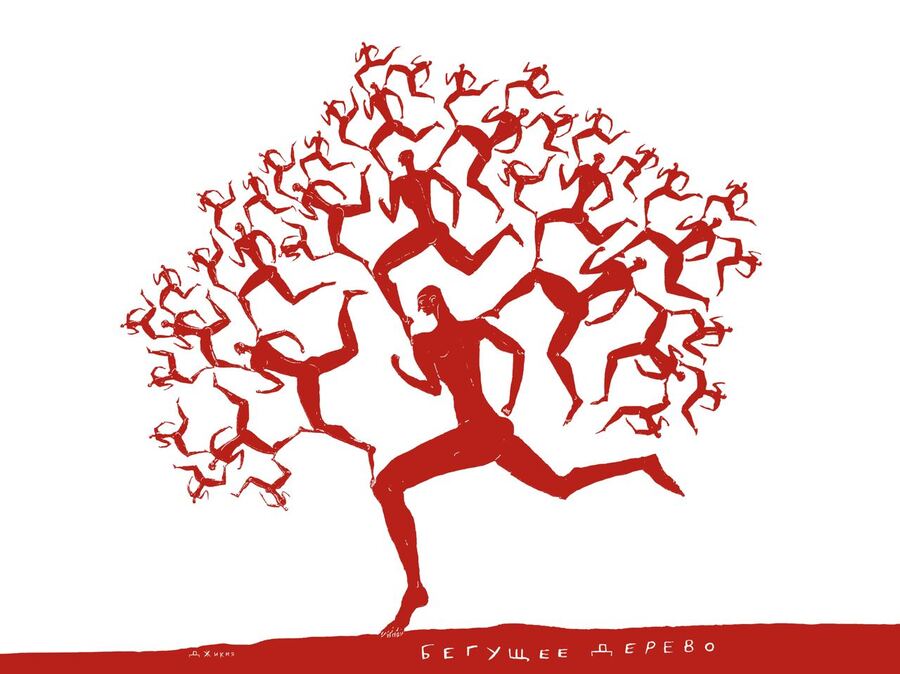
A. Jikia. A running tree. Fanera, 2023
Alexander Jikiya is a master whose works have been shown in Russia, Germany, Italy, the United States and other countries, a real member of the Russian Academy of Arts, and a professor of the ICU School of Design. He has been known since the late 1980s as the author of graphics with absurd and dramatic signatures — and surprisingly, he does not like theatre at all, nor comic books, cartoons, and filming of literary works. How it happened, what he loved, and how he was led by accident in life, Alexander was spoken to by the theatre manager, the teacher, and the first director of the Electrotheater, Stanislavsky Marina Andreikin.
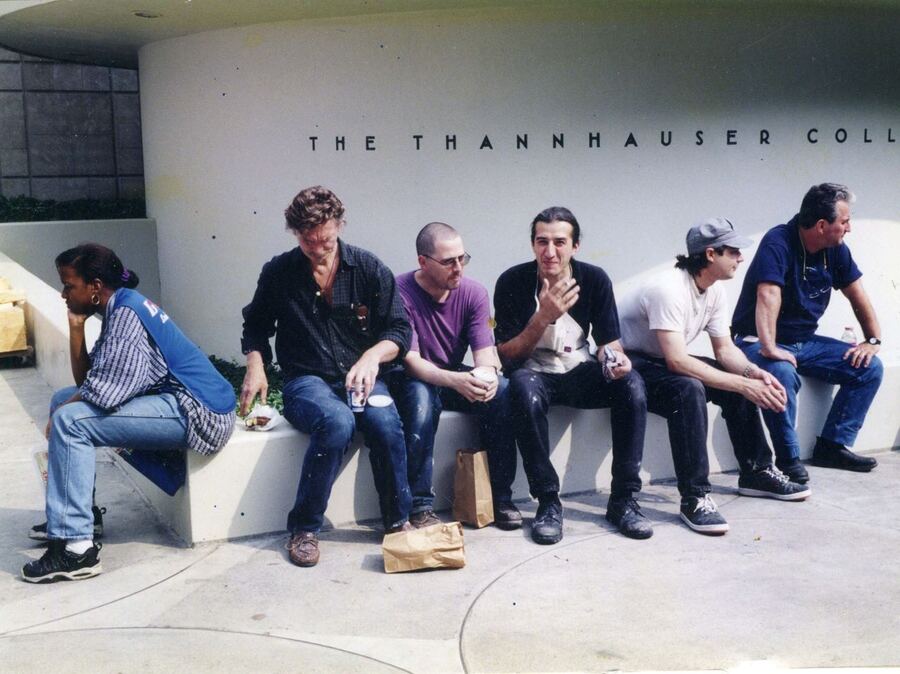
Lunch Bracke (Jikia on the Guggenheim carpenter team, 1998), photo by Pavel Horoshilov.
It’s a seal designer case.
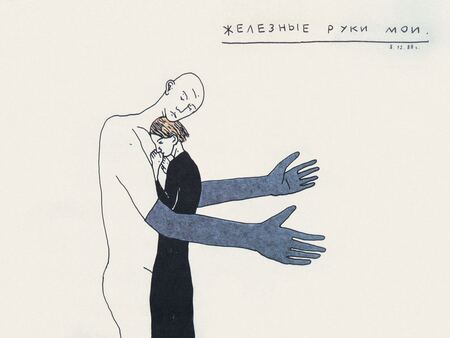
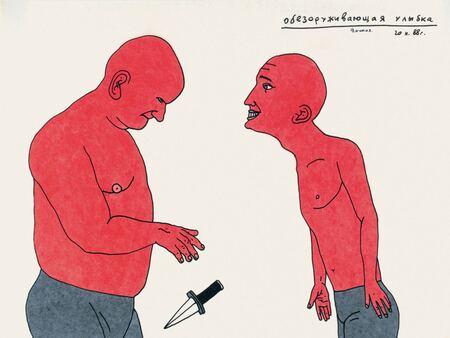
A. Jikia. On my left: Iron hands. On the right: A chilling smile. Calca, 1988.
Harms. Commencement
Why did you go to MARHI in your time? A: I was gonna go to the biofact of the MGU, but I realized I didn’t want to cut frogs. Then my parents remembered that I was a good painter when I was a kid, and they sent me to the MARHI prep class, and, in addition, to learn the drawing for the tutor. They turned out to be Nikolai Nikolaevich Markarov, with whom I had been in a relationship my whole life before his death in 2008, and I could even say that I had a teacher because he had been guiding me a lot at the beginning of my journey. I was doing well with the drawing and not very well with the drawing. So it turns out that in 1979 when I went in, they canceled the military department at MARHI, and that’s why the contest fell sharply, and I was able to make it the first time. So the architecture came into your life by accident, too? A: My life is by chance almost everything. Is this the way it’s going? If you hadn’t gone to the architectural office, would you have become an artist? A: I don’t think so. But at MARHI, I got into the 11th group, where I had my friends Misha Labazov and Andrei Vovk, who had a very powerful influence on me. Vovk had a close friend, a wonderful poet, Andrei Turkin, with whom they, while still in school, played in the «Hello» theater, where Kafka and Harms were playing in the late 1970s (which for those years was super cool). If I hadn’t been in this company, my life would have gone the other way. In the first or second year at the Marchi, I got involved, so to speak, in a bohemian party. We didn’t look at anyone, we didn’t copy anyone, we didn’t have any cumers, and we had our own style. Of course, there were authors we should have known — like the same Harms, but we were not interested in modern — day people. And since my father was a diplomat, and my parents were abroad most of the time, the whole party was often with me, and I kind of became the art owner of a salon that worked for almost all of my college studies.
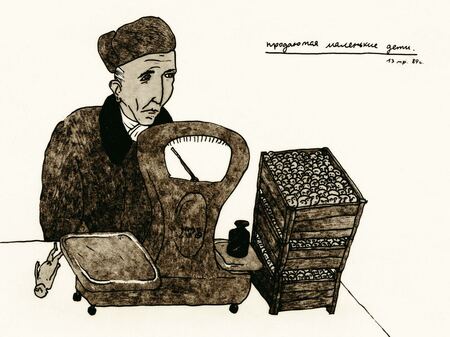
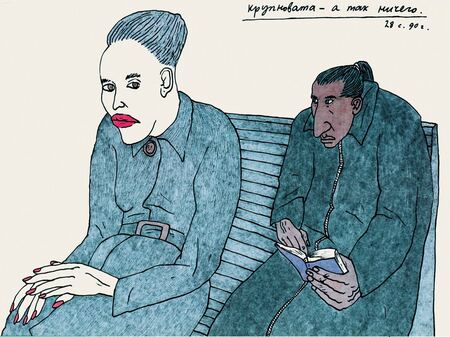
A. Jikia. On the left: Small children are sold. On the right: The big one is fine. Calca, 1989
Where’s the contrast with the theater?
You mentioned the theater, but what happened to the theater in your life? When did you break up with him? A: From early childhood. One day I was taken to MHAT to the Bluebird, and the place was behind the column. There was such a round column. And our place was right behind her. I sat and looked at the column. So when «the long rope followed the blue bird, " I saw only the beginning of the rope and the end. And then I got really excited about the «Ibolit 66» movie, in which reality was sneaky replaced by decorations. The sea was made of pickling tissue, and so on. There was only one thing I liked when Barmaley climbed over the screen, like, into the gym, and I was three years old, and I was scared. Then, I’ve always been embarrassed to look at people who live and do things on stage. Besides, there’s always screaming in the theater. I understand that on stage you have to speak loudly to be heard behind the column. I liked the movie. It’s easier to believe in it. To be honest, I don’t like to go to concerts either, and I prefer to listen to music on the tape. And you didn’t want to create your own theater where it would be different? Never.
Why do artists come to the theater, do you think? A: Make decorations. Even I made two sets. I taught at Bilkent University in Ankara in the early 2000s. There was a large theatre faculty where the main director was Tsotne Nakashidze of Tbilisi. He came to Turkey with no knowledge of any language other than Georgian and Russian. He was given an interpreter who translated the students from Georgian to Turkish. The translator used to sit in a chair and sleep. He yelled in Georgian, gestured, and everyone understood him perfectly. Anyway, he identified me by name as a Georgian and called me to the theater, and we made two sets, Lorca’s Bloody Wedding and Shakespeare’s Summer Night Son. On the zero budget, with your own hands. A turning scene was built in Lorca. There was a flat house, a facade on the one hand, and an interior on the other. Actors turned this thing around when the scene changed. On the back, you could change the set while you were playing in front. And in «Sleep on the Summer Night,» we put construction forests in which action was taking place. And you didn’t like that story? A: I liked it, but everyone was screaming. It’s Rezo Gabrielze’s memory. He made a puppet theater where he was also a painter. They don’t have to scream in the puppet theater, and he’s got no words. A: By the way, I like the doll theater, like the Model. You didn’t want to make a doll? A: No. Maybe because there’s something infrared in dolls.
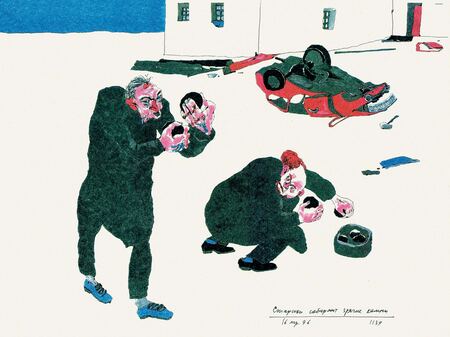
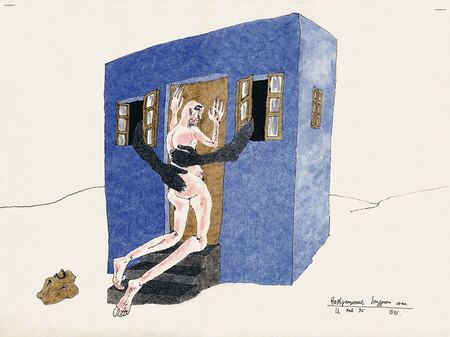
A. Jikia. On the left: Old people collect sighted stones. On the right: Return of the prodigal son. Calca, 1996.
Should the drawing be revived?
You’re not just a drawing in your own creation, you add a word. So something about drawing isn’t enough for you? Has there not been a need to revive this word? A: That should stop. I’ve been drawing pictures that were popular enough in my time because they were published in millions of copies in Student Meridian and New Time magazines. They were signed drawings. I’ve been approached several times by cartoons and asked to continue making a cartoon. I’ve had to explain to them that there’s nothing to go on there, the picture is painted, and that’s all it says. There’s no plot development. There’s a single action that’s done in itself. He doesn’t have to go anywhere. Was there a need to tell a story in a few pictures? A: That’s exactly what I’ve always avoided. I don’t like the words «comics» and «caricature» very much. In principle, pictures of signatures, that’s a big topic. Greek vases, Russian meadows are all signs. They have a niche in art. In fact, most of the paintings hanging from museums have names. Only usually these names are written on a bronze plate attached to the frame, and I put it in the image. It’s not my know-how, there’s a genre like this, pictures of signatures. It is more characteristic of the popular style and the avant-garde of the twentieth century. Larionov included texts in his paintings, Mayakovsky, a lot of people.
It’s Jikia. Father. Crete-Miccan seals. Paper, 2002
Maybe it’s because you read the book as an artist, and you can imagine everything in your head very alive, and other people need help, an illustration? A: And it’s very hard for me to imagine. You look at a man and you don’t understand how he really feels about reality. But I’m basically trying not to watch the screens. Let’s say Masters and Margarets. I didn’t look at any of them, and I’m not going to. Not that the screens are very few good illustrations to the books. And when it comes to successful illustrations, it turns out that they were either by the authors themselves, like «Little Prince» Antoine de Saint-Exuperi, or by the group of authors, as Joseph Lada and Jaroslav Gashek did to «Brave Soldier Schweik». You can’t imagine a Sweake without these drawings, and neither can a Little Prince. I have to admit, I’ve illustrated three things to Harms — and only because I didn’t like the way he was illustrated. I don’t like my illustrations either.
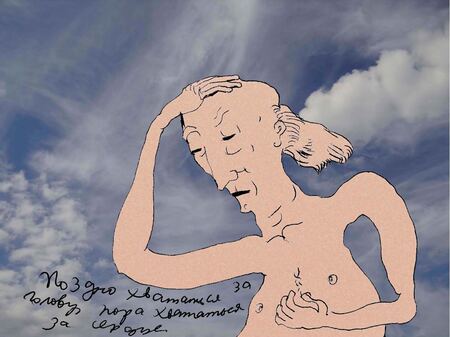
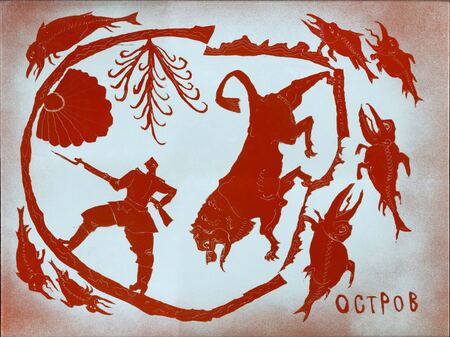
A. Jikia. It’s too late to grab your head, it’s time to grab your heart. Photo, 2012. On the right: Island. Glass, 2010.
Intergenerational break-up at quote level
What are you inspired to do? A: Music. Literary. The art of art. Architecture. Geometry. Nature. Russian. From music, I’m not listening to anything except Bach in Glenn Guld’s performance. But I’ve read a lot of people, mostly Russian writers in recent years. Art isn’t exactly someone. I like a lot of artists, but sometimes you run into one single picture of someone completely unknown, and she picks up. I love it when artists get to catch a picture of life. Architecture is a separate subject. Moscow is my favorite city. One in the world. I don’t want to live and die in Paris. Geometry is the shortest way to understand the divine structure of the universe. Nature is geometric. The cancers, the bumps, the flowers, the clouds are geometry. Russian is great. And now I know he’s on the biggest and most powerful. By the way, I’ve been passing through a few quotes that we know by default, and I’d like to point out that our kids don’t recognize them because they’ve never been heard. As I interacted with the students all the time, I began to realize that their information field hardly crossed with ours. We will soon have a mental breakup of generations much more serious than in 1917. I think it’s comparable to the Russian divide of 1650 when the population changed their worldview. Eighteen-year-olds don’t know any writer, no historical character in our first row. Neither Tsiolkovsky nor Chapaev nor Utyos mean anything to them. They have a set of names we haven’t heard from you. A: That’s what I call the breakup of generations. When we were 18 years old, we understood 19th — century literature well, that is, despite the 100 — year — old gap, we were not really different from our grandparents. When I read Turgenev’s Hunter’s Notes, I knew from my own experience how autumn foliage creeps under my feet, how a netter makes a stand, how they smoke a macho and get water out of a well. Our kids don’t know much about the 20th century right now.
Frida and Mayakowski. Photo college, A. Jikia with R. Toren (Frida College)
This change is happening all over the world. The division you mentioned was to a large extent linked to the printing of books — also a period of global consciousness transformation. The man found the speech, then found the writing, then the printing, and now the digitization. How do you view these changes — apocalyptic or philosophically accepting as a given? A: We will watch the end of the era of humanism. Humanization, man’s slaveization, will take place quickly and irrevocably. Are you familiar with the theme of the new Middle Ages? A: It’s not even the Middle Ages, it’s the new dark ages. The Middle Ages were the time of the highest culture. Renaissance failed to exceed the complexity of the Middle Ages architecture.
Still, Theater?
What kind of theater is it that makes you happy and remembers it? A: I remember once coming to Moscow the theatre from Milan (most likely the Milan company of puppets carlo Colla & Figli, Carlo Colla and sons), it was 1982 or 1983. It seems that Carlo Gozzi was walking «Love to Three Oranges». But there were no tickets in Moscow. My friend Andrei Vovk and I got into an electrician who drove for a very long time, drove to Leningrad. There was a half-empty gym, and we watched the play, and we went back to Moscow the next night. There were dolls playing with living people, which was fun. M: Theatrical direction is now being opened at the School of Design — at theatrical workshop will train actors and directors as you think it’s even natural for the School of Design, and can it happen, for example, your meeting with the theatre? A: Of course it can. Our whole life is a theater, isn’t it?
A. Jikia. Model to Horbun Horse, 2018

Some works by Alexander Jiquia <a href="https://artz.work/file/catalog/d639b7b2f7584bc2d21b4666559?card=f49a144719764079ac7ab3fe8a7c&utm_source=google&utm_media=organic&xref=media.com&session_id=SrKMNC5Qs2B44lS2XDtbQJ" Target="_blank" rel="noopener norefer"=can be purchased, stored or booked in a digital collection.
Photo on the cover of Olga Capitonova