
Concept
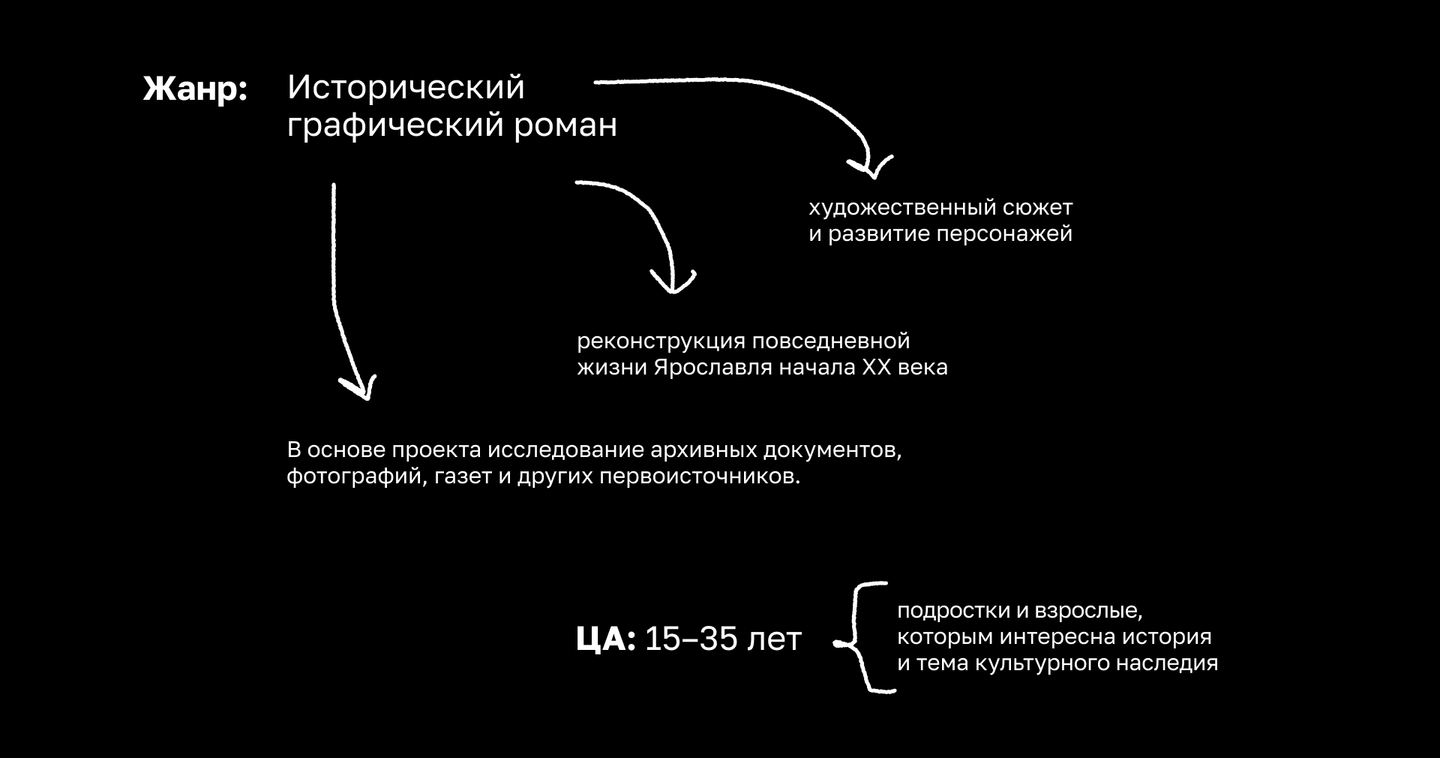
A graphic novel about the life of a Yaroslavl merchant family in the early 20th century. Through family conversations, daily routines, household life, and the changes on the city streets, the book illustrates how historical events impact private lives, alter interpersonal relationships, and transform perceptions of the future.The focus is not on the historical events themselves, but on how they are experienced by people whose familiar lives are slowly changing. This is a story about memory, growing up, and the fragility of the familiar world.
Problem and Relevance
Historical memory is often presented through dates, the biographies of notable figures, and architectural monuments. However, the everyday experience of an ordinary person, especially a woman in a provincial town, less frequently forms the basis of visual storytelling.

in situations where an interest in family history and preserving urban memory becomes a way to understand one’s own identity, the book suggests viewing the past not as a distant era, but as the world of specific people with understandable fears, attachments, and an uncertain future.This illustrated historical prose, situated at the intersection of graphic novel, local history, and family drama, may appeal to readers who value not only historical facts but also the personal experiences of people caught up in major changes.
Project Goals
— To recount the life of Yaroslavl at the beginning of the 20th century through the fates of its people and the city’s daily life;
— to demonstrate how World War I and the Revolution affected families, domestic life, and the usual way of life;
— to convey the atmosphere of the era through architecture, interiors, artifacts, and the urban environment;
— to connect the artistic narrative with real historical events and archival materials;
— to make the city’s history accessible and vivid through graphic storytelling.
Heroes
The main character is a young woman from a well-off Yaroslavl family who has an interest in art and education, but she is not yet sure how her future will unfold. Her archetype is the observer—a person who tries to understand herself and the world around her, without always having the courage to act.The characters surrounding her represent different views on life: her parents strive to maintain the established routine, some loved ones cling to the past, while others are ready to embrace change.Through their relationships and daily activities, the narrative explores family expectations, generational differences, and the choices that must be made in new circumstances.
Format and Design Principles
The book is conceived as a graphic novel, where the narrative unfolds through a combination of text and illustrations. Archival photographs, newspaper clippings, and documents will supplement the artistic storytelling and help convey the atmosphere of the era. A unified typography and the design of reference elements will maintain the book’s integrity. The estimated volume is about 28 spreads.
Promotion Strategy
The book’s promotion will focus on its creation process and the historical research behind it. On social media, you can publish archival finds, character sketches, comparisons between old photographs and original illustrations, and excerpts from the finished pages. To find a publisher, we plan to prepare a project presentation and send it to publishing houses that work with comics and illustrated literature. Alternatively, the book can be presented at events in libraries, museums, and book festivals.